


Last Updated on September 10, 2026 by Nadia Halfway
📜 Introduction.
Beijing, a city between tradition and modernity, was the first stop of my month-long journey through China. Visiting it felt like travelling through time: from ancient imperial palaces and millennial-old temples to modern skyscrapers and high-speed trains.
I dedicated 4 days (well, technically 3!) to explore this incredible city. My flight was from Bari (South Italy) with Turkish Airlines to Baku (Azerbaijan), where I spent two days. Then, I continued on to Beijing with a night flight, stopping briefly in Urumqi, the gateway to China’s Xinjiang region.
So, if you’re planning a trip to Beijing and don’t know where to start, this 4-day Beijing itinerary will guide you through the most iconic sights: the Great Wall of China, the Forbidden City, the Summer Palace, and much more. Along with a day-by-day travel guide, you’ll find practical tips on where to stay, what to eat, how to get around, and where to buy tickets in advance.
Here’s my personal travel story of Beijing, a city between tradition and modernity, full of discoveries, local dishes, and extraordinary places.
⚠️Disclaimer: Some of the websites below are affiliate links or require a promo code for receiving a discount. If you book through them or use my personal promo code at the time of subscription or reservation, I’ll earn a small commission (at no extra cost to you), and you’ll get a discount or a special promotion too. It’s a win–win!
Please be aware that affiliate links may expire and promo codes may reach their usage limit. If you find that a link or code no longer works, kindly let me know. I’ll be happy to share an updated one (if available) directly with you.
Day 1: A Brief Stop in Urumqi and Arrival in Beijing.
My journey through China began with two stopovers: one in Baku, where I spent two days exploring Azerbaijan’s capital, then Urumqi, in the heart of Xinjiang.
After clearing border control, I had planned to explore the city briefly, but a small tech mishap changed everything. I hadn’t activated my eSIM, which I had purchased before departure, and the Wi-Fi at the airport didn’t work. With no internet connection, I couldn’t use translation apps or maps, so I decided not to venture too far. Thankfully, a guy from a shop let me use his hotspot, but it was already too late to explore the city. However, here are the main things to do in Urumqi if you plan to spend half a day there.
- Visit the Local Mosque
- Explore the Grand Bazaar
- Lunch at Jiamu Restaurant (伽穆餐厅)
In the afternoon, I took a domestic flight to Beijing Daxing International Airport (PKX), arriving around 8 PM. However, only by 11 PM, I was finally settled in my hostel. Just enough time for a shower and some rest before the adventures awaiting me the next morning.
Day 2: The Great Wall of China.
I had promised myself I’d wake up at 5.30 and leave by 6.00, but exhaustion won the battle. So I hit the road at 7.30 AM instead. Destination: The Great Wall of China!
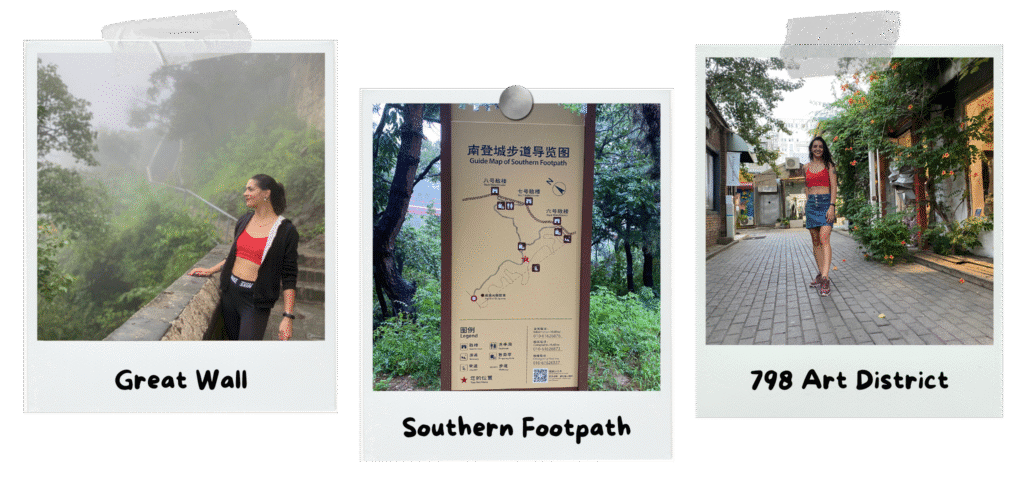
I chose the Mutianyu section, one of the most scenic and less crowded areas, yet still easy to reach from Beijing. After about an hour and a half by taxi, I arrived to find the site already quite busy. Luckily, I had purchased my ticket online, so I skipped the main queue. From the entrance, I took the shuttle bus that leads to the wall.
Once there, visitors can either take the cable car via the North Trail or hike via the Southern Foot Path. I chose to hike. After walking 2-3 km through a shaded forest path, the Wall finally appeared before me: majestic and timeless. I entered through Tower 8, walked up to Watchtower 4, then took the cable car down from Tower 6 (the toboggan slide was closed that day). I had lunch at one of the nearby restaurants and then caught a tourist bus back to Beijing, booked directly on-site for about ¥50.
Back in the city, I visited the 798 Art District: a former industrial area turned into a trendy neighborhood filled with art galleries, design stores, and cafés. The day ended perfectly with dinner at Jiaodong Liu Mama Rouzhi, famous for its handmade dumplings. There are dozens of varieties, and the portions are generous!
- h 07.30 – Departure to Mutianyu
- h 09.00 – Visit to the Great Wall
- h 14.00 – Lunch
- h 15.30 – Bus to Beijing
- h 17.30 – Explore the 798 Art District
- h 20.00 – Dinner at Jiaodong Liu Mama Rouzhi
Day 3: Hanfu Experience, Temples, and Imperial Palaces.
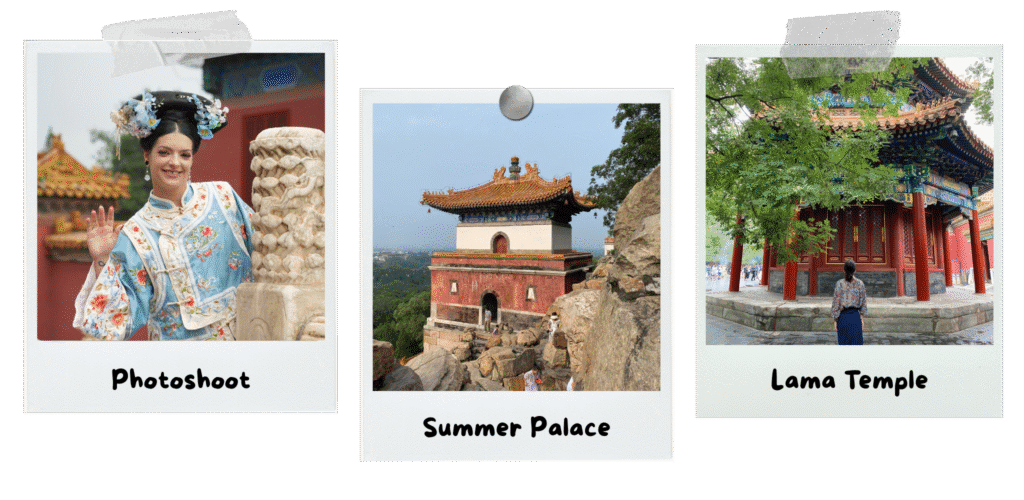
For my third day, I had booked a Hanfu photoshoot, wearing traditional Chinese clothing. Accompanied by a professional photographer, I experienced imperial Beijing through a lens: an unforgettable funny moment.
The studio offered me to keep the outfit until 6 PM, but the heat was intense, so I returned it right after the photoshoot.
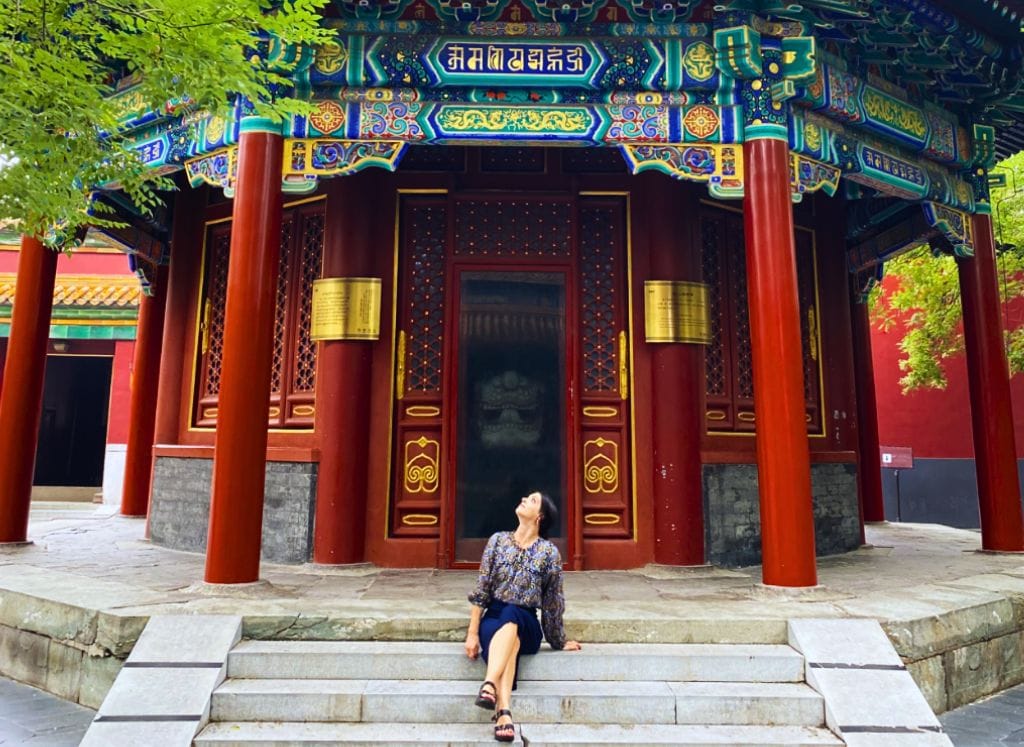
I grabbed a quick lunch at Fangzhuanchang, known for its noodles with soybean paste and minced meat. After lunch, I visited the Lama Temple (Yonghe Temple): one of the most spiritual places in the city and home to one of the largest wooden Buddha statues in the world.
In the afternoon, I explored the Summer Palace, an imperial masterpiece of gardens, lakes, and pavilions once used as the royal family’s summer retreat.
The evening was magical: I attended the Folk Art Show at Lao She Teahouse, a unique mix of Chinese music, theater, and traditional arts, served with tea and local snacks (check out my post related to the theatre in China). To end the day, I delighted my palate with Peking Duck for dinner, an iconic dish from Beijing.
- h 09.00 – Photoshoot
- h 13.30 – Lunch at Fangzhuanchang
- h 14.30 – Visit at Lama Temple
- h 16.30 – Visit at Summer Palace
- h 20.00 – Folk Art Show at Lao She Teahouse
- h 21.30 – Dinner with Peking Duck
Day 4: Temple of Heaven, Hutongs, and the Forbidden City.
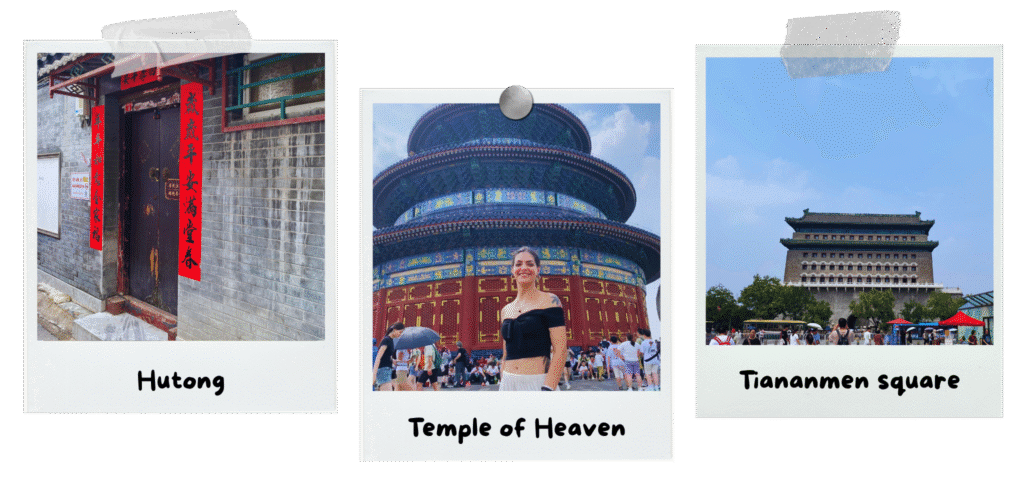
The last day began early with a visit to the Temple of Heaven, one of Beijing’s most iconic landmarks. Surrounded by a large park where locals practice tai chi or play badminton, the temple stands on top of a stunning white staircase, symbolising harmony between heaven and earth.
Right after, I joined a free walking tour through the Hutongs, Beijing’s narrow alleys lined with traditional courtyard homes known as siheyuan. It’s one of the best ways to explore the city’s local life and hidden stories.
I grabbed some snacks for lunch during the tour, and in the afternoon, I headed to the Forbidden City, the imperial residence for over 500 years. Wandering through its courtyards, palaces, and galleries felt like stepping into a living history book.
By 6 PM, I was back at the hostel for a quick shower (I paid an additional ¥10 to use the shower as I already checked out) and to collect my luggage before catching the night train to Luoyang, ready for the next adventure.
- h 08.00 – Visit at Temple of Heaven
- h 10.30 – Free Walking Tour through the Hutong
- h 13.30 – Lunch
- h 14.30 – Explore the Forbidden City
- h 18.00 – Return to hostel to collect luggage
- h 20.47 – Night Train to Luoyang
🛏️ Where to Stay in Beijing.
Beijing is generally more expensive than other Chinese cities, so I chose to stay in a hostel instead of a hotel.
I stayed at Paoju Factory Youth Hostel / P.Loft Youth Hostel in the Dongcheng district, just 10-minute walk from the metro. The reception is open 24/7, breakfast and meals are available on-site, and they also organise group tours to the Great Wall and other attractions. I booked via Trip.com and paid only €50 for three nights in a female dorm with a shared bathroom: a great deal for central Beijing.
🎁 Use the referral code below or register via Trip.com to unlock your €10 discount 🎁
U51IZ5
🔽 If you’d prefer the comfort of a hotel, you can explore plenty of options in Beijing using the map below 🔽
🍜 What to Eat in Beijing.
Beijing’s food scene is one of the most underrated in China. Beyond the tourist menus, the city hides incredible street food, centuries-old recipes, and local restaurants where a full meal costs less than €5. Here are the dishes you absolutely cannot leave without trying.
- Peking Duck. The city’s most iconic dish: crispy skin, tender meat, served with thin pancakes, spring onions, cucumber, and hoisin sauce. Prices vary enormously: a full duck at a mid-range restaurant costs around ¥150-300, but smaller portions are available for less. Book in advance at popular spots or ask your hostel for a local recommendation away from the tourist traps.
- Jiaozi. Dumplings filled with meat or vegetables, perfect for a quick and filling meal at any time of day. I had mine at Jiaodong Liu Mama Rouzhi. Here, the portions are generous, the varieties are endless, and the atmosphere is wonderfully chaotic.
- Zhajiangmian Noodles. A Beijing staple: thick wheat noodles topped with a rich, savoury soybean paste and minced pork. Simple, deeply satisfying, and cheap.
- Jianbing. Beijing’s ultimate street food breakfast. A thin crispy crepe made with egg, herbs, chilli sauce, and a crunchy wafer folded inside. You will find vendors on street corners from early morning.
- Baozi. Soft, fluffy steamed buns filled with juicy pork or vegetables. Ideal for a cheap and filling snack on the go. Grab a bag from a street vendor or a local bakery and eat them while exploring the Hutongs.
🎫 Where to Buy Tickets.
I highly recommend booking your tickets in advance as attractions often sell out fast, especially the Forbidden City. For some, I preferred to book directly on the official websites, for others I found great deals on third-party platforms. The below prices may vary depending on season and platform discounts.
- Great Wall of China: official website (about 20€)
- Theatre Show: official website (about 53€)
- Photoshoot: Klook.com (about 72€)
- Lama Temple: Klook.com (about 5€)
- Summer Palace: Klook.com (about 7€)
- Temple of Heaven: GetYourGuide.com (about 8€)
- Forbidden CIty: Viator.com (about 18€)
- Hutong Tours: GuruWalk.com (free but tip-based at the end)
🎁 Subscribe via Klook.com to receive €5 off your next booking 🎁
🚌 How to Get Around Beijing.
Getting around Beijing is surprisingly straightforward, even without speaking a word of Mandarin. The city has an excellent public transport system and a reliable ride-hailing app.
- Metro. The Beijing subway is fast, cheap, and covers virtually every major attraction in the city. A single journey costs ¥3-5 regardless of distance, and trains run from around 5 AM until midnight. Signs are in both Chinese and English, which makes it easy to navigate even for first-time visitors. I used it daily and never had a problem. I usually bought tickets at the machine and paid via Alipay or WeChat.
- DiDi. DiDi is China’s equivalent of Uber, and it is the most convenient way to get around when the metro does not quite reach your destination or when you are carrying luggage. Download the app before you leave home and set it up with an international payment method. The interface is available in English, and you can type your destination in English (but the driver receives it in Chinese). Fares are very reasonable: most rides within the city centre cost ¥15–40. I used DiDi to get to Mutianyu and back, and it was seamless.
- Taxi. Traditional taxis are available but require more effort. Drivers rarely speak English and you may need to show a written address in Chinese. DiDi is a far more practical alternative for most travellers.
- Walking and cycling. Beijing has an extensive network of shared bicycles (Hello Bike, Meituan Bike, DiDi Bike) that you can unlock with a smartphone app for around ¥1.5 per 30 minutes. They are perfect for exploring the Hutongs and the areas around the Forbidden City, where motorised traffic is limited.
💡 Travel Tips.
At the end of July, the heat in Beijing can be intense, but it’s still wise to carry an umbrella for sudden summer showers. Always keep an insect repellent with you, preferably one containing deet since many attractions are surrounded by greenery, including the Summer Palace!
In the more touristy areas, you’ll find plenty of shops renting Hanfu, the traditional Chinese attire, often offering makeup and hairstyling services as well. To avoid language barrier, it would be better to book it via a third-party platoform like Klook.
Keep in mind that the cable car at the Great Wall is only included in the ticket if you board at Watchover 14. I took it from Watchover 6 instead and had to pay an additional fee of about ¥100.
Lastly, note that the final entry to the Forbidden City is at 4.00 PM. Plan your visit carefully, as the site is vast and usually crowded. Two hours may not be enough to see everything. As I mentioned above, tickets also tend to sell out quickly, so it’s best to book in advance through platforms like Viator or Klook to secure your entry.
🎈 Conclusion.
My 4 days in Beijing were intense and unforgettable. From the Great Wall to the Forbidden City, from modern art districts to ancient temples, the Chinese capital enchanted me at every turn.
It’s not just a journey through history, it’s an immersion into flavours, colours, and the unstoppable rhythm of a metropolis that never sleeps.
If you’re planning a trip to China’s capital, this 4-day itinerary is the perfect starting point to experience the magic of Beijing! What’s next? Luoyang and Xi’an, the ancient Chinese capitals!
💬 And you? Are you ready to explore Beijing? Which places would you like to visit the most in China’s capital? Tell me in the comments below!
☕ Did you find this post helpful? If you’d like, you can support my blog by treating me to a virtual coffee!

Are you dreaming of your next trip but not sure where to start?
Book a 1:1 travel consultation or request a personalised itinerary and I will design the trip of your dreams!
✨Click the button below for my Travel Services✨
