


Last Updated on August 22, 2026 by Nadia Halfway
📜 Introduction.
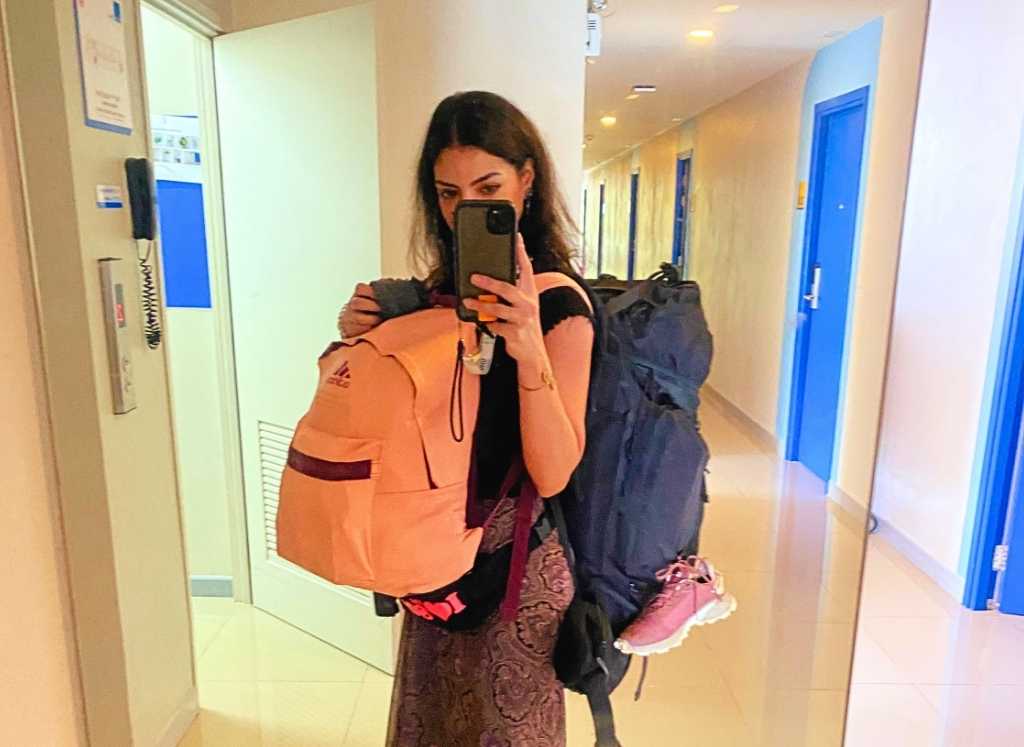
When people find out I’ve spent months backpacking, with only an 80-litre rucksack, sleeping in hostels and overnight buses, exploring jungle villages, the reaction is almost always the same:“But… with diabetes?!”
Yes. With diabetes!
Backpacking with Type 1 Diabetes is probably the most logistically demanding type of travel. Not because it’s impossible, but because it asks a lot of you. You need to plan carefully, listen to your body, and pay attention to everything. You will end up eating street food withouth counting carbs precisely, sleeping in dorms with no guaranteed fridge access, and somehow keeping your insulin cool through tropical heat while carrying a heavy luggage everywhere!
I’m not going to sugarcoat it. But I am going to tell you that backpacking is one of the most freeing and transformative things I’ve ever done, and I wouldn’t trade a single chaotic blood sugar day of it.
In this post, I’ll share everything I’ve learnt about backpacking with T1D. From planning your supplies and managing unpredictable food, to storing insulin in hostels and knowing where to find medical help abroad. If you’ve been dreaming of a big backpacking adventure but your diabetes has been whispering “maybe not,” this is the post to read.
⚠️Disclaimer: The products listed below are Amazon affiliate links. If you decide to purchase through them, I’ll earn a small commission at no extra cost to you. Please also bear in mind that prices may vary and products may become unavailable at any time!
🎒 Why Backpacking Is a Unique Challenge for T1D.
Standard travel tips for diabetics (keep insulin refrigerated, eat at regular times, check your blood sugar before meals) were clearly written by someone who has never spent three months moving between guesthouses, eating street food, or woken up at 4 AM to catch a bus to the next destination.
Backpacking strips away the routines that make diabetes management easier. There is no fixed mealtime when your schedule changes every two days. There is no guaranteed fridge when you’re staying in a 12-bed dorm. And there won’t be a pharmacy when you’re three hours from the nearest city.
What backpacking does give you, though, is adaptability. And that, ironically, is also what living with T1D teaches you. The specific challenges of backpacking with Type 1 Diabetes include:
- Irregular mealtimes. Late nights, early departures, long stretches between towns where food options are limited.
- Unrecognisable foods. Eating local cuisine is one of the great joys of backpacking. However, when you don’t know exactly what’s in a dish, estimating insulin doses becomes complicated.
- Physical variability. One day you walk 25,000 steps exploring a city, but the next you sit on a bus for 12 hours. Your insulin needs shift dramatically.
- Storage issues. Not every hostel has a fridge, and those that do aren’t always accessible at all hours.
- Emotional highs and lows. Excitement, anxiety, jet lag, and loneliness all affect blood sugar in ways that are hard to predict.
- Heavy weight. Travelling for months means carrying not only a backpack filled with clothes, gear, and other travel essentials, but also a supply of insulin, extra sensors, needles, and other diabetes-related items. And it is exhausting and strenuous.
My Advice.
Keep a small notes section on your phone (or a paper logbook if you prefer) where you jot down what you eat, how much insulin you’ve taken, and how your blood sugar responds in different situations while you travel, especially if you do not use sensors and pumps. Over time, you’ll start spotting your own patterns, and that knowledge is genuinely priceless.
⏱️ Calculating and Packing Your Supplies.
This is the most important part, because getting the maths wrong can turn an adventure into a crisis. For a full guide on calculating exactly how much insulin and how many supplies you need per month, have a read of my post Tips for Travelling Long-Term with Type 1 Diabetes where I go into detail there. But for backpacking specifically, here are the extra considerations:
- Pack more than you think you need. I’d say add at least 50% on top of your usual monthly quantity of insulin. Backpacking is demanding, food is unpredictable, you might use more insulin and there’s the high risk it can get wasted.
- Distribute supplies across multiple bags. I never keep all my insulin in one place. Rucksacks get stolen, bags get left on buses, and backpacks occasionally end up in rivers. Spread your supplies.
- Sensors. I bring extras and I bring my glucometer and lancets. In humid climates, sensors fall off and in extreme heat, they give unreliable readings.
- Don’t forget the side stuff. Extra lancets, alcohol wipes, spare batteries if your glucometer uses them, a small sharps disposal container (essential and often overlooked). Most of all, bring a printed copy of your prescription. Take a look at my article about Type 1 Diabetes travel essentials for the complete list.
My Advice.
Before you leave, ask your diabetologist to write you a letter in English (if it’s not your mothertongue) confirming your diagnosis and listing all your medication and devices. Carry it in both a physical copy and a digital scan saved to your phone. Border control and airport security can sometimes question the amount of medical supplies you’re carrying. This letter solves that problem instantly.
🍜 Eating on the Road: Street Food, Unknown Carbs, and Staying Healthy.
Let me be honest with you: I am not obsessed with counting carbs, as I have my own established daily diet. However, if you count carbs out of habit, you have to accept that, at some point while backpacking, you just have to make peace with doing it on a whim.
Street food, which is often the cheapest, most accessible, and most delicious option when backpacking, rarely comes with a nutritional label. A bowl of noodles in China, a generous portion of pad thai in Thailand or a plate of khinkhali in Georgia are not things you can Google an exact carb count for. You estimate, and inject.
Here’s what’s worked for me over years of eating my way around the world:
- Learn to recognise high-carb dishes in the cuisines of the countries you’re visiting. Rice, noodles, bread, and root vegetables are everywhere. Knowing roughly how much you’re looking at saves you from complete guesswork.
- Eat the protein and vegetables first, then the carbs. This slows glucose absorption and gives you a flatter post-meal spike.
- Inject after you’ve seen the portion, not before ordering. Street food portions vary wildly. What looks like a modest bowl of noodles can turn into a family-sized serving.
- Try to maintain your meal schedule just as you do at home. Avoid eating between meals so you don’t mess up your routine.
- Always carry a snack and fast-acting sugar. A low can happen at any time, even while you’re standing in line waiting at a food stall.
My Advice.
In countries where you don’t speak the local language, learn to say “I’m diabetic, I need sugar”. Even a rough approximation of the words can be enough to communicate urgency to a stranger. I keep mine written in my phone notes alongside a quick explanation card I can show people if needed.
🏨 Sleeping in Hostels: The Insulin Storage Problem.
I genuinely love hostels: the energy, the people you meet, the spontaneous conversations. But they do present a very specific problem for T1D travellers: where do you keep your insulin?
Most hostels have a communal fridge in the kitchen or common area, and most will let you store medical supplies there if you ask. Over the years, I’ve found that being upfront works best: “I have Type 1 Diabetes and I need to keep my insulin refrigerated, is there somewhere safe I can store it?” Staff are almost always accommodating when they understand the medical reason.
That said, there are a few things I’ve learnt the hard way (some of which you can read about in full in my post Travelling with Type 1 Diabetes: My Experience):
- Label your insulin bag clearly as life-saving medication. Something like “INSULIN — DO NOT REMOVE OR FREEZE” in both English and the local language. People are usually well-meaning but not always careful.
- Check fridge settings. Hostel fridges are not always calibrated correctly. Insulin should be kept between 2°C and 8°C. Too cold and it freezes; too warm and it degrades.
- Think about access times. If you have an early morning departure, check whether the kitchen will be open. I was locked out of a hostel kitchen in Kuala Lumpur at 5 AM with an early flight risking to either leave my insulin there or missing my flight.
- For your active pen, you don’t need to refrigerate your in-use insulin pen. Once opened, insulin can be kept at room temperature (below 25-28°C) for up to a month. However, extreme heat and freezing temperatures can damage your insulin, with catastrophic consequences for your health. Instead, use a small cooling pouch to keep it at a stable temperature throughout the day without needing a fridge.
My Advice.
If a hostel genuinely has no fridge or the setup makes you uncomfortable, it’s worth spending a small amount extra for a private room or a guesthouse with more reliable facilities.
🚌 Long Travel Days: Buses, Trains, and Overnight Journeys.
Some of my most diabetes-testing moments have happened not in remote places or extreme climates, but on long transit days such as 16-hour overnight buses, connecting flights with a 6-hour layover, slow train with no buffet car and limited snacks.
Long travel days are deceptive. You’re sedentary for hours, which typically raises blood sugar, plus the disrupted sleep and irregular meals can make things even more complicated. Here’s how I manage them:
- At airports and on a plane, keep your diabetes kit in your hand luggage only, never in checked baggage. Temperature in the hold can damage insulin, and you need your supplies accessible at all times. It is also worth contacting your airline beforehand, as some allow an extra bag free of charge for carrying medical supplies.
- Eat before you board if at all possible. Bus stations and airports don’t always have great food options.
- Bring more snacks than you think you’ll need, including both fast-acting sugar for potential lows and something more substantial for long stretches without food.
- For overnight buses or trains, check blood sugar before you sleep and set an alarm for a mid-journey check. Post-meal hyperglycaemia and overnight hypos are both common on travel days.
My Advice.
If you’re crossing time zones, speak to your diabetes team before the trip about how to adjust your long-acting insulin timing. The general rule is to make gradual adjustments rather than sudden shifts. However, the right approach depends on your individual regime, so this one really is worth a proper conversation with your specialist.
💊 Finding Medical Supplies Abroad.
One of the questions I get asked most often is: “What if you run out of insulin while you’re in the middle of nowhere?”
Firstly, good planning should mean this doesn’t happen. But if it does, or if something unexpected damages your supplies (like it happened to me in Thailand) here’s what I’ve learnt:
- In most countries, insulin is not available without a prescription, and you have to go straight to an A&E department just to get one. Teaching hospitals are usually your best bet if you need a proper medical consultation or a large quantity of supplies. They often have English-speaking staff and are used to treating foreign patients.
- Traveller communities help. Through hostels, expat Facebook groups, and travel forums, someone almost always knows where to source a specific brand or what the local equivalent is.
- Keep digital scans of all your prescriptions and medical documents. Some countries will issue emergency supplies if you can show proof of your existing prescription. Alternatively, pharmacies might sell you insulin without a prescription; even though it may not be the exact brand you use at home, rapid-acting and long-acting insulins exist almost everywhere. Knowing the international generic names (such as insulin lispro, aspart, glargine) rather than just your brand name is genuinely useful.
My Advice.
Before you travel, look up the generic names of all your medications and note them down alongside the brand names. Also check whether any of your supplies require a prescription in your destination country as rules vary significantly, and it’s better to know in advance.
💯 Travel Insurance for Backpackers with Diabetes.
I cannot stress this enough: do not travel without insurance that covers your diabetes ever. I know it’s more expensive but having been hospitalised with DKA in Canada, I can tell you with absolute certainty that the cost of insurance is nothing compared to the cost of being uninsured.
The key things to look for in a travel insurance policy as a diabetic backpacker are:
- Pre-existing condition coverage. Many standard policies explicitly exclude chronic conditions, so you must ensure chronic illnesses are actually covered. Not many insurance providers offer this, so here is a comprehensive article featuring 5 travel insurance policies that truly cover Type 1 Diabetes.
- Long trip duration. Standard travel insurance often only covers trips up to 30 or 45 days. If you’re backpacking for longer, you need a specialist policy. True Traveller is one of the few insurers that covers trips up to 18 months and allows you to declare diabetes as a pre-existing condition.
- Coverage for medication and equipment loss. If your insulin is damaged or stolen, you want to be reimbursed for replacement costs.
My Advice.
Buy your insurance as soon as you book your trip, not the day before you leave. Some policies won’t cover conditions that arise in the period between booking and departure if you delay purchasing. And always, always read what is and isn’t covered before assuming everything is fine.
🤝 Telling People You’re Travelling with Diabetes.
When you’re backpacking, you’re constantly meeting new people: fellow travellers in the hostel, tour guides, locals, etc. Because of this, you’ll have to make quick decisions about who to tell about your diabetes and how much to share. Loneliness and the feeling of being different can hit hard when you travel solo with Type 1 Diabetes.
I usually don’t overshare that I have T1D, but sometimes it can be a life-saving choice. If you’re about to spend a day hiking with someone, joining a shared tour, or sitting next to them for a long overnight journey, they should know.
A brief explanation works perfectly: “I have Type 1 Diabetes. If I seem confused or shaky, I might need sugar, and here’s where I keep it.” Most people appreciate being informed rather than being left to panic in an emergency.
My Advice.
Consider wearing a medical alert bracelet or ID tag when backpacking, especially in countries where you don’t speak the language. In an emergency where you can’t communicate, it could be the thing that makes a critical difference. There are some elegant, discreet options available: it doesn’t have to look like a medical device.
🎀 Backpacking with Type 1 Diabetes: My Experience.
To date, besides living in six different countries, I’ve been on three backpacking journeys: nearly ten days in Georgia, a full month in China, and three months in Southeast Asia, including two full months exploring Thailand.
Personally, the hardest parts were carrying the weight of my main backpack alongside my dedicated diabetes bag, and keeping my insulin safe and cool. Travelling for months can be tough enough on its own. You never quite know how many clothes to pack or exactly what you’ll need, so adding a multi-month supply of insulin, sensors, and needles can feel frustrating and physically demanding.
Plus, I didn’t just have to worry about my regular belongings getting stolen or damaged. Looking after insulin is even more stressful since it’s a life-saving medication.
However, these challenges are nothing compared to the joy of witnessing marvellous places and breathtaking landscapes. Nothing beats the sheer satisfaction of completing a long journey while successfully managing such a demanding condition.
Even though I’ve faced a few scary, life-threatening moments during my travels and backpacking trips, I would never give up.
❓ FAQ.
Absolutely! It takes more planning than a standard holiday and more attention, but it’s completely doable. The key is packing smart, getting the right insurance, and being honest with yourself about your limits.
Use a reliable cooler bag with ice packs or a USB mini fridge for long bus rides or flights. When staying in hotels or hostels, always ask the staff to store your life-saving medication in their fridge.
You need a policy that explicitly covers pre-existing conditions and longer trip durations. Sadly, most standard policies cap at 30-45 days, which isn’t enough for a proper backpacking trip.
Start with your usual monthly insulin dose, then add at least 50% more. Backpacking is physically demanding, and there is a greater risk of your insulin going off. You should also take extra sensors, test strips, a glucose meter and a glucagon pen.
In most countries, insulin is not available without a prescription. You may have to go straight to an A&E department to purchase it.
🎈 Conclusion.
Backpacking with Type 1 Diabetes is not impossible and being a diabetic traveller doesn’t make you any less of a backpacker. It’s the real thing: every chaotic, beautiful, overwhelming bit of it, with an extra layer of planning and attention underneath.
The truth is, diabetes has made me a better traveller. It’s made me more organised, more resourceful when things go wrong, and more grateful for the moments when everything goes right.
Don’t let anyone, not even yourself, tell you that your diabetes is a limitation and that you cannot go backpacking or travel for months. You can! Pack smart, plan ahead, get the right insurance, and go. The world is waiting for you.
💬 And you? Have you ever gone backpacking with Type 1 Diabetes, or are you planning your first trip? Tell me everything in the comments!
☕ Did you find this post helpful? If you’d like, you can support my blog by treating me to a virtual coffee!

Want to stay updated with my latest itineraries, receive practical guides and unique travel tips, and enjoy exclusive discounts on hotels, flights, and activities?
✨Click the button below and join my community of travel girls!✨
