


Last Updated on September 10, 2026 by Nadia Halfway
📜 Introduction.
Chiang Rai was the very first stop of my 2-month journey in Thailand, not Bangkok, as you might expect. After landing at Suvarnabhumi Airport in the middle of the night, I only had time to sleep for a few hours before catching an afternoon flight straight up north. In a short time, I swapped the capital’s chaos for misty mountains, spectacular temples and riverside cafés.
Surprisingly, Chiang Rai doesn’t get as much attention as Chiang Mai, and that’s exactly what makes it special. Here, you can visit some of the most striking Thai temples and stand precisely where Thailand, Laos and Myanmar meet.
In this short 2-day itinerary, I’ll take you through Chiang Rai just as I experienced it: my first moments in the Land of Smiles, followed by a full day exploring the city’s most iconic sights.
⚠️Disclaimer: Some of the websites below are affiliate links or require a promo code for receiving a discount. If you book through them or use my personal promo code at the time of subscription or reservation, I’ll earn a small commission (at no extra cost to you), and you’ll get a discount or a special promotion too. It’s a win–win!
Please be aware that affiliate links may expire and promo codes may reach their usage limit. If you find that a link or code no longer works, kindly let me know. I’ll be happy to share an updated one (if available) directly with you.
Day 1: A Fairytale Evening.
After landing in Bangkok at 2 AM and spending what was left of the night at a hostel near the airport, I took an early afternoon flight up to Chiang Rai. The contrast with Bangkok was immediate: cooler air, far fewer people, and a calm atmosphere.
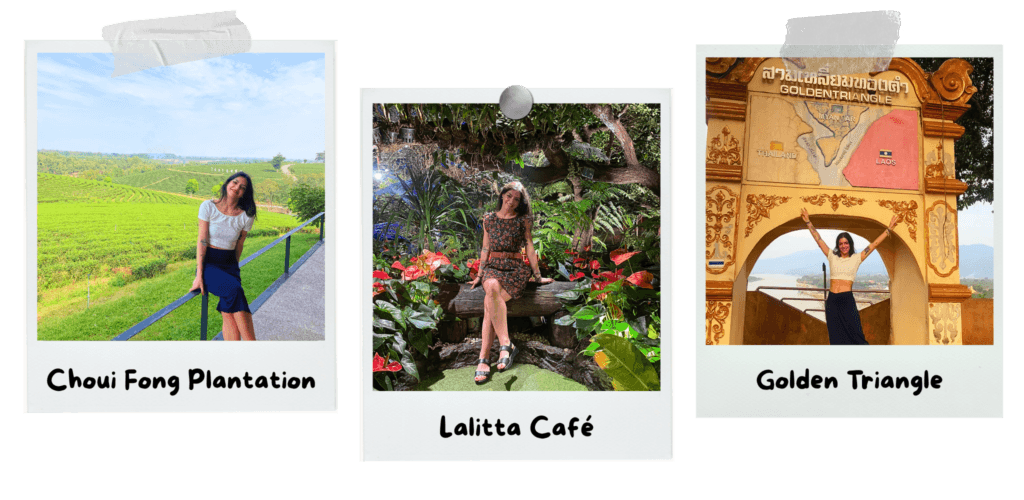
Since it was already 4:30 PM when I touched down, I checked into my hostel to drop off my bags and headed straight to Lalitta Café. This café is a truly fairy-tale-like place: with a waterfall, tropical flowers and plants, and fairy statues. Even though I went after sunset, when it was already dark, the atmosphere was still magical.
Afterwards, I went for dinner at Ban Suan Shrimp Farm, a local restaurant built around its own shrimp ponds, for a taste of northern Thai flavours.
I closed out the day wandering through the Night Bazaar, a lively market packed with food stalls and street performances. It was about a 20-minute walk from my hostel, but I felt extremely safe walking after dark.
However, if you have a little extra time during your stay in Chiang Rai, you must visit Wat Huay Pla Kang. This sacred temple is home to the enormous “Goddess of Mercy” statue overlooking the city. It is just a short ride away from the airport and only 5 minutes drive from Lalitta Café.
Day 2: Beautiful Temples and Tea Plantation
This was, without question, one of the most jam-packed and rewarding days of my entire two months in Thailand.
You might have heard of the White Temple and the Blue Temple in Chiang Mai. However, these famous landmarks are actually located within the Chiang Rai province. As time was limited and transport difficult, I joined a full-day organised tour. With an early morning pickup at my hostel, we covered an extraordinary amount of ground in Chiang Rai and the surrounding areas.
Wat Rong Khun (White Temple).
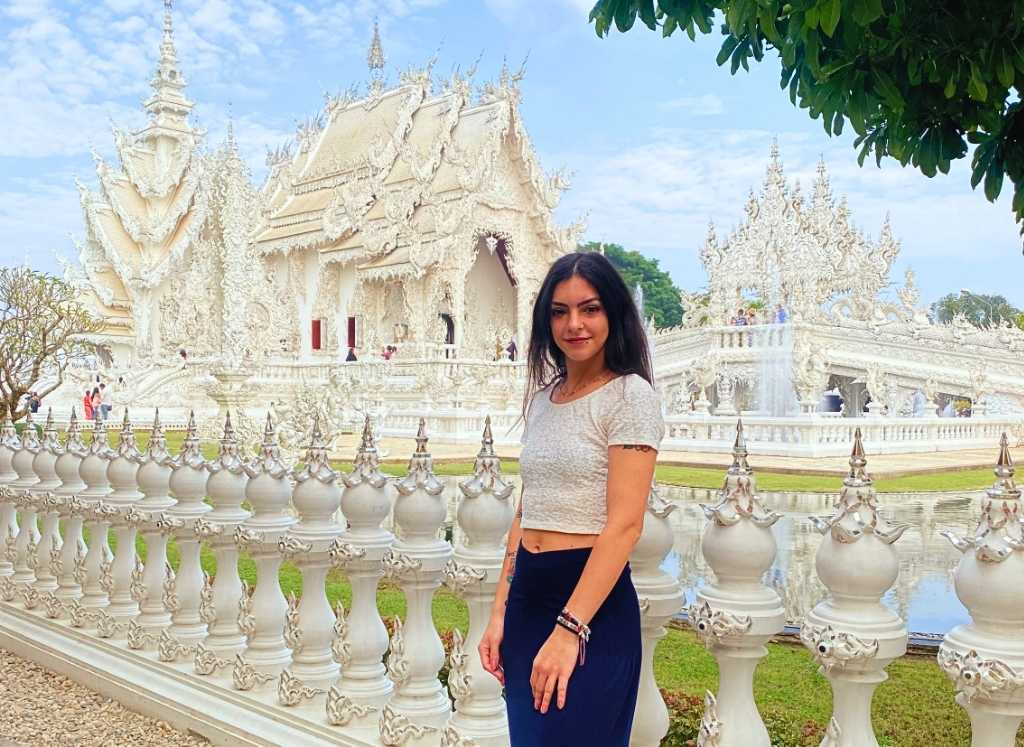
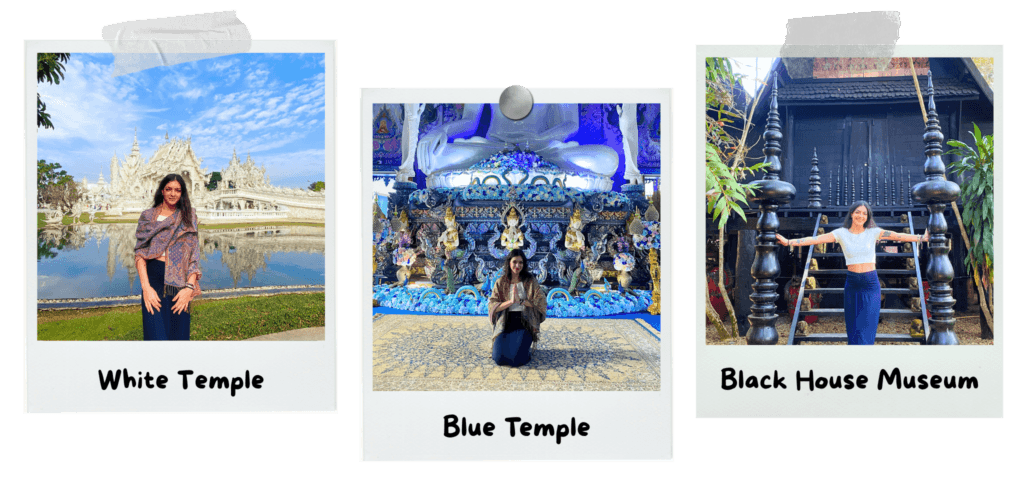
No photo really prepares you for it. Completed in 1997, Wat Rong Khun, or the White Temple, is a unique masterpiece that stands out because of its stark white colour and the fragments of glass embedded in the plaster, which sparkle beautifully in the sun. The white colour signifies the purity of the Buddha, while the glass symbolises the Buddha’s wisdom and the Dhamma (Buddhist teachings).
The entrance bridge crosses a sea of outstretched hands symbolising desire and suffering, making the whole structure feel like a piece of surreal contemporary art.
However, it is not only white. Within the grounds of Wat Rong Khun, you will also find a striking golden building, golden statues and a golden arch. The gold symbolises how people focus on worldly desires and money. This stands in sharp contrast to the white, which represents the idea of making merit and focusing on the mind instead of material things.
Wat Rong Suea Ten (Blue Temple).
The Blue Temple is equally striking, but in an entirely different way.
Construction was initiated by the community in 1996 to replace an old, abandoned temple, and was finally completed in 2016. Its design was realised by local artists and follows a neo-traditional Buddhist style, featuring intricate sculptures and psychedelic imagery.
A deep cobalt-blue exterior covered in gold detailing houses an impressive white Buddha statue inside, where all the walls and ceilings are magnificently decorated. It will absolutely leave you speechless.
Baan Dam (Black House Museum).
Also known as the Black House Museum, is a private art exhibition comprising a mixture of 40 traditional northern Thai buildings infused with unconventional, contemporary architecture, all sprawling across an area of about 160,000 square metres.
Created by a renowned local artist, it is a complex of dark wooden structures filled with animal skulls, skins and bones. These are displayed almost like art installations, exploring themes of death, the macabre and nudity.
Union Hilltribe Villages.
After the temples, we stopped at one of the Union Hill Tribe Villages to gain some insight into northern Thailand’s hill tribe communities. However, if I had known what really lay behind this visit, I would have thought twice before participating.
Refugee women from Myanmar and Laos, living in these villages in the Nanglae District, are forced to wear heavy brass neck rings from the age of 5. They add a new ring each year and can never take them off.
These women, who mainly belong to the Karen Tribe (often called the Long Neck Tribe), are denied Thai citizenship. This allows the government to avoid providing social care, leaving the women highly vulnerable to exploitation for tourism.
The entry fee to the village, which feels completely artificial, and the souvenirs these women sell are what fund the community. On one hand, using vulnerable, exploited women purely as an exhibition, almost like a zoo, feels incredibly cruel and unethical. On the other hand, it is their only way to survive and sustain themselves.
Choui Fong Tea Plantation,
After lunch at a restaurant along the way, we continued to the Choui Fong Tea Plantation, where rolling green tea terraces stretch across the hillside as far as the eye can see. It is a wonderful place to slow down for a bit, complete with a café overlooking the fields.
Established in 2013, Choui Fong is the largest tea producer in Chiang Rai province. It grows several distinctive types of tea including Assam, Green, Oolong and Black Tea across an area of over 1,200 rai, at an altitude of 500 to 1,200 metres above sea level.
You can either take a stroll through the plantation right between the tea bushes, or simply enjoy a fresh cup of tea while taking in the views over the fields.
House of Opium and Golden Triangle.
From the tea fields, we carried on to the House of Opium, a small museum documenting the region’s complicated history with opium cultivation and trade, before finishing at the Golden Triangle. In fact, since the 1950s, it has been notorious as one of the largest opium-producing areas in the world.
The Golden Triangle is a vast, mountainous region spanning Thailand, Myanmar and Laos, centred on the confluence of the Ruak and Mekong rivers.
During the visit, we were actually allowed to cross the border into Laos just to get a passport stamp. However, I preferred not to do it. Standing there, looking across into two other countries at the same time, was a genuinely powerful way to end the day.
🛏️ Where to Stay in Chiang Rai.
I stayed at a cosy, centrally located hostel called Stay In and there I discovered how much I would have loved South East Asia hostels. It was simple, clean and exactly what I needed after a long flight and a busy day of temple-hopping: a comfortable bed, a calm atmosphere and a quick homemade breakfast before heading out to explore again.
A bed in a female-only bunk dorm costs just €7 per night, with breakfast included: an absolute bargain for solo travellers on a budget.
🎁 Use the referral code below or register via Trip.com to unlock your €10 discount 🎁
U51IZ5
🔽 If you’d prefer the comfort of a hotel, you can explore plenty of options in Chiang Rai using the map below 🔽
🍜 What to Eat in Chiang Rai.
Chiang Rai’s food scene is a wonderful introduction to northern Thai cuisine. Since I only stayed for a couple of days, I didn’t get the chance to dive incredibly deep into every single regional dish, but these are the absolute stand-out spots you cannot miss during your stay!
- Lalitta Café. This is a beautiful riverside café, ideal for a slow afternoon in the city. As I mentioned in my post, you need to buy an entrance ticket to get in, as the café has become incredibly popular for its stunning, fairytale decor.
- Ban Suan Shrimp Farm. If you want excellent fresh shrimp dishes, this is the place to go. It is wildly popular with locals and sits right beside a shrimp pond.
- Tong Tung. A local favourite for a proper, hearty dinner. The top-notch service and exquisite cuisine are paired with a beautiful, museum-like setting. It gets incredibly busy, so I recommend booking a table.
- Wood.Lover Café. Nestled amidst the beauty of rolling rice fields, this cofee shop offers a peaceful escape from the city life.
- Porwa Farm. This is a gorgeous place surrounded by lush plants, with rabbits, turtles, and a pond with koi fish. The atmosphere is wonderful, the food is high quality yet reasonably priced.
- Chiang Rai Night Bazaar. The absolute go-to spot in the evening and night for cheap, incredibly varied street food. The atmosphere is vibrant and lively, making it the perfect place to grab a bite and wander around.
💡 Travel Tips.
If you’re flying in from Bangkok, I suggest you to book directly to Chiang Rai rather than connecting through Chiang Mai first. Domestic flights between Bangkok and Chiang Rai are frequent and affordable. Moreover, starting here gives you a gentler introduction to northern Thailand.
I visited Lalitta Café by taking a Grab taxi and, if I had more time, I would have also visited Wat Huay Pla Kang on my own. They are located very close to one another, just a few minutes’ drive apart. Alternatively, there are several guided tours that include these spots (see below).
For the full-day tour covering the White and Blue Temples, Black House Museum, etc., I booked through TripAdvisor. Pick-up and return transport are included within a certain area of Chiang Rai, lunch is also included, but entrance tickets for each place are not.
Always bring cash for the smaller stops. Entrance fees at some of the sights, plus food and drinks along the way, are easier to handle with Thai Baht in hand rather than relying on cards.
Needless to say, wear comfortable shoes and modest clothing. Several of these are sacred temples, and you’ll be walking across uneven ground at the Black House Museum and around the tea plantation.
Finally, in case you want to skip Chiang Rai, platforms such as GetYourGuide and especially Klook offer similar day tours covering the same highlights from Chiang Mai. This way, you have the advantage of a guide and not arrange transport between sights.
Klook.com🎁 Subscribe via Klook.com to receive €5 off your next booking 🎁
🎈 Conclusion.
Two days in Chiang Rai were enough to fall completely in love with northern Thailand, before I’d even properly started my two-month journey through the country. Between the otherworldly White and Blue Temples, the unusual Black House, the calm of the tea plantations, and standing at the meeting point of three countries at the Golden Triangle, this small, often-overlooked city packs in an extraordinary amount.
From Chiang Rai, I continued south by bus to Chiang Mai, the next stop on my itinerary but this city will always have a special place in my Thailand journey. It was the very first place that showed me what this country was capable of.
💬 And you? Have you ever visited Chiang Rai, or is it on your list for your next trip to Thailand? Let me know in the comments below!
☕ Did you find this post helpful? If you’d like, you can support my blog by treating me to a virtual coffee!

Are you dreaming of your next trip but not sure where to start?
Book a 1:1 travel consultation or request a personalised itinerary and I will design the trip of your dreams!
✨Click the button below for my Travel Services✨
