


Last Updated on August 3, 2026 by Nadia Halfway
📜 Introduction.
Travelling solo with Type 1 Diabetes carries more than an additional bag of insulin and CGMs. The emotional weight is what nobody actually talks about, and it is probably heavier than a bag full of supplies.
I’ve read every “travelling with T1D” article on the internet: the ones with lists of what to bring, the ones about managing carbs on the go, the ones with the smiling author at an airport gate. I’ve even written extensively about this myself.
But here’s what I’ve rarely seen anyone write honestly: the internal experience, the struggles of travelling solo and being very far away from home and family, and the parts you can’t solve with a juice.
So this is that piece: what no one actually tells you about travelling solo with Type 1 Diabetes.
💙 The Guilt You Carry.
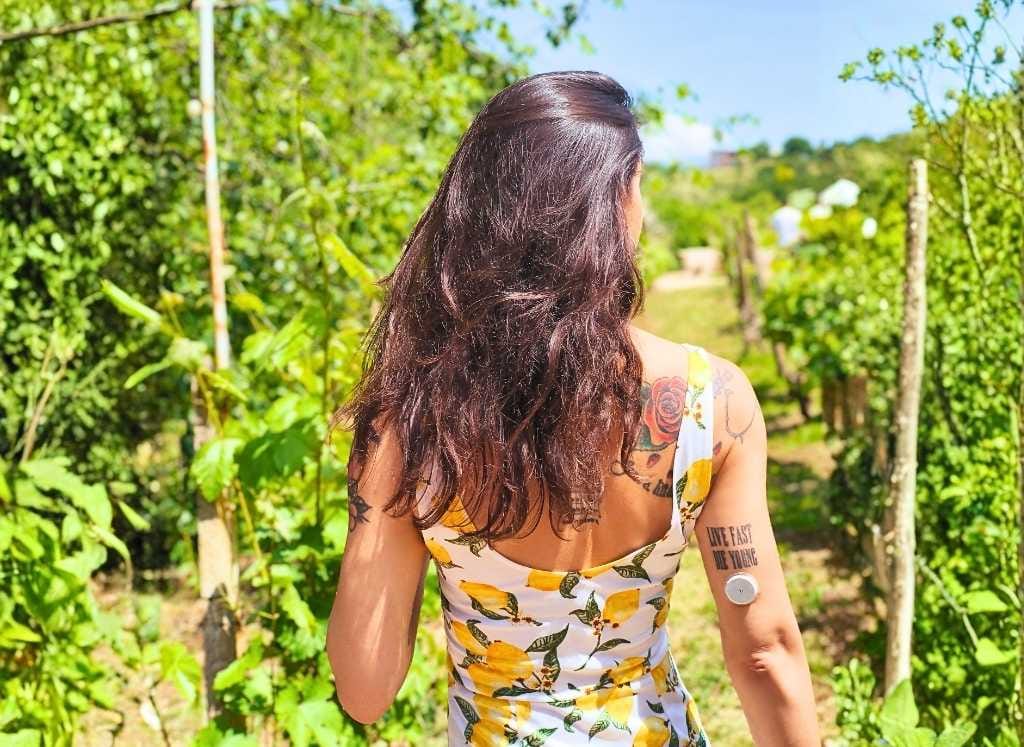
If you have been reading my articles about Diabetes and Travels series, you already know I have been T1 diabetic since I was little. For me, there was no switch from “normal” to being diabetic. This has been my routine for almost 30 years now. However, my mum never stops being anxious about me managing diabetes when I go and live abroad or travel in a tropical country.
I know that the moment the gate closes, she’ll be sitting at home worrying: did she bring everything? Could something bad happen? And there was nothing I could do about that. Nobody really talks about this part of travelling with diabetes and the guilt of being someone whose passion carries genuine medical risk.
When bad things happened (for instance when my insulin was accidentally frozen in Thailand, or when I lost my only CGM in Georgia), I didn’t tell my family. I was scared and needed someone to talk to who could give me advice and reassure me, but these were situations I could figure out and solve on my own without causing anyone any concern. However, when I was diagnosed with sepsis leading to DKA in Canada, that was a different story entirely.
I felt guilty because I had been warned that the weather was extreme, I hadn’t anticipated how badly things would unfold, and I felt responsible for the worry I caused my family. Luckily, everything turned out well.
🧠 The Mental Load.
Non-diabetic travellers talk a lot about “switching off” during a trip. Leaving work, responsibilities, and stress at home and simply being somewhere, enjoying a holiday.
I have never once fully switched off. Not anywhere.
Every meal is a calculation: what’s actually inside this meal, how active will I be this afternoon, is it going to hit me fast or slow? Every time zone is a disruption: not just to sleep, but to basal rates, to the way the body normally behaves. Moving from one place to another brings its own challenges: how do I keep my insulin cool and safe? Then accommodation is always a mystery even if you read every review carefully: will there be a fridge in my room? Will someone at the hostel take my insulin bag from the communal fridge? And so on.
There is a particular exhaustion in being unable to fully relax. Not because travel isn’t joyful (it is, deeply) but because there’s always a small part of your brain running in the background. Monitoring. Calculating. Planning. Worrying about the worst.
🫂 The Identity Split.
I want to be a traveller. Not a diabetic traveller, not an inspiring-despite-her-condition traveller, not someone whose chronic illness is the most interesting thing about her adventures. And yet I cannot fully separate the two.
I truly believe that even though I have done extraordinary things, I would have accomplished much more without the constraints of this condition.
Every time, I have to bring what is essentially a travelling pharmacy, which takes up a third of my hand luggage. I have to control my eating and stick to strict timetables, have to portion out, measure and calculate my food, and often eat even when I don’t feel like it.
I stop conversations to check my blood sugar or inject myself in any sort of environment or drink a juice in critical conditions. The identity split is this: the version of myself that wants to just wander, unencumbered, spontaneous, carefree. I don’t want to be a slave to my own injections, or be on costant alarm or stop for hypo. But this is not possible.
What helped me was reframing it. I don’t travel despite having diabetes, but with diabetes. This is who I am and this is the traveller I am.
😔 When No One Around You Knows.
As I mentioned above, I was diagnosed at 5 years old, so every diabetic situation has happened to me: at every age, in every circumstance, in every aspect of my life, in public and in private. I’ve had hypos at school, while reading, after brushing my teeth… And also on a plane, hiking somewhere, during a tour, and in the middle of the night in a ten-bed hostel dorm.
These situations can be very stressful, especially when you don’t speak the local language and are far from the comfort of home. But they can also be life-threatening. If things had been worse (if I’d been confused, or unable to communicate, or collapsing), the people around me would have had no idea what is happening or what to do.
This is the scenario that lives in the back of every solo T1D traveller’s mind. Not the manageable lows, but the ones you don’t catch in time. The ones where you need someone else to act.
What I do now is to carry a card in the local language explaining what T1D is and what to do in an emergency. I’ve practised saying “I have type 1 diabetes, I need sugar, please call an ambulance if I’m unconscious” in more languages than I ever expected to need. None of this is foolproof, but makes me feel a little bit more peaceful.
💉 The Loneliness of Being the Only Diabetic and Feeling Different.
I travel solo pretty much always but sometimes I join organised tours and group activities (cooking workshops, pub crawls, that sort of thing) with other people.
There’s a particular loneliness in being the only person in the group dealing with diabetes. The only one who can interpret what your CGM graph means at 2am in an unfamiliar city. The only one checking carbs or glancing at a CGM throughout the day.
This is a bit like the feeling of being “the odd one out” that I used to have at school. But it’s not just about feeling different from others; there’s also the loneliness. There’s no one to ask me, “have you checked your blood sugar?” or “have you taken your injection?”. Because that’s part of travelling alone, too.
I’m not saying this to be negative. I’m saying it because this loneliness is one of the hardest parts of travelling alone, especially when you’re ill.
🪁 The Moment You Realise You Can Do It.
The trust you build in yourself as a solo T1D traveller is different from any other kind of personal growth I’ve encountered. It’s not thinking “I’m brave” but “I have the skills, the training, the confidence, and I know what I’m capable of”.
I am not saying you should just jump on a plane with a backpack and travel across Asia. Being a seasoned traveller and having lived with the diagnosis for many years gives you experience in both solo travel and diabetes management. Start with a short weekend trip to a nearby city. You will learn a lot about self-awareness, recognising the symptoms of hypos and hypers, and stepping outside the comfort of home before embarking on a longer solo trip.
Type 1 Diabetes can be debilitating if not well taken care of, and it can have life-threatening consequences if not well managed, but it is not something that can stop you from travelling solo.
You just need time, preparation and organisation so you can do it!
🎈 Conclusion.
Romanticising travelling despite chronic illness can be encouraging, but it can also downplay the real risks and overshadow the emotional side. Listing medications and supplies, recommending reliable travel insurance, and sharing practical gear advice are all genuinely useful. But being honest about the difficulty and the truth matters just as much as simply saying you can do it.
What I wish this post does is sit somewhere in the middle. I hope it is honest enough to acknowledge the weight, and inspirational enough to show that you can do it. If you are wondering whether you are ready, the answer is in you. Start small, plan carefully, and trust that the confidence will come.
Solo travel is already a challenge, especially for women travelling alone. Travelling solo with Type 1 Diabetes is even more demanding. And yet it is one of the most beautiful gifts you can give yourself.
💬 And you? Have you ever travelled solo with Type 1 Diabetes? What are your worries and difficulties when it comes to this?
☕ Did you find this post helpful? If you’d like, you can support my blog by treating me to a virtual coffee!

Want to stay updated with my latest itineraries, receive practical guides and unique travel tips, and enjoy exclusive discounts on hotels, flights, and activities?
✨Click the button below and join my community of travel girls!✨
