



Last Updated on September 13, 2026 by Nadia Halfway
📜 Introduction.
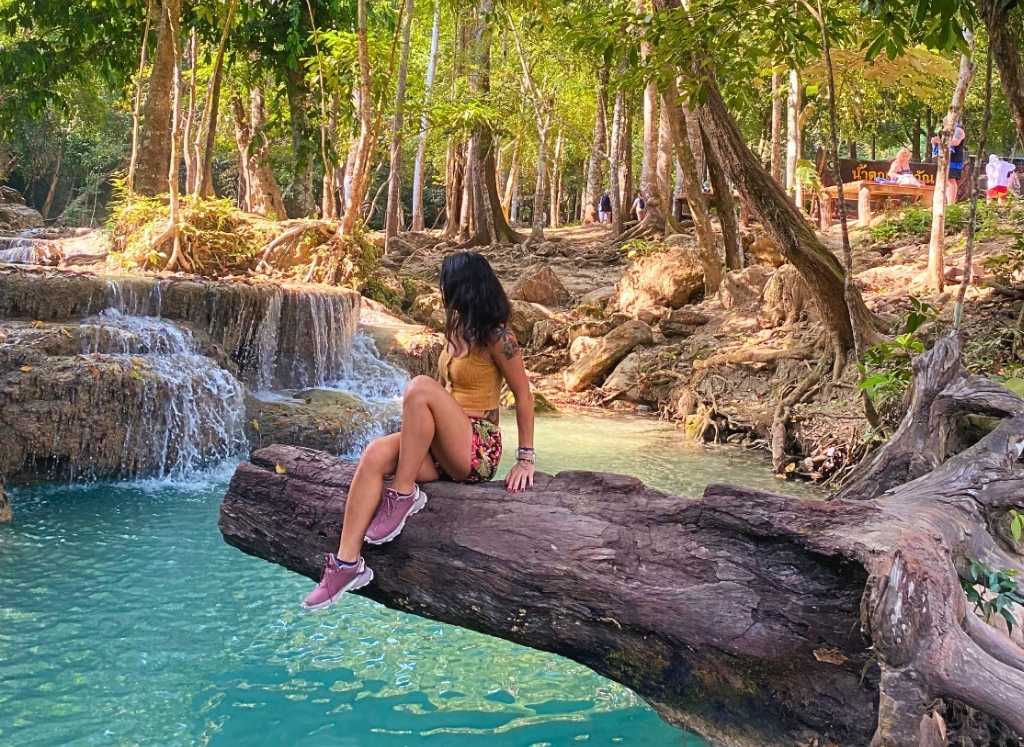
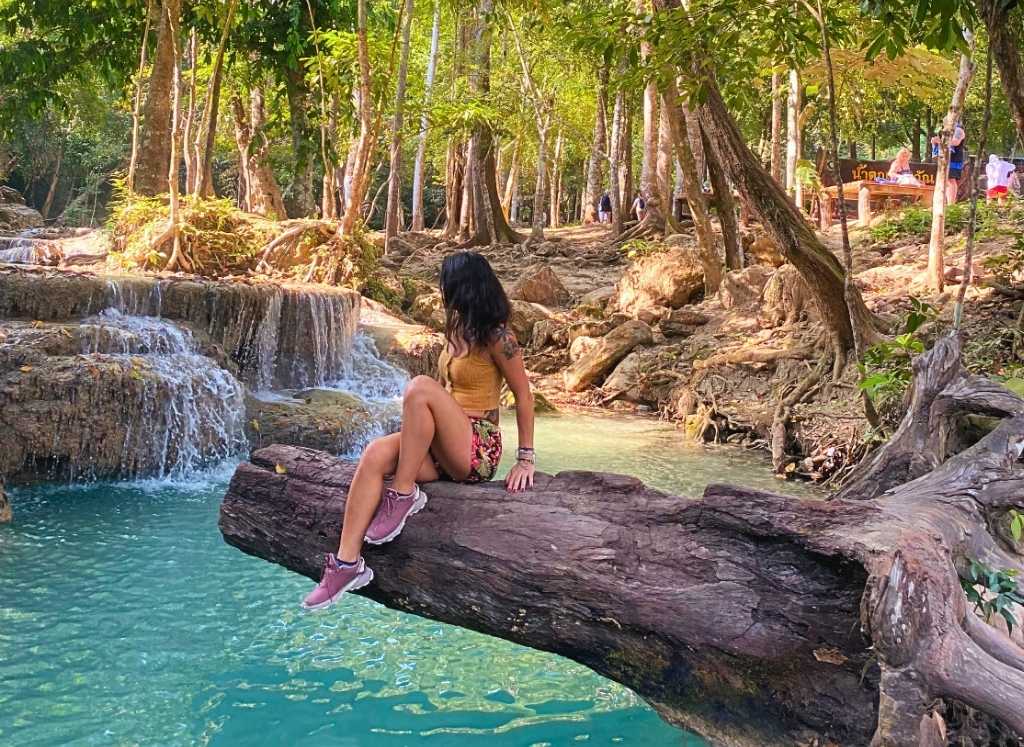
Erawan National Park sits in the heart of Kanchanaburi Province, roughly three hours west of Bangkok. The park is dense with jungle and cut through by the Khwae Yai River, but what draws visitors from across the world are the seven-tiered waterfalls that cascade through the forest filling emerald pools with white stones.
There is a particular shade of water that exists almost exclusively in waterfalls. That deep, mineral turquoise that looks enhanced in photographs and yet somehow manages to be even more vivid in person. The first time you see it at Erawan National Park, you’ll be speechless.
I spent almost a day here climbing tier by tier, pushing as far as my body and the terrain would take me reaching the fifth tier. In this guide, I will share how to get to Erawan National Park, some practical information and tips, and how to make the most of your visit.
⚠️Disclaimer: Some of the websites below are affiliate links or require a promo code for receiving a discount. If you book through them or use my personal promo code at the time of subscription or reservation, I’ll earn a small commission (at no extra cost to you), and you’ll get a discount or a special promotion too. It’s a win–win!
Please be aware that affiliate links may expire and promo codes may reach their usage limit. If you find that a link or code no longer works, kindly let me know. I’ll be happy to share an updated one (if available) directly with you.
🐘 The Name Behind the Falls.
The park takes its name from Erawan, the three-headed white elephant of Hindu and Buddhist mythology, sacred mount of the god Indra. The connection becomes clear when you reach the upper tiers: from certain angles, the highest cascade of the seventh waterfall is said to resemble the silhouette of Erawan rising from the water, three streams of white meeting in a form that is almost unmistakably elephantine.
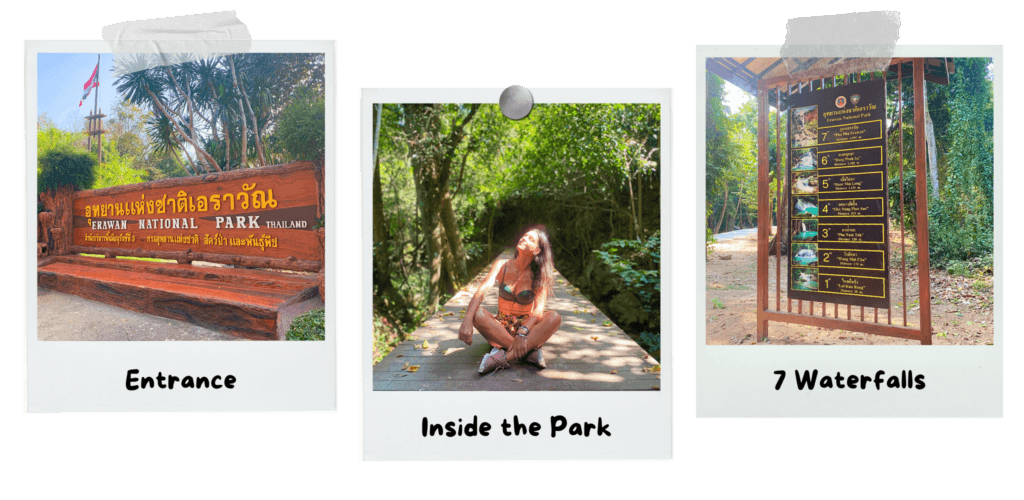
💦 The Seven Tiers: What to Expect.
The trail that connects all seven waterfalls covers roughly 2 km of forested terrain, gaining steady elevation along the way. On paper, 2 km sounds like a short walk. In practice, with heat, humidity, river crossings, and the irresistible pull of cool water at every turn, it can easily fill five to six hours.
The lower tiers and upper tiers are genuinely different experiences: in atmosphere, difficulty, and the type of adventure on offer. Each one will reward you with stunning views and beautiful natural scenery.
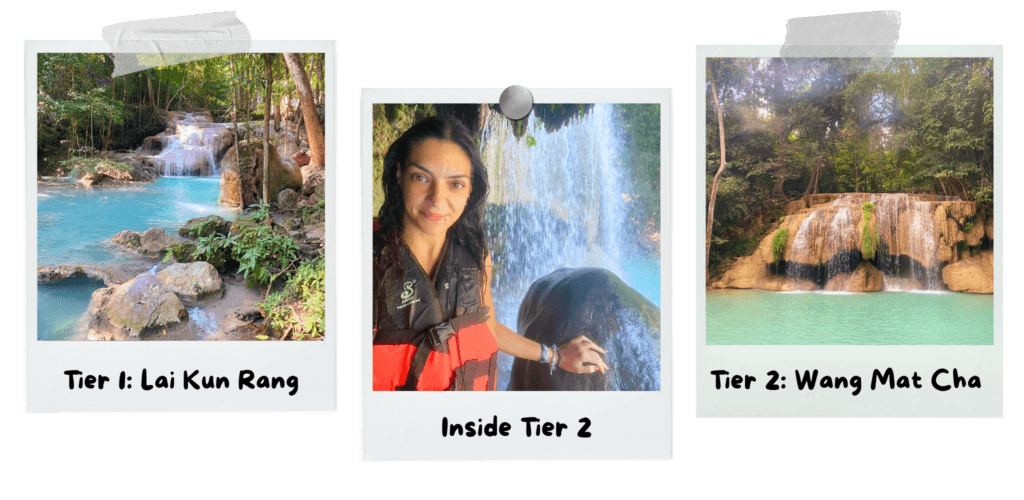
Tier 1: Lai Kun Rang (distance 20 m).
From the parking lot, it is only a simple 500 m stroll to the first level. Lai Kheun Rung is the waterfall with the most dramatic series of rock steps where the water flows through.
It’s wide, accessible, and busy, and for good reason. The pool here is shallow enough to sit in safely, and the resident fish make it instantly extraordinary. Small, silver, and completely unafraid, they swarm around anyone who steps into the water and begin gently nibbling at skin and heels.
Tier 2: Wang Mat Cha (distance 170 m).
The second waterfall flows into a deeper, wider lake, surrounded by limestone formations with trees leaning over the water. It is one of the most photographed spots in the whole park, and by mid-morning it is teeming with visitors.
The water here is cool and clear, and you can take a quick dip and swim out to the cove behind the waterfall. It’s exactly what you’ll need after the short climb. If you only have time to visit one level, this is definitely the one to choose.
Tier 3: Pha Nam Tok (distance 220 m).
The trail begins to shift here. The wide, easy path of the lower section gives way to something slightly more demanding: narrower in places, with tree roots crossing underfoot and the first real climb of the day. In fact, the crowds thin noticeably.
The pool is large enough to accommodate many people, and since the waterfall is higher than Wang Mat Cha (the second tier), Pha Nam Tok looks a little more impressive. The reward is a waterfall less theatrical than tier 2, but with a quietness that the lower tiers can’t offer on a busy day. The pool is cooler, the trees closer, and the sense of having gone somewhere on your own steam more felt.
Tier 4: Nang Phee Sue (distance 520 m).
By the fourth tier, you’ll have left the majority of the day’s visitors behind. The trail becomes properly jungle now: steeper, shadier, with wooden steps and fixed ropes.
The waterfall itself drops into a narrow pool. The blue-green here is at its most concentrated: the mineral-rich water held in a tighter space, the jungle canopy filtering the light. I observed it from above and didn’t make it down to the water’s edge.
From tier 4, the trail gets a little longer and a little steeper. This is where you will feel the most fatigue, but if you push past this point, you should have no trouble completing the rest of the trail.
Tier 5: Buar Mai Long (distance 1120 m).
The fifth waterfall is where my day at Erawan ended.
The approach to tier 5 involves the longest and most challenging stretch of path I’ve encountered, with a significant elevation gain, including a flight of steps. The heat at this point in the morning was considerable, and the path was narrow and technical underfoot. For those who take care of their bodies (managing energy levels, hydration and specific health needs), this is a point worth considering before continuing.
Tier 5 is genuinely magnificent: it looks like a small collection of little waterfalls, with the forest around it utterly undisturbed. There were perhaps a handful of other visitors when I arrived so the contrast with the buzzing lower tiers could not have been more complete.

Tiers 6 Dong Pruk Sa (distance 1420 m) and 7 Phu Pha Erawan (distance 1550 m).
Sadly, I didn’t reach tiers 6 and 7. What I can tell you is that those who do describe the trail as increasingly challenging, and the seventh waterfall as the most spectacular of all, with the clearest water on the entire trail.
You will also get to take a photo with a “You are the Conqueror” sign installed at the top level to celebrate your achievement.
🚗 How to Get to Erawan National Park.
I had quite an adventurous journey getting here. I had just had my Sak Yant tattoo done, and my private driver kindly dropped me at Nakhon Pathom train station. After a few stops, I got off in a small village and, after asking some locals for directions, managed to find the bus station, where I took a minibus to Kanchanaburi city. From there, I took a Grab taxi to my accommodation. So the first step is always reaching Kanchanaburi itself.
The resort where I stayed was fairly close to Erawan National Park, so I had planned to walk there, roughly one and a half hours. However (and I felt extremely lucky), a local bus spotted me along the road, stopped, and let me on without even charging me for the ticket.
For the return journey, I used a local bus again. There were several local and tourist buses at the park entrance, so I checked the timetable and was able to get back to my accommodation without any trouble after my visit.
By Public Transport.
If you are based in Bangkok and want to do a day trip or spend a few days in the area, here are your options.
BKS public buses leave from Bangkok’s Southern Bus Terminal (Sai Tai Mai, สายใต้ตลิ่งชัน), located in the western suburb of Thonburi. In Kanchanaburi, they arrive at the main bus terminal near Thanon Saengchuto. Buses run approximately every 15-30 minutes from early in the morning until the evening (around 8:00 PM), and the journey takes two hours for just 150 THB, depending on the class and the operator.
Some buses and vans also run from Bangkok Bus Terminal Chatuchak (Mo Chit 2). Services are less frequent than from Sai Tai Mai but still regular through the day. Journey time about two to three hours, fare around 130-170 THB.
If you are already based in Kanchanaburi city, there are regular services from Kanchanaburi Bus Station directly to Erawan Falls. A one-way ticket costs around 60 THB and the journey takes approximately one and a half hours. This is an indicative schedule, so always confirm the departure and return time at the station:
- From Kanchanaburi to Erawan Falls: 08:00, 09:40, 11:00, 13:00, 15:00, 17:40
- From Erawan Falls to Kanchanaburi: 05:20, 06:10, 08:30, 10:00, 12:00, 14:30, 16:30
You can either purchase your ticket directly at the train or bus station, or via 12Go using the widget below.
🔽 Ready to travel? You can search for your next train or bus directly in the bar below! 🔽
Alternatives.
If you are staying at a resort along the river, you can try walking to reach Erawan National Park and hope a songthaew will pass and pick you up. Otherwise, you can take a taxi, or ask your hotel if they can arrange a driver.
Finally, if you prefer the most hassle-free option and don’t want to deal with trains, vans and local minibuss, you can always look into organised tours. GetYourGuide has plenty of them. Below I have selected three, whether you are travelling from Bangkok or from Kanchanaburi.
🛏️ Where to Stay at Erawan National Park.
There aren’t many places to stay within walking distance of Erawan National Park. The main exception is the camping ground just a few hundred metres from the entrance. Camping there is relatively cheap: around 30 THB per person per night, and you can rent a tent, sleeping bag, pillows, and a mat for additional charges.
However, along the Khwae Yai River there are accommodations for all types of traveller: from more affordable guesthouses to proper resorts. I personally wanted to treat myself and stayed at The Hub Erawan Resort for two nights.
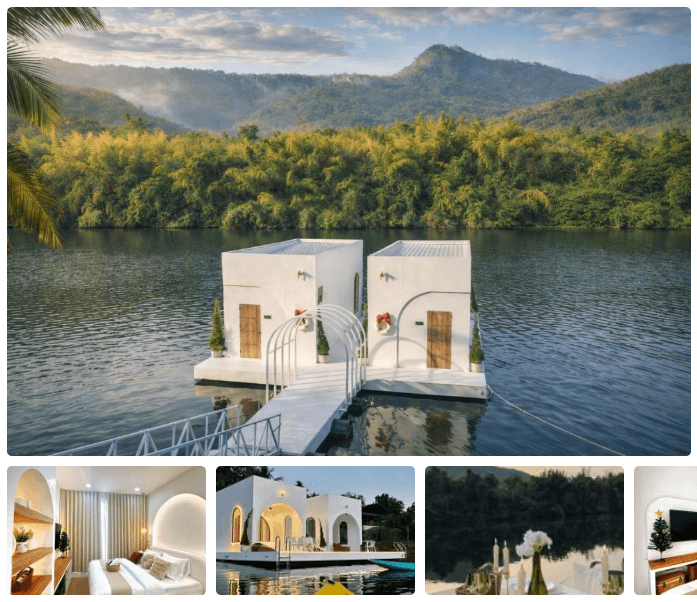
While writing this article, I also came across a new property called Heaven Raft Erawan, which looks absolutely stunning if you are looking for a touch of luxury in the forest. Breakfast is included in the price and, based on the reviews, it is served as room service. The property also offers a ferry boat to reach Erawan National Park on the other side of the river.
💰 Price: starting from €130 per night
Keep in mind that due to their position by the river, both Heaven Raft Erawan and similar properties may have insects, and given the stilted construction facing the water, privacy is not guaranteed.
Nevertheless, if you are looking for something different, Booking.com has a brilliant variety of stays tailored to every budget and travel style.
🔽 Ready to travel? You can search for your next accommodation directly in the bar below! 🔽
🎫 Tickets and Practical Info.
Erawan National Park opens at 8:00 AM and closes at 4:30 PM all year round, including public holidays. However, entry is not permitted after 3:30 PM. Day-trippers from Bangkok typically arrive between 10:00 and 11:00, and those two hours make an enormous difference to the atmosphere at the lower tiers and to the temperature on the upper trail.
The entrance fee is 300 THB for foreign adults and 150 THB for children. While locals can pay digitally with domestic solutions, foreign visitors are advised to carry cash for the entrance fee.
Wearing a safety jacket is mandatory if you decide to swim in the designated pools. I only swam at the second tier.
Keep in mind that food and drinks are strictly forbidden beyond the second tier. Visitors must pay a 20 THB deposit per drinks bottle, which is refunded at the exit. This helps prevent bottles from being left behind in the park.
💡 Travel Tips.
The waterfalls are most spectacular between October and December, when the rainy season has charged the river and the water flow is at its peak. January to May offers stable, dry conditions and vibrant colour. Instead, the height of the wet season (July to September) can bring trail closures for safety, so always check before you travel. I visited in January and it was brilliant.
I suggest you go early in the morning and hike all the way to the seventh tier, then descend. Have a swim at waterfall 3, and then relax at waterfall 2, the largest pool for swimming, with a nearby area for eating.
Respect the wildlife and the fish. The park’s macaque population is confident, intelligent, and completely shameless about taking unattended snacks. Keep bags closed, hold onto your water bottle, and do not attempt to feed or approach them. Also, do not feed the fish in the pools.
🎒 What to Bring.
Wear comfortable trekking shoes, as the rocks can be quite slippery. Also, don’t forget your swimsuit: you are allowed to swim in the pools at the second and third tier. Staff at the entrance will give you a life jacket, and it is mandatory to wear it at all times when swimming.
The park is surrounded by jungle, so don’t forget mosquito repellent and sunscreen.
Bring a dry bag and a waterproof case for your phone. I purchased a waterproof case for my iPhone 11 Pro Max and managed to take spectacular underwater photos, even inside the waterfall at tier 2.
I also suggest you to bring a change of clothes, or at the very least a dry top. By the time you emerge from the forest you will have been in the water several times, whether intentionally or otherwise.
💉 Hiking the Erawan National Park with a Chronic Illness: My Experience.
If you have been following my blog, you already know I have Type 1 Diabetes, Graves’ Disease, and mild exertional asthma.
This trek was not particularly difficult. I had brought my Ventolin spray for mild asthma attacks during heavy exertion, but it wasn’t necessary. I enjoyed walking through the jungle, had a swim at waterfall 2, stopped for lunch, and kept hiking. When I reached tier 5, my blood sugar started dropping. At that point, I decided to turn back especially because I couldn’t bring any water, juice or food beyond the second tier.
The descent wasn’t particularly difficult either, but with my blood sugar dropping I preferred not to risk it. Turning back at tier 5 was not a defeat but a rational choice about what my body needed that day, and the fifth waterfall was worth every step to reach it.
❓ FAQ.
Yes, swimming is permitted in the designated pools at tiers 2 and 3. A life jacket is provided at the entrance and must be worn at all times while in the water.
Reaching tier 7 and returning to the entrance takes approximately 2-3 hours, or 5 to 6 at a comfortable pace and stops to swim. Consider a full morning if you want to do the trail properly and enjoy the waterfalls along the way.
Absolutely. The seven-tiered waterfalls, the extraordinary turquoise water, and the jungle setting make it one of the most memorable natural attractions in Thailand. Even if you only reach the lower tiers, the experience is well worth the journey.
October to December offers the most impressive water flow after the rainy season. January to May provides stable, dry conditions with beautiful colour. Avoid the peak wet season (July to September), when trails can close for safety reasons.
Yes, though it makes for a long day. The journey from Bangkok to the park takes roughly three hours each way. Staying overnight in Kanchanaburi or near the park is a much more relaxed option and allows you to arrive at the park early.
🎈 Conclusion.
I’ve visited several waterfalls but those in Erawan belongs in a category of its own. It’s not just the colour of the water or the scale of the cascades: it’s the way the whole system unfolds, tier by tier, rewarding patience and effort in equal measure.
Even though I reached only the fifth waterfall, I’m proud of every step it took to get there.
If you’re planning a trip to Thailand, Kanchanaburi deserves at least three days: long enough to do the falls properly and to absorb something of the province’s layered, complicated history. The falls are extraordinary, and the journey to get here is worth making.
💬 And you? Have you heard of Erawan National Park before, and will you add it to your itinerary? Let me know in the comments!
☕ Did you find this post helpful? If you’d like, you can support my blog by treating me to a virtual coffee!

Are you dreaming of your next trip but not sure where to start?
Book a 1:1 travel consultation or request a personalised itinerary and I will design the trip of your dreams!
✨Click the button below for my Travel Services✨
