


Last Updated on September 10, 2026 by Nadia Halfway
📜 Introduction.
The two months I spent in Thailand changed me in ways I’m still processing. It was one of the most meaningful, joyful and at times gruelling trips I have ever taken as a solo female traveller with Type 1 Diabetes.
I had been dreaming of Southeast Asia for years. Even though I had already lived in six countries and visited over 150 cities, I had never imagined I could pull off something as ambitious as this journey. I didn’t want just to travel here. I wanted to do something special and memorable.
It took me almost two years to save enough money and plan every detail: the cities, the activities, the volunteer projects, the connections between places. This post will take you with me across two months of backpacking through the Land of Smiles managing insulin in tropical heat, teaching English to kindergarten children in a remote village, caring for elephants, celebrating Christmas and New Year’s on the islands, and finding out, somewhere between all of it, that Thailand gets under your skin in a way no other place quite does.

⚠️Disclaimer: Some of the websites below are affiliate links or require a promo code for receiving a discount. If you book through them or use my personal promo code at the time of subscription or reservation, I’ll earn a small commission (at no extra cost to you), and you’ll get a discount or a special promotion too. It’s a win–win!
Please be aware that affiliate links may expire and promo codes may reach their usage limit. If you find that a link or code no longer works, kindly let me know. I’ll be happy to share an updated one (if available) directly with you.
🤔 Why Thailand?
If you asked me why Thailand, I honestly couldn’t give you a answer. I just had a feeling I had to go even though at the time I had already lived in six countries and travelled extensively. There was something about it that I couldn’t let go of.
At the time, I was living in Sofia, Bulgaria. I had graduated from the New Bulgarian University and started working in corporate, and I genuinely loved the city. But after a couple of years, I felt the pull to move on. And if I was going to leave my home, my friends, and a good job anyway, I wanted to make it count.
So in November 2023, I worked my last day at the office and started packing for Southeast Asia, starting with Thailand.
Since I was leaving from Sofia and there were no cheap flights, I took a night train to Istanbul, then flew to Muscat, in which I spent a night, joined a day tour of Oman’s capital, and finally landed in Bangkok at 2 AM on 28 November 2023. Not the most conventional route but absolutely worth it.
After two months in Thailand, I continued to Kuala Lumpur, Vietnam, Indonesia, and Singapore. But that’s a story for other coming posts. This one is all about the Land of Smiles.
📅 The Complete Day-By-Day Programme.
The itinerary I designed was organised hour by hour for each day. As I wanted to see as much as possible whilst combining volunteering work and leisure, I created a very strict plan (perhaps too strict, looking back). I wouldn’t recommend that level of precision for a two-month journey in any Southeast Asian country. However, if you have limited time and don’t want to miss out on anything, have a read of my How to Plan the Perfect Trip guide for practical guidance on creating your own packed itinerary.
It’s impossible in such a condensed space to recount every hour of a 60-day trip. What follows is my actual travel plan, which is why you will read mentions of “Christmas” or the “Full Moon Party” on specific days. During my journey, I explored some off-the-beaten-path destinations alongside the popular spots like Bangkok, Pattaya, and Phuket (all of which I visited and loved!).
However, every single city itinerary has been adjusted and adapted for each article to give you real insights and inspiration. This makes them achievable without rushing too much.
Thailand is a vast and incredibly rich country, and one lifetime wouldn’t be enough to explore it all. With patience, solid planning, and plenty of energy, I managed to cover a great amount of ground and immerse myself in Thai culture at every turn.
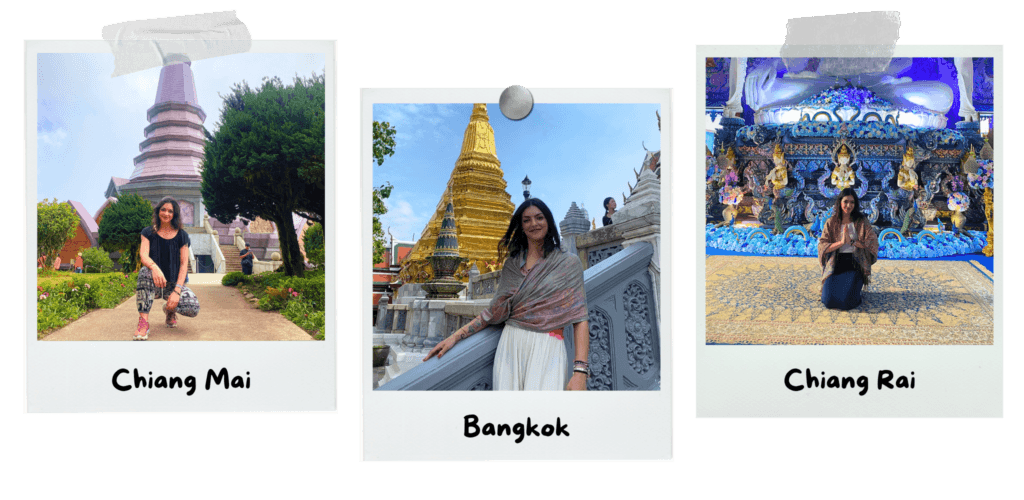
Click on the city names to view the full, detailed itinerary.
(work in progress!)
Chiang Rai.
Chiang Rai was my very first stop in Thailand. I landed in Bangkok Suvarnabhumi Airport, slept at a hostel nearby, and took an early afternoon flight to Chiang Rai the following day.
- Day 1: Arrival, Lalitta Café and Night Bazaar
- Day 2: Day trip to White and Blue Temples, Black House Museum, Golden Triangle
Chiang Mai.
I spent a few days in Chiang Mai before a week of volunteering at Elephant Nature Park, then returned for a couple more days afterwards.
- Day 3: Arrival, city temples and visit to Wat Phra That Doi Suthep
- Day 4: Buffalo Market (Saturdays only!), Wat Phra That Doi Kham
- Day 5: Day trip to Doi Inthanon National Park
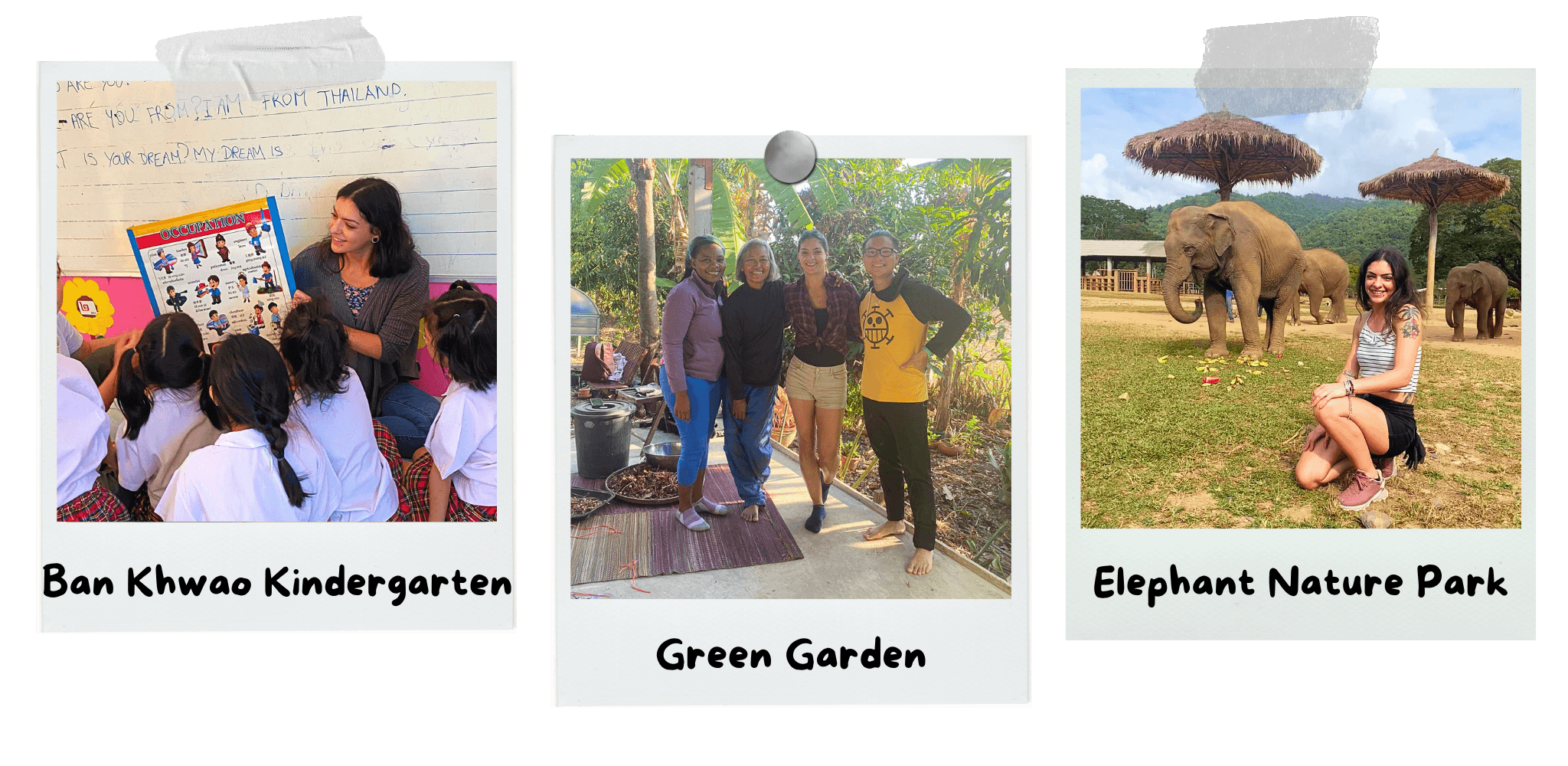
- Day 6-12: One week volunteering at Elephant Nature Park
- Day 13: Temple visits and a free afternoon in Chiang Mai
- Day 14: Thai cooking workshop, bus for Chaiyaphum
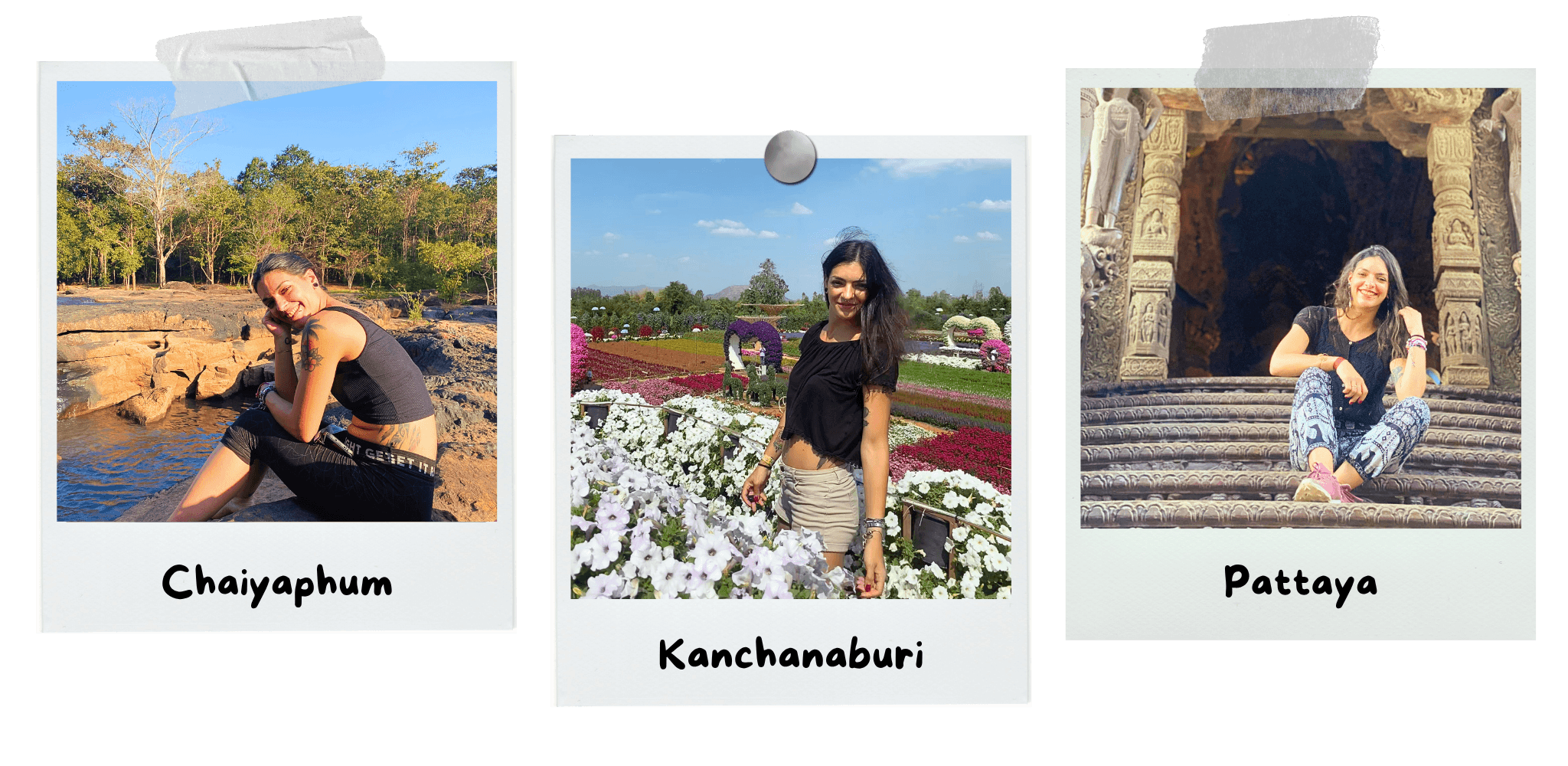
Chaiyaphum and Ban Khwao.
There isn’t much to do in Ban Khwao, a small, remote village in the province of Chaiyaphum and that’s precisely what made the experience so special. This is where I volunteered at a local kindergarten, teaching English to young children from Day 15 to Day 28. During the weekend, when the school was closed, I explored the surrounding area and the city of Chaiyaphum with a French couple who were also volunteering alongside me.
Bangkok and Pattaya.
I returned to Bangkok several times throughout this 2-month trip in Thailand, as it’s the main transport hub for connections elsewhere. Over Christmas, I spent three days in the Thai capital with a friend who flew in to celebrate with me and we spent a day exploring Pattaya.
- Day 29: Chinatown, Soi Cowboy (Christmas’s Eve)
- Day 30: Day trip to Pattaya
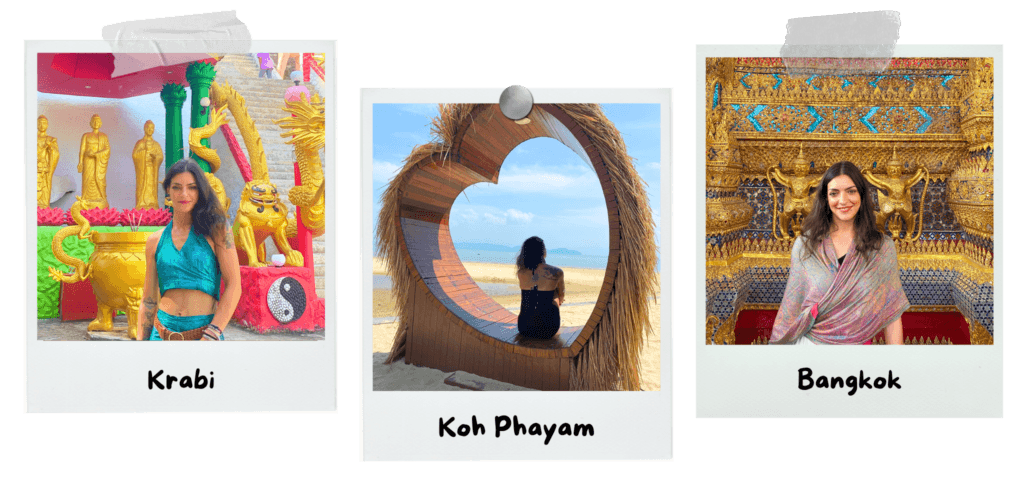
- Day 31: Grand Palace, Emerald Buddha, and Wat Arun
Koh Phangan.
Me and my friend travelled to Koh Phangan just in time for the famous Full Moon Party.
- Day 32: Full Moon Party
- Day 33: Relax at the Haad Rin Beach
- Day 34: Roseville viewpoint and Bottle Beach
Koh Phi Phi Island.
We crossed to Koh Phi Phi by overnight ferry from Koh Phangan and spent New Year’s Eve here.
- Day 35: Arrival, boat trip to Maya Bay
- Day 36: Pool Party and New Year’s Eve dinner
- Day 37: Loh Moo Dee Beach
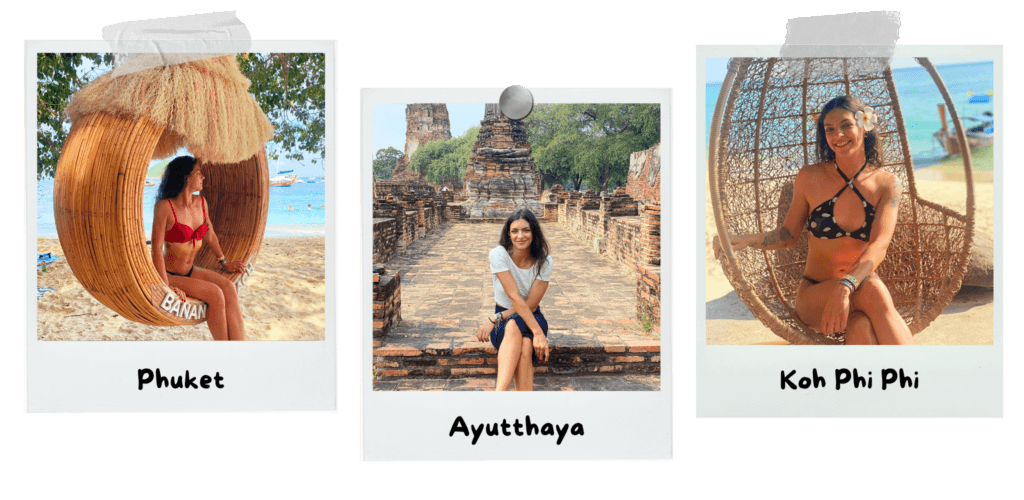
Phuket.
Phuket is Thailand’s largest island and one of its most visited destinations. This is where my friend and I went our separate ways.
- Day 38: Arrival, Patong Beach, night clubs
- Day 39: Big Buddha
- Day 40: Sightsee the city, then overnight bus to Bangkok
Buri Ram and back to Bangkok (plus Ayutthaya).
In this province in northeast Thailand, I completed my third volunteering project: six days working at Green Garden, a permaculture eco-farm in the Satuk District. I then returned to Bangkok for a couple more days to explore parts of the city I hadn’t yet seen and to visit also Ayutthaya.
- Day 41-45: Volunteering at Green Garden permaculture farm
- Day 46: King Power Mahanakhon observation deck and Bangkok sightseeing
- Day 47: Visit to Ayutthaya
- Day 48: Railway and Floating Market, Muay Thai lesson
Kanchanaburi.
After a wild Christmas time, six days in the garden, a brief return to Bangkok, and a rather unforgettable early-morning sacred tattoo experience, I gifted myself three days at a beautiful resort in Kanchanaburi. This is one of the least-touristed provinces in Thailand and one of the most surprising.
- Day 49: Sak Yant tattoo experience, and relax at the resort
- Day 50: Erawan National Park
- Day 51: Maple Garden
Koh Phayam.
After a long journey, I then arrived in one of the less touristic Thai islands with daily tides, wild beaches, and a wonderful laid-back atmosphere.
- Day 52: Arrival and beach day
- Day 53: Ao Kwang Pheeb Beach
Krabi.
When my last volunteering project was cancelled at short notice, I decided to simply relax in Krabi for my final week in Thailand, living day by day, with no schedule.
- Day 54: Arrive in Krabi, relax at the beach
- Day 55: Day trip to James Bond Island
- Day 56: Ao Nang Mountain Buddha Temple and relax at the beach
- Day 57: White-water rafting and ATV experience
- Day 58: Phra Nang Beach
- Day 59: Last day in Thailand
🗺️ My Map of Thailand.
💸 What’s the budget for 2 months in Thailand?
It depends. It depends on what kind of traveller you are and what sort of experience you’re looking for. Totally low-cost, luxury hotels, or a mix of indulgence and savings? It’s also worth considering eating habits, transport preferences, whether you rely on tour operators or plan everything yourself, plus the season and departure city.
Speaking from my own experience, I set off from Sofia, Bulgaria at the end of November 2023. To save on flights, I took a night train to Istanbul and flew via Muscat (adding a day’s stopover in Oman’s capital along the way). I tried to travel as low-cost as possible, relying on volunteering projects that covered accommodation and food for a significant portion of the trip. I stayed mainly in hostels, with two exceptions: once when my friend joined me for Christmas and New Year’s, and once in Kanchanaburi, where I treated myself to a proper resort stay.
Quantifying the exact total is tricky, because Thailand was just one chapter of a longer Southeast Asia journey. After leaving Krabi, I continued to Kuala Lumpur, Vietnam, Indonesia, and Singapore.
Below, you’ll find a summary of all my expenses split into main categories. Some costs (such as accommodation) are itemised, others (food, water, small purchases) are approximate. I’ve also included pre-departure expenses, namely items I needed to buy before leaving that were essential for the trip. For more guidance of what to bring during a trip, see my travel essentials series.
When selectable, click on the item, product or activity, to learn more or purchase.
💼 Pre-departure expenses = €725
- Probiotics, lactoferrin, vitamins, omega 3 = €86
- Medicines = €50
- Vaccines = €100
- First Aid Kit = €15
- Backpack = €100
- Organisers = €15
- Shoes = €86
- Towels = €23
- Clothes = €50
- Foldable Hair Dryer = €25
- Solid Shampoo and conditioner = €30
- 6 Menstrual Panties = €70
- Waterproof phone case = €25
- Powerbank = €25
- Tripod = €25
✈️ Flights (and train) = €1070
- Night train Sofia – Istanbul = €65
- Flight Istanbul – Muscat – Bangkok = €350
- Internal flight Bangkok – Chiang Rai = €40
- Internal flight Krabi – Kuala Lumpur = €65
- Return flight Singapore – Italy = €550
📑 Various bookings = €1645
- Insurance = €360
- Workaway subscription =€50
- Elephant Nature Park = € 310
- Visa and extension = €100
- Accommodation (hostels and affordable hotels) = €350
- Resort = €205
- Trains, coaches and ferries = €235
- Sim and eSIM = €35
🚕 Expenses during the trip = €760
- Grab (taxi and mototaxi) = €200
- Metro = €15
- Restaurants = €250
- 7/11 (water, snacks, cigarettes, various items) = €125
- Drinks, wine and coffee = €50
- Laundry = €30
- Post Office = €90
💅 Shopping, souvenirs and treatments = €380
- Shopping and souvenirs = €120
- Manicure and pedicure = €50
- Tattoo = €70
- Sak Yant Tattoo = €100
- Various Thai Massages = €40
🎭 Activities and tickets = €370
- Entrance tickets = €80
- Day trips and tours = €220
- Cooking workshop = €25
- Muay Thai lesson = €45
🔢 Total = approx. €5000
🎀 My Experience.
Two months in Thailand was, without a doubt, the most transformative chapter of my life so far. It wasn’t just a holiday, but a deliberate decision, one I’d been building towards for years.
The volunteering formed the backbone of the entire trip. Three projects across three very different environments: caring for rescued elephants in Chiang Mai, teaching English to kindergarten children in the remote village of Ban Khwao, and working on a permaculture eco-farm in Buri Ram. Each experience was humbling and rewarding.
The practical reality of travelling for two months through a tropical country as a Type 1 diabetic was something I had prepared carefully for and yet it still caught me off guard in unexpected moments. Heat and physical activity affect blood sugar in ways that are hard to predict. Street food stalls don’t come with nutritional labels. The language barrier posed a significant problem when I requested to store my insulin in the fridge and it was mistakenly placed in the freezer, resulting in a complete disaster.
The people I met shaped my entire experience. The whole group of volunteers and staff at the Elephant Nature Park were extraordinary. The French couple volunteering at the Ban Khwao kindergarden helped me immensely during those two weeks. The hospital nurses and doctors were well-prepared. Additionally, the owner at Green Garden is an exceptional hard-working woman. Even perfect strangers were unexpectedly kind and respectful.
The difficult parts were real, though. Overnight buses and fatigue. A heavy backpack to carry everywhere in the heat. A volunteering project cancelled at short notice. Missed buses and trains. Tight schedule. Days when managing blood sugar in extreme tropical heat felt exhausting. But those are also the moments I remember most vividly because they forced me to adapt, ask for help, and trust the journey.
Travelling solo in Thailand as a woman never felt unsafe or alone. Quite the opposite: I felt seen, helped, and welcomed.
💡 Travel Tips.
📄 Documents and Visa.
At the time (2023), as an Italian citizen, I was allowed to enter Thailand visa-free for stays of up to 30 days for tourism, business, family visits, or transit. Only a passport with at least six months’ validity was required.
As I was planning to stay for two months, I needed to apply for a visa. Since I was living in Bulgaria at the time, I applied through the Thai Embassy in Romania but it was denied. At my own risk, I decided to travel anyway and request an extension once inside the country.
Currently, depending on your passport, you are permitted to stay in the Kingdom of Thailand for up to 60 days. Please note that you must submit your Thailand Digital Arrival Card (TDAC) online within 72 hours of your scheduled arrival.
Should you wish to extend your stay, you will need to visit the local immigration office with the following documents:
- Original Passport. Valid for at least 6 months.
- Passport Photocopies. Copies of the bio-data page, current visa stamp, and your departure card (if applicable).
- Application Form TM.7. This is an “Extension of Temporary Stay in the Kingdom” form that you collect and fill there.
- Your Photo. One recent, 4×6 cm passport-sized photo.
- Proof of Address (TM.30). a rental agreement, hotel booking, or TM.30 receipt from your accommodation. I requested mine at my hostel.
- Extension Fee. THB 1,900 in cash (approx. €50)
Never let your visa expire. Overstaying is a serious offence in Thailand. Fines are THB 500 per day, up to a maximum of THB 20,000, and repeat violations can result in deportation and future entry bans.
Always check the official guidance and consult your Embassy before travelling to confirm current rules.
🏥 Health and Travel Insurance.
For travel insurance, I chose True Traveller because, at the time, it was one of the only policies that allowed me to declare a chronic condition, even though with a few limitations. Having insurance that actually covers your condition isn’t a nice-to-have, it’s vital!
However, if I were going now, I would choose a different travel insurance that covers my Type 1 Diabetes fully. Depending on where you’re from and your residency, you’ll have a few options available which I’ve researched in detail in my article 5 Insurance Policies for Travelling with Type 1 Diabetes.
As this was my first trip to Asia, I got vaccinated under medical advice for: meningococcal disease, tetanus, hepatitis A and B. Contact your local travel medicine centre in advance for further information, as some vaccines require multiple doses.
I also packed essential medicines, painkillers, and antibiotics. One week before departure, I started taking daily probiotics and vitamins to help my body adapt to climate and dietary changes. I continued this routine throughout the trip and even after returning home. You can find the complete list of probiotics and medications in my Travel Essentials: Medicines and Supplements post.
I didn’t experience any stomach problems during my three months in Asia, but I made sure not to have drinks with ice or tap water, and I didn’t eat raw vegetables or fruit with the skin on.
Finally, I always carry a reliable mosquito repellent. Thailand is lush and green: parks, forests, jungles, and rice paddies surround many points of interest. It is important to protect yourself from insect bites.
🏨 Where to Stay in Thailand.
Hostels and backpacker culture are a proper philosophy in Thailand and across Southeast Asia. I loved every hostel I stayed in: all affordable, clean, and with a warm community feel. I generally budgeted between €8 to maximum €15 per night to avoid the very cheapest end, but if you’re comfortable with basics, you can absolutely find dorms for €3-€4 per night!
For booking accommodation in Thailand, the best platforms are Booking.com and Trip.com for hotels and hostels, and Agoda for more luxury stays and resorts.
🔽 Ready to book? You can search for your next resort directly in the bar below! 🔽
📱 Internet and Must‑Have Apps.
I bought a local SIM card as soon as I landed. There are kiosks right in the arrivals hall at Bangkok’s Suvarnabhumi Airport. However, my strong recommendation is to avoid this and instead purchase a practical eSIM before you leave home. It’s cheaper, faster to set up, and you can activate it before you even board your flight.
🔽 You can search for your next destination and purchase your eSIM directly in the search bar below! 🔽
The only app I used in Thailand was Grab, for taxis, motorbike taxis, and occasionally food delivery. It works across all of Southeast Asia, including Malaysia, Vietnam, and Indonesia.
I didn’t use it at the time, but I’d advise you to keep an eye on Thailand’s official weather forecast website and download its weather and earthquake apps.
🎫 Where to Buy Tickets and Book Day Trips.
You can buy tickets for palaces, museums, temples and attractions either on the spot or via travel platforms. For tours and day trips, you can either book at local stalls and try to negotiate the price, or take advantage of popular third-party websites:
- TripAdvisor: Ideal for day trips and tours
- GetYourGuide: Offers an excellent selection of activities and workshops
- Klook: Great for entrance tickets, transport and tours; very popular in Asia
🎁 Subscribe via Klook.com to receive €5 off your next booking 🎁
Klook.com🚋 Getting Around.
I walked a lot but I also frequently used taxi and motorbike taxis via Grab. A word of warning: many drivers do not provide helmets as standard so you need to ask. Grab taxis are cheap, convenient, and available almost everywhere in Thailand.
In Bangkok, the BTS Skytrain and MRT metro are easy to navigate and very affordable. You can buy tickets directly at the station withouth any apps.
If you want to use minibuses, particularly in rural areas, bear in mind that neither the routes nor the timetables are shown on Google Maps. You pay for the journey in cash, and you’ll need to ask locals or the driver for information about your destination and let them know where you want to get off.
In case you want a ride on a tuk-tuk you must pay in cash and need to negotiate route and price directly with the driver.
For long-distance travel between cities, or island-hopping by sea I relied exclusively on 12Go Asia. It’s reliable, safe, and you can book trains, coaches, night buses, ferries, and combinations of multiple transport types in a single booking.
🔽 Ready to travel? You can search for your next train or ferry directly in the bar below! 🔽
🏍️ Renting a Motorbike.
Unless you’re an experienced rider, please don’t. I know the temptation is enormous: everyone wants to feel free and live the adventure. But if you’ve never ridden a scooter before, please resist. You can hurt yourself and put others in danger. Traffic in Bangkok and other cities is extreme, chaotic, and utterly unpredictable. Thai people, it’s said, learn to ride a scooter before they learn to walk.
Anyway, if you do decide to rent a motorbike, here is the minimum you should do:
- Get an International Driving Permit. This is a translation of your driving licence that allows you to drive legally in countries that follow the relevant convention. I obtained the Geneva Convention version (one year’s validity) from my driving school, for around €80.
- Have comprehensive travel insurance that explicitly covers motorbike accidents.
- Always wear a helmet. Non-negotiable.
- Ride alone. Don’t carry passengers and avoid heavy luggage.
- Start somewhere quiet. Short distances, uncrowded roads, maybe in a small island, not in the city.
Honestly, I had never ridden a motorbike before. In Ban Khwao, the French couple I volunteered with taught me the absolute basics (how to start, stop, and accelerate) around the small pond close to our accommodation. In Koh Phayam, a small, quiet island with easy roads, I rented a scooter for a day and rode 15 km to a beach and back. I drove slowly, carefully, and with the adrenaline very much in check. It was enough of an adventure for someone with zero prior experience.
💳 Payments and Currency.
€1 corresponds to approximately 38 Thai Baht (THB) and cash is much preferred for most transactions.
Avoid withdrawing too frequently, as ATM fees and conversion charges add up. I used Revolut throughout the entire trip without any issues. It’s excellent for tracking spending by location and minimising unnecessary fees, still conversion changes were around €2,50!
🌞 When to go to Thailand.
The best overall time to visit Thailand is during the cool and dry season, from November to February. The weather is sunny, less humid, and much more comfortable for sightseeing. However, this is peak season, so expect higher prices and larger crowds at popular sites.
Nevertheless, the ideal timing varies significantly by region:
- Bangkok and Central Thailand: November to February for cooler, breezy days ideal for exploring. April is the hottest month (often exceeding 40°C). May to October brings the monsoon.
- Northern Thailand (Chiang Mai and Chiang Rai): November to February are best. Avoid February to April if possible cause this is the region’s “burning season”, when agricultural fires cause heavy smoke and seriously poor air quality.
- The Andaman Coast (Phuket, Krabi, Koh Phi Phi): Best from November to April, with calm seas perfect for diving and island-hopping. Monsoon runs from May to October, with rough seas.
- The Gulf of Thailand (Koh Samui, Koh Phangan, Koh Tao): A different weather pattern here. Best months are January to March and July to September. Avoid October and November since these are the wettest months on this side of the peninsula.
🚔 Safety.
I have never felt as safe anywhere as I felt in Thailand. The country is genuinely welcoming, people are helpful and respectful, and solo female travel here is very manageable. Of course, this is my personal experience and I can’t speak for an entire country, but Thailand is, in my view, an excellent destination for women travelling alone.
As always, common sense applies: don’t walk alone in unlit areas late at night, keep an eye on your drink on party islands, and choose accommodation with good reviews.
⛔ Things to Avoid.
Drugs.
Thailand has some of the world’s strictest drug laws. Penalties include lengthy prison sentences and, in the most serious cases, the death penalty.
However, you will find a lot of cannabis shops that sell joints, weed, and even cookies and space cakes. You can only buy cannabis from licensed dispensaries, and you are legally required to have a consultation and medical prescription from a certified practitioner. Remember that smoking or vaping cannabis in public is illegal and carries heavy fines.
Moreover, on some tourist islands like Koh Phangan, Koh Samui, Koh Phi Phi and surely others, you will also find stalls that sell mushrooms (yes, magic mushrooms!). They are completely illegal for recreational use, sale, or possession. The police often turn a blind eye in certain tourist enclaves, but this is selective enforcement, not legality.
The Monarchy.
Thailand’s lèse-majesté laws are severe. Never speak negatively about the royal family, in public, online, or to strangers. This applies to tourists too.
Buddhist Temples.
Dress modestly (covered shoulders and knees) when visiting temples and royal buildings. Remove your shoes before entering. As a women, you should never touch or hand anything directly to a monk.
Buddha images.
These are sacred objects, not decorations or photo props. Treat them with respect.
Furthermore, having a Buddha tattoo is considered highly disrespectful. If you have one, you need to cover it completely and avoid showing it in public spaces at all costs!
✅ Pros and Cons.
| Pros | Cons |
|---|---|
| Very affordable day-to-day costs | Pricey tickets and entrances |
| Excellent transport connections | Overcrowded at peak season |
| Amazing food | Too many foreigners and tourists |
| Extraordinary places | Long distances |
| Kind and welcoming people | Intense heat and humidity |
| Safe (even for women) | Linguistic barrier outside tourist areas |
| Thriving hostel and backpacker culture | Poverty, exploitation and prostitution in some areas |
❓ FAQ.
EU citizens can enter Thailand visa-free for tourism stays of up to 60 days, with a valid passport (minimum 6 months’ validity) but need to request TDAC online within 72 hours of your scheduled arrival date in Thailand. Always verify current rules with the Thai Embassy in your country before you travel.
Yes. Thailand is one of the safest countries I have visited as a solo woman. People are generally kind, respectful, and willing to help. That said, standard precautions apply: avoid isolated areas after dark, keep an eye on your drink on party islands, and book accommodation with strong reviews.
Impossible to say. However, for temples and culture, head north to Chiang Mai and Chiang Rai. For stunning beaches, the Andaman Coast and the Gulf of Thailand are both exceptional. Bangkok is a must-see stop here. For a more authentic experience, any remote village will give you a taste of genuine Thai culture.
The best overall time is the cool and dry season from November to February: sunny, less humid, and comfortable for exploring.
The budget varies greatly depending on your travel style. Generally, for backpackers, it’s around €30-50 a day (hostel, street food, local transport, a few activities).
🎈 Conclusion.
59 days exactly. More of a dozen destinations. Three volunteer projects. One Full Moon Party and one New Year’s Eve at the beach. A week with elephants. Two tattoos. A 3-month insulin supply destroyed. A lot of heat, a lot of insects, and uncountable pad thai.
Thailand has this extraordinary quality: it lets you be whatever kind of traveller you want to be. For me, it was the first chapter of a longer journey through Southeast Asia. On 27 January 2024, I boarded a flight from Krabi to Kuala Lumpur, and the adventure continued. But Thailand was the one that started everything and proved to me that long-term solo travel, as a woman, with a chronic illness, is not just possible: it’s extraordinary.
If you’ve been dreaming about a trip like this, especially solo and while managing a health condition, I hope this post gives you not just an itinerary, but the inspiration and the push to start planning. If you love this kind of articles where I share my long-term travel adventures, personal experiences and detailed itineraries, don’t miss my posts 4 Months in Canada and 1 Month in China.
💬 And you? Have you been to Thailand or are you planning a long trip here in the Land of Smiles? Let me know in the comments!
☕ Did you find this post helpful? If you’d like, you can support my blog by treating me to a virtual coffee!

Are you dreaming of your next trip but not sure where to start?
Book a 1:1 travel consultation or request a personalised itinerary and I will design the trip of your dreams!
✨Click the button below for my Travel Services✨
