


Last Updated on September 11, 2026 by Nadia Halfway
📜 Introduction.
After volunteering for one week at Elephant Nature Park and spending a couple of days back in Chiang Mai, I embarked on a new adventure in Ban Khwao.
As I wanted my journey in Thailand to be meaningful and useful, I applied via Workaway (a popular work exhange platform) to teach English in schools and kindergartens as a volunteer. This is how I ended up in Ban Khwao, a remote Thai village in Chaiyaphum Province, not very far from Bangkok, but quite difficult to reach, especially from Northern Thailand.
In this post, I want to share with you my experience of volunteering for two weeks in rural Thailand and how I spent the day between classes. What’s more, in case you do decide to pop over, here are some places to visit in Ban Khwao, where to eat, where to stay and, most importantly, how to get to this village.
⚠️Disclaimer: Some of the websites below are affiliate links or require a promo code for receiving a discount. If you book through them or use my personal promo code at the time of subscription or reservation, I’ll earn a small commission (at no extra cost to you), and you’ll get a discount or a special promotion too. It’s a win–win!
Please be aware that affiliate links may expire and promo codes may reach their usage limit. If you find that a link or code no longer works, kindly let me know. I’ll be happy to share an updated one (if available) directly with you.
📍 Where is Ban Khwao and How to Get There?
Ban Khwao was founded around 300 years ago and recently gained the status of Amphoe (a small district) in Chaiyaphum Province. It is located in the heart of Isan, northeastern Thailand.
It’s a quiet, rural part of the country, best known for its traditional silk weaving and close-knit local communities. Ban Khwao is particularly famous for mudmee silk, a traditional tie-dye weaving technique passed down through generations.
Getting to Ban Khwao there was part of the adventure. As I mentioned in my Chiang Mai post, I missed my bus because my tattoo appointment ran over. This meant scrambling for the next departure and arriving a few hours later than planned, in the middle of the night. I was proud of myself: I didn’t panic or cry. I went to the station anyway asking for the next bus to my destination and that’s it!
From Chiang Mai, Ban Khwao is roughly 700 km away. I had to take a bus from Chiang Mai to Chaiyaphum, where I spent the night and, the next morning, the staff of the school where I was about to volunteer picked me up by car.
From Bangkok, it is roughly 320 km away. The easiest option is to take a bus from Mo Chit Bus Terminal to Chaiyaphum. The journey takes around five hours and from there, you can continue by Grab taxi or local transport.
🏡 My Accommodation.
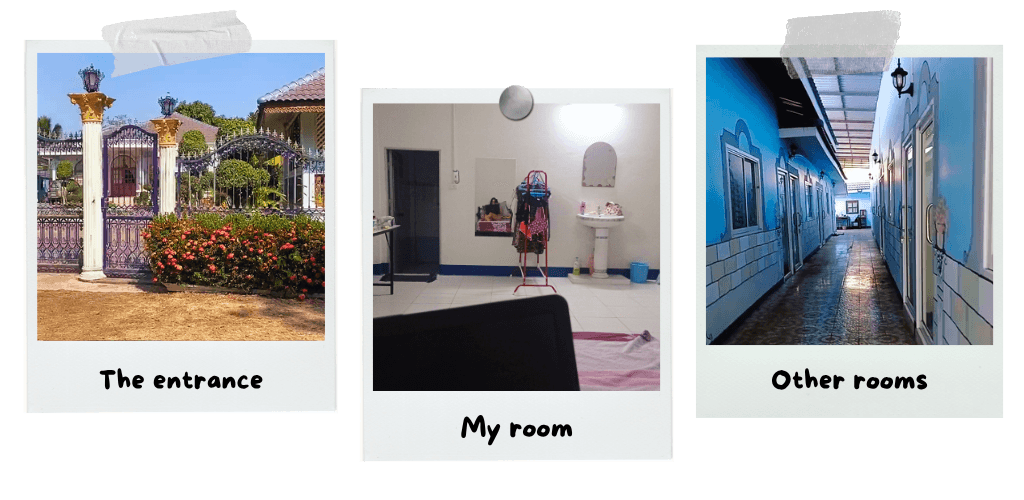
For my entire volunteer stay, I was hosted at one of the teachers’ homes. I was impressed, as she lived in a large villa overlooking a tranquil pond. It was about a 15-minute walk from the school and 20 minutes from the town centre where shops, 7-Elevens and markets are located.
Past the gate, there was a big garden with the teacher’s main villa. On the left, there was a row of small outbuildings with a lot of guest rooms. I had my own room, and it was bigger than expected with a private bathroom, an ensuite sink, two single beds and a large sofa. The French couple who volunteered with me shared another room right across from mine but with the external toilet.
We were also given a motorbike to get to school and around the village. I can’t ride one, so Jonathan, the guy in the couple, drove us everywhere, even to Chaiyaphum. Yes, three people on one motorbike and no helmets. Well… no type-approved helmets.
🏫 The School.
The kindergarten where I volunteered was a private school called โรงเรียนอนุบาลหลวงภักดี. The head teacher had the idea of teaching basic English through volunteering programmes like Workaway. As Thailand is a developing country that relies heavily on tourism, learning English can open important doors. This is especially true for children living outside Bangkok and other major tourist destinations.
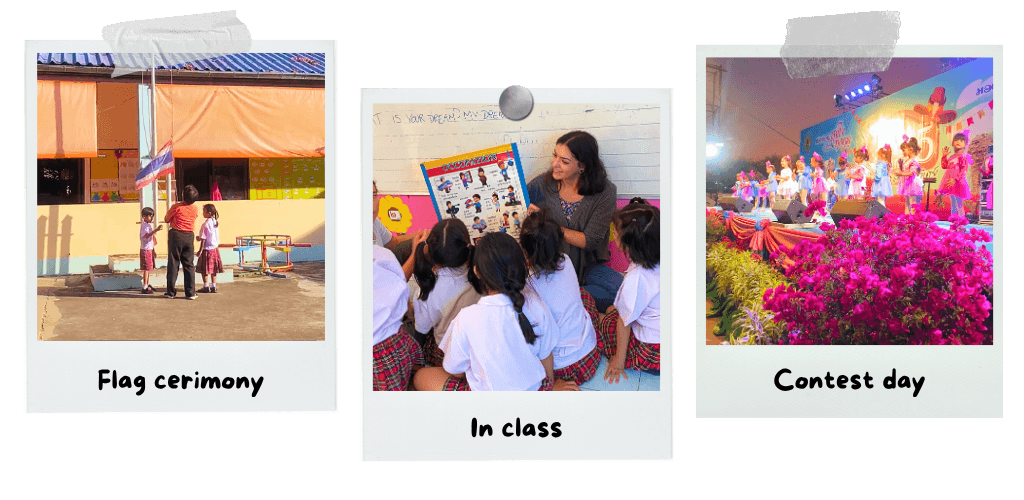
The school had a large garden and a fairly big teachers’ room where we spent most of our free time. There were several classrooms and an open-plan canteen. Classes started at 8 AM, and the children were dropped off by their parents quite punctually.
The morning always began with a Thai kingdom celebration: the children raised the flag as a daily ceremony while singing the National Anthem, followed by exercises and dancing. The dancing was particularly important, as Christmas was approaching and they were training for a contest in Chaiyaphum.
🐥 The Kids.
Being so involved within the kindergarten gave me the chance to witness first-hand how the educational system works outside Italy (and outside Western countries in general). It also made me realise how different childhood can look across cultures and especially how the strict education shape Asian kids in, allow me to say, better way.
The first thing I noticed was that children are still slapped by their teachers. This was probably the biggest cultural shock for me. At times it was hard to watch, but I was aware that discipline can be approached in very different ways depending on the culture, and that it was not for me to judge teaching methods.
Nevertheless, Thai children very polite and well mannered compared to many Italian children. Even when they played, they were calm, respectful and obedient. There were no crazy tantrums, crying or screaming. Children are taught to obey, greet people, respect their elders and always say thank you.
On most days, all the pupils wore their school uniforms: they had different colours depending on the day of the week, and on more than one occasion they wore a traditional outfit, as you can see in some photos throughout this post. The girls arrived with their hair perfectly combed and styled in plaits and ponytails. They looked incredibly tidy and well cared for.
📚 In the Classroom.
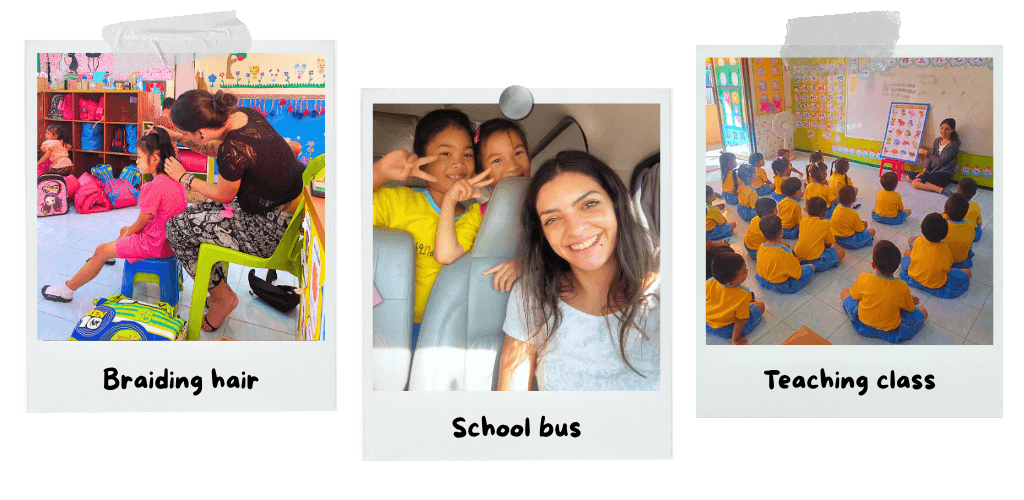
I started alone and taught by myself for two days before a lovely French couple joined: Jo and Jonathan. From then on, the three of us led the classes together, and I was genuinely glad they were there, since I don’t have much experience with young children. Jonathan, however, was a trained educator.
We were given posters featuring animals, colours, jobs and everyday objects. So, our task was mainly to teach the children how to pronounce these words and have very basic conversations. Sometimes we also sang songs or played more active games like Simon Says. However, communication was challenging because almost nobody spoke English, including the other teachers. The school principal was the only exception so with the others, we used Google Translate to explain an activity. Some classes were made up of tiny toddlers, just two or three years old that barely speak Thai.
We had two classes each morning until around 11:30 AM. After that, the children had lunch and were put down for a nap on small futon mats on the floor. When they woke up, they folded their futons and washed their faces by themselves. Jo and I would usually braid the girls’ hair. It is almost an unwritten rule to send the children home looking just as clean and tidy as when they arrived in the morning. I was amazed by how still these little girls sat. At the same time, I was terrified of hurting them or pulling their hair too hard. The boys were a little more lively but Jonathan usually kept them entertained while Jo and I brushed the girls’ hair. Afterwards, the girls thanked us and bowed to show their respect and gratitude.
🌅 Life Between Classes.
After class, once the children had woken from their nap, we were usually free by 2 or 2:30 PM.
Sometimes, we joined the school driver to drop the children home. Despite this being a private kindergarten and presumably quite expensive to enrol a child in, their houses were very simple. Even when parents arrived well dressed or with the latest iPhone, their homes were humble, and some looked almost like huts. Doors were sometimes open, so I could see inside there were no separate rooms and mattresses on the floor. Gardens were often made of mud rather than plants.
Seeing this contrast was one of the moments that stayed with me the most. I won’t say “they are poor but happier than us” the way people often say about children in poorer communities especially in Africa. Genuinely I don’t know how difficult their lives were, or whether living simply without our comforts is better or worse.
My days in Ban Khwao were extraordinarily peaceful. There was no rush and no packed itinerary to follow. We spent time by the small lake, drinking a beer and watching life go by. We wandered through the market and the Night Bazaar or explored the surrounding temples and discovered every corner of the village. I even found a small beauty salon and had my nails done. I also tried riding a motorbike for the first time. We weren’t driven by the oppressive FOMO to do something; it was all a sense of peace.
For the first weekend, I had planned to go to Ubon Ratchathani. However, a rather serious accident completely changed my plans and everything that followed.
💉 Frozen Insulin.
Long story short as I’ve already touched this topic on other posts especially the one related to my mishaps travelling with diabetes: the school staff put my entire six-month insulin supply in the freezer rather than the fridge, destroying it completely.
I had explicitly asked for my bag to be kept refrigerated at the accommodation. Instead, it was moved to the school fridge without even telling me and I only found out what had happened when one of my pens had run out and I needed to get a new one. When I asked for my bag, they took me to school.
Nobody there seemed to understand the seriousness of what had happened. What I believe was the teacher’s husband laughed while I stood there crying in front of a bag of frozen insulin. I understand language barriers and cultural differences, but that is not the appropriate response to a medical emergency. The teacher responsible stopped showing up for the rest of my stay (even if I was literally living in their house). The school principal accused me of not being clear with my instructions when I had been explicit to her, as it was her who then gave my bag to this other person.
The French couple drove me to every pharmacy in Ban Khwao and then in Chaiyaphum that same afternoon. Sadly, no pharmacy would sell insulin without a prescription so we had to go to hospital and purchase emergency pens (at an expensive price).
🧾 A Complete Lack of Empathy and Responsibility.
The Workaway platform support was completely useless. Despite their policy stating they intervene when a volunteer’s life is at risk, all they offered was a €50 refund on my subscription. Nothing compared to the damage, the stress, and the fear. If damaging life-saving medication is not considered a threat to someone’s life, I don’t know what is.
My diabetologist back home was no better. Her solution was to go home and cancel the rest of the jourmey. If you’ve read pieces of my story, she was the same doctor who once told me that diabetes is a limitation and I shouldn’t have applied for a scholarship in Canada.
Healthcare for Italians Abroad was equally useless. This is the institution theoretically there to help Italians in exactly this kind of situation. They claimed it wasn’t their concern and provided no guidance whatsoever on how to navigate the urgency without breaking the bank.
After buying some emergency pens at the hospital, me and the French couple spent that weekend in Chaiyaphum. Once back in Ban Khwao on monday, I insisted the school principal to take me back to Chaiyaphum hospital to buy the rest of what I needed to cover the rest of my journey since they had destroyed six months’ worth (both Humalog and Lantus). She agreed and brought me with her daughter, who was one of the only people, besides the French couple, who genuinely understood the gravity of the situation.
My travel insurance agreed to assist me. However, they did not cover it as a medical expense. Instead, they treated it as compensation for damaged goods. They requested a signed statement from the school admitting their mistake. I was eventually reimbursed, minus the excess.
💔 What Stayed With Me.
I won’t pretend this didn’t affect the rest of my stay and my mood. I spent the remaining days looking forward to leaving, but I stayed for the children and because, in any case, everything was already planned.
What hurt most was that nobody ever apologised. Nobody acknowledged the danger they had put me in. Nobody took responsibility for what had happened. And nobody, except for Jo and Jonathan helped me and comforted me.
If I had the awareness I have now, I would have taken formal action. I would have reported both Workaway and the Italian institution and I would have made the whole story public. It seems that only things that go viral make people pay attention.
The following weekend, we went back to Chaiyaphum for the children’s dance contest. My two weeks were also coming to an end and from there, I headed to Bangkok to meet a friend for Christmas and spend a long week together for the holidays.
Despite everything, the experience gave me something I would not trade. Spending time with Thai children was incredibly meaningful and so was experiencing life in a genuinely local community. Without question, it was one of the most valuable things I have ever done.
🗺️ What to see in Ban Khwao?
I’m not going to lie: there isn’t much to see in Ban Khwao. If you’re looking for parties, spectacular trekking landscapes or huge markets, you won’t find them here or anywhere that hasn’t been taken over by overtourism.
What you will find is calm village life: small temples, essential shops, a good Night Bazaar, local restaurants and a peaceful pond. Most importantly, there is a genuinely welcoming community.
For those seeking a quiet experience and real immersion in Thai culture, Ban Khwao is the ideal place and also has a few spots well worth exploring.
The Pond.
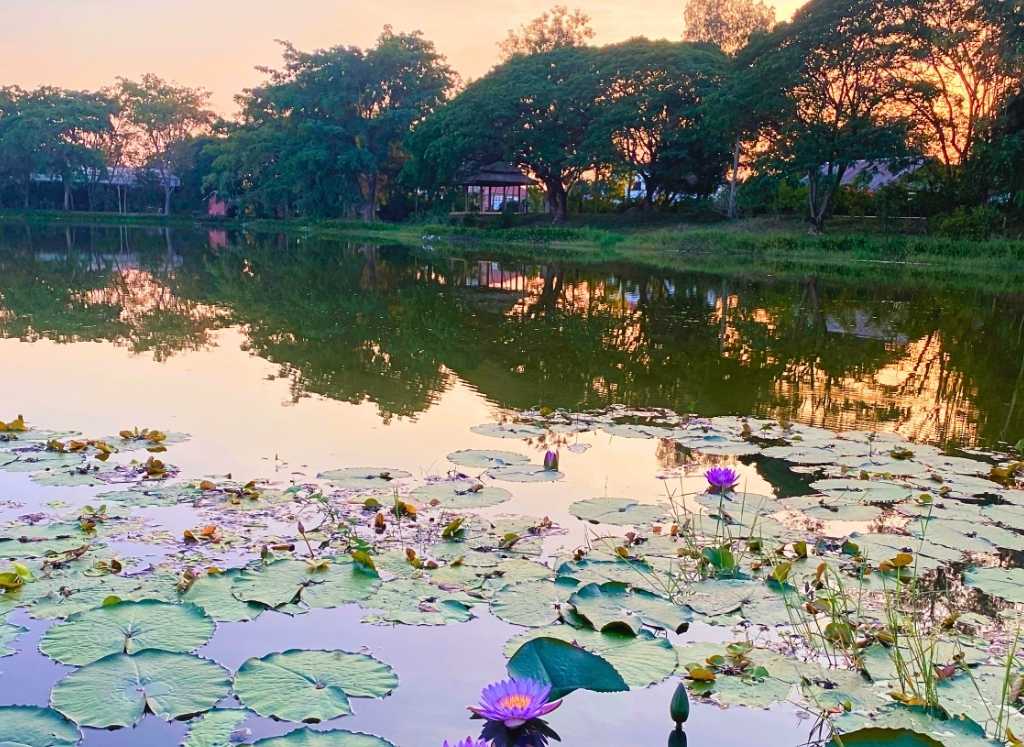
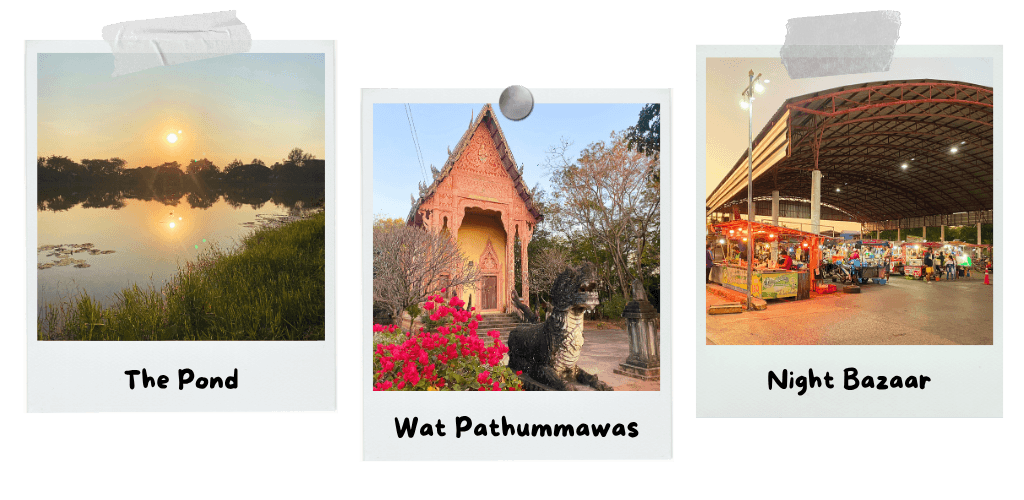
There are no proper public parks in Ban Khwao. This small lake serves as the village’s natural outdoor gathering space. A few benches line the edge, where locals come to walk, sit and slow down.
At sunrise and sunset, the pond is genuinely beautiful. If you’re lucky, you might spot lotus flowers scattered across the surface. We spent quite a few evenings here with a beer, doing nothing in particular to just enjoy the calm.
The Temples.
There are several Buddhist temples in Ban Khwao, including Wat Pathummawas, Wat Charoen Phon and Wat Sala Loi. The first has a charming pink chedi beautifully decorated which is worth a short stop.
What makes visiting temples in a village like Ban Khwao different is the complete absence of crowds. These are working temples, visited by local residents rather than tour groups.
If you arrive early in the morning, you might see monks receiving alms. Dress modestly, with your shoulders and knees covered, and move quietly. People will be friendly and occasionally curious and some might even be keen to practise a few words of English with you.
The Night Bazaar.
The Night Bazaar is the main gathering point in Ban Khwao. Locals come here to chat, stroll, eat street food or simply hang out. It isn’t a large market, but it has an authentic atmosphere that tourist-facing night markets struggle to replicate.
You’ll find classic street food such as pad Thai, grilled snacks, shakes, rice dishes, noodles and soups. If you’re feeling adventurous, you might even find grilled rat. Just to be clear, Thai people don’t eat urban rats. but rice field rats, known as Noo Na in Thai. These live in agricultural areas and feed on rice seeds, grains and insects. They are considered clean, healthy and perfectly safe to eat. In case you are wondering, I haven’t tried it, and probably never will.
The Silk Street.
Ban Khwao is known throughout the region for its silk, and Road 3002, a long street dotted with silk production centres, tailors, and clothing shops, is the place to see it. The area is home to the Ban Khwao Silk Centre, a well-known production hub specialising in high-quality mudmee silk.
Mudmee is a traditional tie-dye weaving technique: threads are bound and dyed before weaving, creating intricate geometric patterns in deep, rich colours. Watching it being made on a traditional loom is genuinely fascinating. Many of the shops along the street are family-run operations where the same women who weave the fabric also sell it directly.
It’s worth a browse even if you’re not planning to buy. If you are, the silk quality is excellent and prices are very reasonable by any standard (and cheaper than Hoi An in Vietnam). With a little time and communication, you might even manage to have a piece made to measure.
Market, Shops and 7-Eleven.
Beyond the Night Bazaar and the further Night Market (which sells crafts alongside food stalls), there’s also a classic local market selling fresh fruit, vegetables, meat, fish, and other produce. It’s right in front of one of the two 7-Elevens in town.
The 7-Eleven barely needs an introduction. It’s practically an institution in Thailand and a proper tourist attraction across all of Southeast Asia. You can literally find everything here: ready-to-eat meals, fresh fruit, water, alcohol, snacks, hygiene products, cigarettes. You can even buy an eSIM there. In a small village like Ban Khwao, it’s also the most reliable place to stock up on anything you’ve forgotten.
In the village, you can also find a beauty salon (ละออตา), a tattoo shop (ร้านสัก ช่างต้อ ชัยภูมิ รับสักลาย) and an optician (ปัณณ์วลีการแว่น).
🛏️ Where to Stay in Ban Khwao.
There are neither hotels nor hostels in Ban Khwao, or at least, you won’t find them on popular booking platforms, not even on Agoda, which is hugely popular in Southeast Asia. Instead, you can find a few guest houses on Google Maps, but you mostly need to contact the property directly via email, LINE (Thailand’s go-to messaging app, similar to WhatsApp), or Facebook (if they have a page).
Your best bet is to stay in Chaiyaphum, which is a larger city with plenty of good hotel options. I stayed at HOP INN Chaiyaphum for a night at €20, but the school staff had to pick me up because it is 25 km from Ban Khwao.
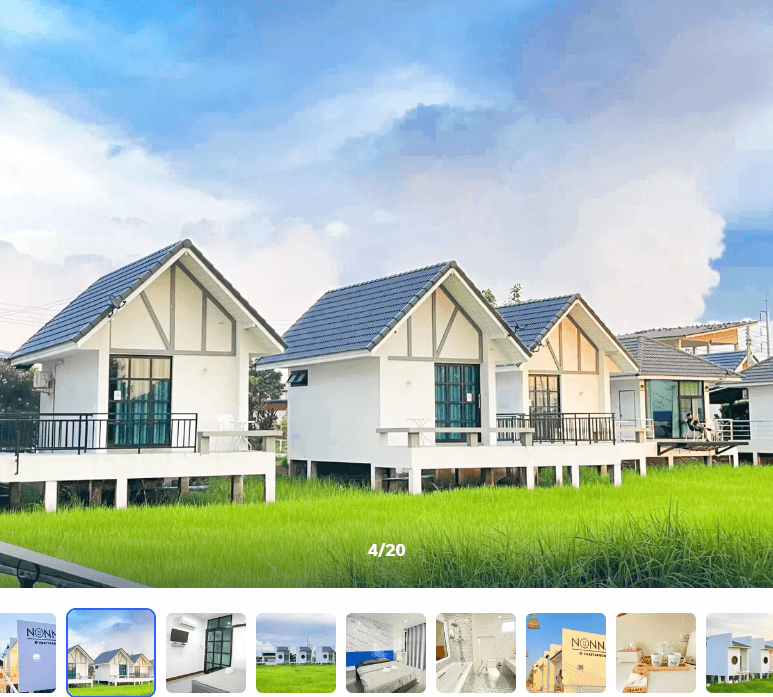
Alternatively, I found a cute place with bungalows called Nonna Resort, located 17 km from the town. I don’t usually recommend accommodation I haven’t stayed at myself, but it has a 4.5-star rating on Google Maps with lots of positive reviews mentioning that the bungalows overlook rice fields and includes breakfast. You can search for it using its Thai name: นอนนา รีสอร์ท@โรงเเรม ที่พัก ชัยภูมิ
💰 Price: starting from €35 per night
🎁 Use the referral code below or register via Trip.com to unlock your €10 discount 🎁
U51IZ5
🍜 What to Eat in Ban Khwao.
In Ban Khwao, I had the lucky chance to eat real traditional Thai food. The head teacher provided us with lunch and dinner from Monday to Friday and regularly took us to local shops and small family-run restaurants.
If you happen to be in Ban Khwao, here are the most memorable places I tried. To make them easy to find, I’ve given each a descriptive name alongside its Thai name. You can click on any of them to go directly to their Google Maps location.
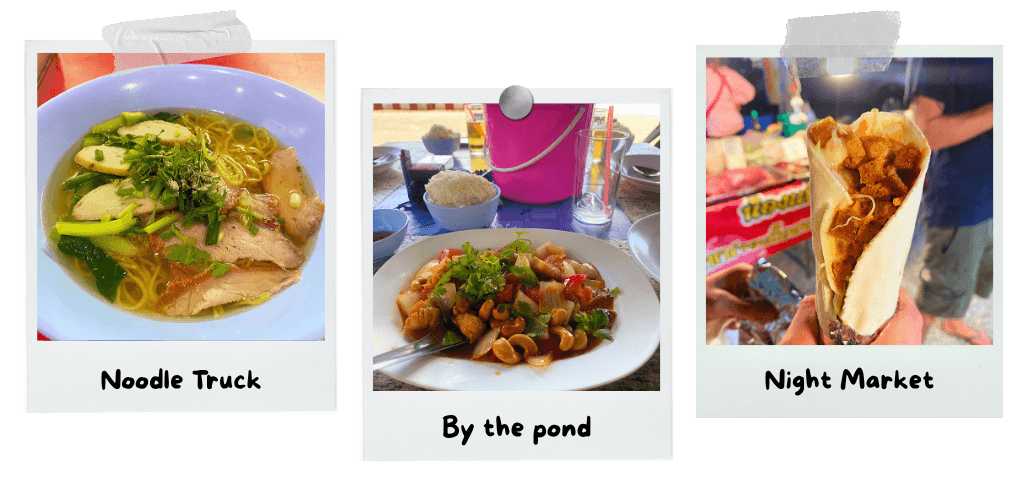
- Noodle Truck / บะหมี่เกี้ยวเฮียลิ้ม (ตลาดเช้าบ้านเขว้า). She brought us here at least three times a week. It’s a small food truck run by an elderly woman, right in front of the 7-Eleven. Behind the truck, there’s a tiny dining room where locals sit down for lunch.
- By the Pond / Rim Bueng Restaurant (ร้านอาหารริมบึง). This restaurant was right next to our accommodation. The chicken with cashew nuts was one of the best dishes I tried in all of Thailand.
- Town Centre / ก๋วยเตี๋ยวต้มยำแม่มาศ. Looks basic and sketchy from the outside but the food was delicious and the atmosphere genuinely welcoming
- Night Bazaar / ตลาดเทศบาลบ้านเขว้า. We ate here several times, mostly for trying typical street food or for having a snack when we were still hungry.
- Night Market / ตลาดนัดบ้านเขว้า. We went here only once because there was an event of “food around the world”. It’s bigger than the Night Bazaar and a bit far away from the town centre, full of food stalls and local crafts.
- Baan Mulan Cafe / บ้านมู่หลานคาเฟ่. There are a few small cafés but this is probably the best in the area. You can find classic espresso and cappuccino but also flavoured lattes.
💡 Travel Tips.
Safety.
Ban Khwao is a quiet and safe village. Although the community is somewhat used to foreigners thanks to Workaway volunteers at the school, it is still wise to stay aware and use common sense.
Getting Around.
Transport can be a real challenge in Ban Khwao. You can find taxis and book a Grab in Chaiyaphum, but local taxis within the village itself are hard to come by. If you’re lucky, you might spot a songthaew and negotiate a fare back to Chaiyaphum. Otherwise, try to arrange a private driver through your accommodation in advance.
Within the village, you can easily get around on foot. If you find a rental shop, a motorbike is a practical option and riding here is much easier than in a big city or a crowded tourist island. That said, if you’ve never ridden a scooter before, please don’t start here. Don’t start anywhere in Southeast Asia, for that matter.
Food and Health.
The food here is proper Thai food. So prepare for strong flavours, unfamiliar ingredients, and food-handling conditions that may differ from what you’re used to at home. I ate widely especially at the market and never had any problems. Nevertheless, I skipped the rats, insects, and raw fish, but I didn’t obsess over hygiene either.
Before arriving in Thailand, I had started taking probiotics and had also got my vaccinations up to date. I highly recommend doing the same, after consulting your doctor. For the full list of what I took and which vaccines I got, read my dedicated post: Travel Essentials: Medicines and Supplements.
Below are the exact type of supplement I took during my 1-month trip to China. For Thailand, I bought the same kind (probiotics, lactoferrin, vitamins, omega-3) but from different brands at the pharmacy. They were much more expensive than buying them on Amazon.
💰 Click Probiotics, Lactoferrin, Vitamins and Omega-3 to get yours 💰

eSIM.
As mentioned above, you can buy a local SIM card at 7-Eleven. I did this a couple of times, but I noticed that the hotspot function didn’t work. Since I had two phones at the time, I ended up needing two separate physical SIM cards and using my laptop was impossible outside school, where we had free Wi-Fi.
My strong recommendation is to buy an eSIM with good coverage across Thailand. Make sure it also covers rural areas like Ban Khwao or other remote villages. It is the most convenient way to stay connected throughout your trip.
Airalo is one of the best-known eSIM providers on the market and setting it up is also very straightforward. You can search for your destination directly in the bar below.
If you’re a new user, by applying the coupon NEWTOAIRALO15, you will get 15% off. This is a limited-time offer and may expire at any time. Alternatively, you can use my referral code NADIA3391 to get €3 discount on your purchase.
🎁 Use the referral code below or register via Airalo to unlock your €3 discount 🎁
NADIA3391
❓ FAQ.
It depends on what you’re looking for. If you want parties, spectacular trekking, or big markets, you won’t find them here or in any other rural village. But if you want to witness authentic Thai life away from the tourist trail, Ban Khwao is perfect.
Two days are enough for a quick visit. However, the real point of coming somewhere like this is to slow down, immerse yourself in local life, and enjoy simple things at a gentle pace. For that, I’d recommend a minimum of 5-7 days.
No, and my experience is proof of that. I had very little experience with young children before arriving in Ban Khwao. What matters far more is patience, enthusiasm, and the ability to communicate through play, songs, and gestures when words fail.
🎈 Conclusion.
When I planned my backpacking trip to Thailand, I wasn’t looking for a purely touristic experience. What I really wanted was to do something useful, good and helpful, and make even a small difference in the world.
I arrived in Ban Khwao without knowing what to expect and I left with one of the most meaningful experiences of my entire journey. I had never been particularly fond of children, even when I was one myself. Being around more than 20 little kids at once could have been a real challenge for me. However, my whole journey through Southeast Asia was an everyday challenge. Despite the inconveniences and problems, my two weeks teaching English at the kindergarten were incredibly heart-warming.
I cherished every moment I spent with the children. I learnt more about Thai culture but most of all, I learnt a lot about myself: how to be more patient and kinder, how to communicate despite the language barrier and how to be responsible, playful and creative. Ban Khwao taught me something that no popular destination ever could. It showed me what it feels like to be genuinely welcomed into a community, rather than simply accommodated as a tourist.
I was then ready for spending a crazy week with my friend in Bangkok.
💬 And you? Have you ever visited a remote village like Ban Khwao? What was your experience in the local community? Tell me all about it in the comments!
☕ Did you find this post helpful? If you’d like, you can support my blog by treating me to a virtual coffee!

Are you dreaming of your next trip but not sure where to start?
Book a 1:1 travel consultation or request a personalised itinerary and I will design the trip of your dreams!
✨Click the button below for my Travel Services✨
