


Last Updated on September 11, 2026 by Nadia Halfway
📜 Introduction.
When I was planning my 2-month journey across Thailand, I didn’t want to take a simple holiday. I wanted something special, so I decided to apply for some volunteer projects. But diabetes was there too, quietly running in the background, as it always is.
So, if you are also thinking, “Can I volunteer abroad if I have Type 1 Diabetes?”, the short answer is yes. I’ve done it myself three times, and it remains one of the most meaningful experiences of my life. However, the longer answer is that it requires a few non negotiable conditions that not every project can offer.
Volunteering with T1D is not about limiting yourself, but about choosing wisely. You need to search for the right experience, with the right setup, and the right amount of work. The wrong project, one that leaves you without a fridge, eating at unpredictable hours and exhausted beyond your capacity to manage your condition safely, is simply not the right fit. And that’s fine because there are plenty of right ones.
In this post, I’ll take you through everything I’ve learnt about volunteering abroad with Type 1 Diabetes, from choosing the right kind of project to knowing what questions to ask before you commit, and how to set boundaries that keep you safe without sacrificing the experience.
⚠️Disclaimer: The products listed below are Amazon affiliate links. If you decide to purchase through them, I’ll earn a small commission at no extra cost to you. Please also bear in mind that prices may vary and products may become unavailable at any time!
🌍 Yes, You Can Volunteer with Type 1 Diabetes, But Be Smart About It.
Let me be clear from the start: diabetes is not a reason to rule out volunteering abroad. Volunteering is not so different from working, and most people with diabetes I know work hard every day. However, work exchange programmes abroad, especially in remote villages in developing countries, can involve some additional challenges. You may not have your own space, your usual routine, or any certainty about whether the work will suit your energy and fatigue levels.
What volunteering with T1D does require is something that makes you a better volunteer anyway: preparation and self awareness. Before committing to any project, there are three important questions to ask:
- Will I have immediate access to a fridge for storing my insulin?
- Will meals be provided at consistent and predictable times?
- Is the physical demand of this project something I can manage safely and sustainably?
If the answer to all three is yes, then the conversation can continue. If the answer to any one of them is uncertain, that uncertainty needs to be resolved before you sign up. Or you need to reject the offer.
Some people with T1D take on physically demanding projects and manage brilliantly. Others thrive in quieter, more predictable environments. The point is not to follow someone else’s blueprint, but to understand what your own body can actually handle.
💡 Travel Tips.
Before applying to any volunteer programme, contact the host organisation directly with your specific needs. Ask about fridge access, meal provision, daily schedule, and workload. A good host will take these questions seriously. One that dismisses them or gives vague answers is one to avoid.
🏠 Accommodation: Why the Fridge is Non-Negotiable.
If there is one condition I consider truly non negotiable for any volunteer work, it’s this: a working fridge that you can access at any hour and that is kept at the correct temperature.
Insulin must generally be stored between 2°C and 8°C but in volunteer settings, where you may be living in a shared house, hostel, rural guesthouse, or even a homestay with a local family, reliable fridge access is far from guaranteed. For all these reasons, before accepting any proposal, ask the following:
- Is there a fridge in the accommodation?
- Is it accessible 24 hours a day?
- Is the temperature consistent and controllable?
- Is there a secure space, such as a labelled shelf or a locked box, where I can store my medication?
If the volunteering project is in a very remote area, such as a jungle conservation camp, a mountain community, or a farmhouse with no electricity, and reliable fridge access cannot be guaranteed, the project may not be suitable for you as someone with Type 1 Diabetes. That is not a failure on your part but simply a matter of safety.
💡 Travel Tips.
When you arrive at the location, check the fridge temperature yourself on your first day. Volunteer accommodation fridges are not always well maintained. If it feels too cold (close to 0°C), keep your insulin in the door compartment where temperatures are slightly higher. If it is too warm, report it immediately and find an alternative solution before storing your medication there.
If your host offers to put your insulin bag in the fridge, ask to be present when they store it. Make sure it actually goes into the fridge and not the freezer. Language barriers are real, and this is not the time to worry about sounding rude or overly cautious. Your insulin is essential, so checking where it is stored is simply a matter of life.
For insulin you are using daily, a cooling pouch can help keep it within a safe temperature range for several hours. This can be useful during the day when you are out and about because also the extreme heat can damage insulin.
🍽️ Food and Mealtimes: The Most Underestimated Factor.
Of all the logistical challenges of volunteering with T1D, irregular mealtimes are one of the things most volunteers do not think to ask about in advance. And yet, they can be one of the most significant factors when it comes to keeping your blood sugar stable.
Many volunteer projects, particularly those that include board, provide communal meals at set times: breakfast before work, lunch during the working day, and dinner in the evening. This kind of structure can be genuinely helpful when managing a diabetes routine. You know when food is coming, you can prepare your insulin accordingly, and you are not scrambling to find something to eat on your own.
Other placements, however, are far less structured. Work may run through lunchtime, dinner may be served at different times depending on who is cooking ad weekends may be left entirely up to you. In environments like these, blood sugar management can become significantly harder. Before committing to a volunteering projects, ask:
- Are three meals a day included and served at consistent times?
- What happens if I need to eat outside those times? Is food available?
- On days off, am I responsible for sourcing my own food?
- Are there restaurants, shops, or food stalls nearby?
Also consider the type of food being offered. In many countries, volunteer meals are built around carb heavy staples such as rice, bread, pasta, and root vegetables. This is perfectly manageable as I have personally eaten rice twice a day for weeks at a time.
However, other projects may offer very simple meals, such as soup, chicken, or fish. In these cases, you may need to add carbs to your meal. Either way, you need to be comfortable estimating portions and adjusting your insulin accordingly. If you are not used to doing this, practise before you go.
💡 Travel Tips.
Always carry fast acting sugar and a snack with you during working hours, regardless of what the meal schedule looks like. A delayed lunch, an unexpectedly small portion, or a particularly active morning can all trigger a hypo at an inconvenient moment. Do not rely entirely on the project’s schedule or the provided meals to keep you safe. Your own emergency kit should always be ready.
💪 Choosing the Right Project: What to Avoid and What to Look For.
Not all volunteer projects are equally suitable for someone with Type 1 Diabetes, and this is worth thinking through honestly rather than discovering it once you arrive.
❌ Projects to Approach with Caution.
- Farm and agricultural work. Long hours outdoors, unpredictable physical exertion, variable mealtimes, and frequent remote locations with limited fridge access can make farming placements particularly challenging. If you’re set on this type of experience, choose a farm that provides meals, has reliable electricity, and is within a reasonable distance of medical facilities.
- Construction and building projects. Heavy lifting, strenuous physical activity in hot conditions, and irregular schedules can create a challenging combination when managing blood sugar. The risk of injury may also be higher if your blood sugar becomes unstable.
- Remote conservation or environmental projects. Jungle camps, rainforest research stations, and remote wildlife monitoring sites may have no electricity, limited access to refrigeration, and no nearby medical facilities. These environments require a high level of experience and confidence in managing T1D in challenging conditions.
✅ Projects to Prefer.
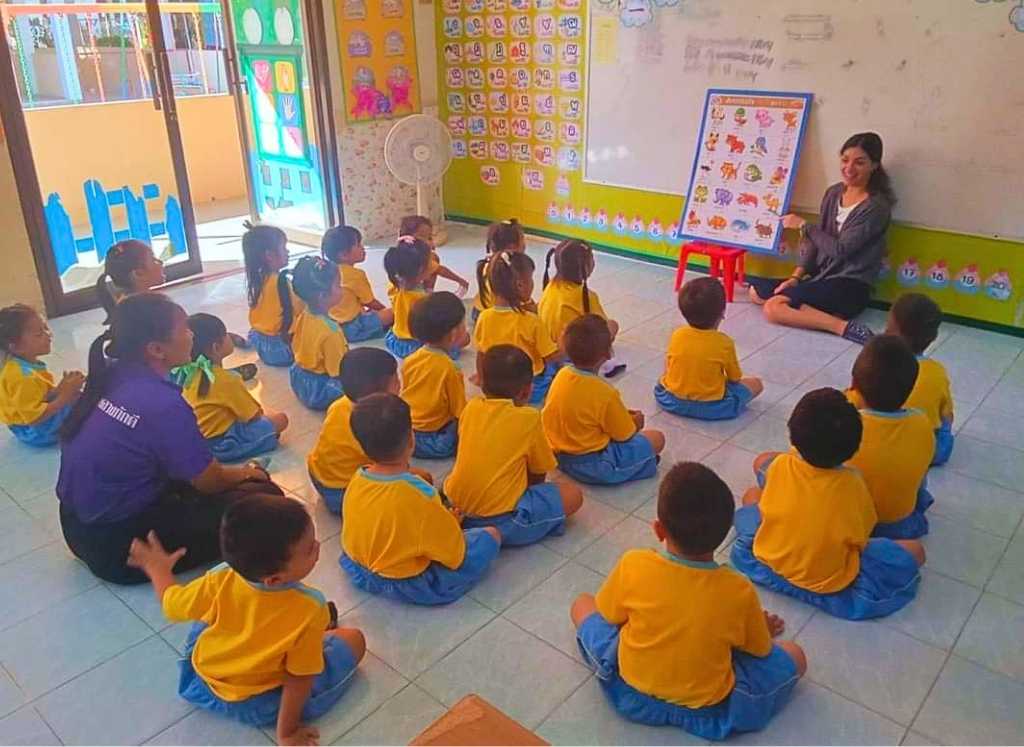
- Teaching and tutoring. Structured school hours, predictable timetables, and indoor environments make teaching one of the most T1D friendly volunteer roles available. This is one of the projects I did in Thailand, and it was ideal for me.
- Childcare and babysitting. These roles offer some similar benefits to teaching, including regular routines, indoor environments, and activities that do not necessarily require extreme physical exertion. However, lively kids might be exhausting.
- Animal shelters and wildlife sanctuaries. These can work very well, provided meals are structured and the physical demands are manageable. Caring for animals often involves moderate activity with a certain degree of predictability.
- Receptionist, admin, and community support roles. Office based or community centre roles with fixed hours and indoor environments are among the more predictable options for managing blood sugar while volunteering.
- Hostel and guesthouse help. Many volunteer stays involve working a few hours a day at the accommodation itself, helping with reception, cleaning, social media, or other tasks. Having a fridge on site and access to regular meals can make this a very practical option. However, heavy cleaning might be exhausting and drops your blood sugar.
💡 Travel Tips.
When browsing platforms like Workaway or Helpstay filter by project type and read the description carefully. Be sure to read the reviews written by other volunteers too, as they often mention meals, timetables, workload and accommodation conditions. These are precisely the most important details when you have a chronic illness to manage.
For a full comparison of the work exchange websites, check out my dedicated article about the Best Volunteering Platforms for Sustainable Travels.
⏸️ Boundaries and Breaks: Knowing When to Slow Down.
This is what I wish I knew even before my first job. In fact, it should be applied not only when you volunteer, but also at your work place.
When you are in a new country, surrounded by motivated people working towards something meaningful, it is incredibly easy to push yourself beyond your limits. The culture of many volunteer environments, particularly physically demanding ones, can subtly reward endurance and discourage stopping. Nobody wants to be the person who slows everyone else down.
But here is what I know after years of diabetes: overexertion can make blood sugar management much more difficult. Physical activity can affect your blood sugar in different ways, and the risk of a hypo can increase during or after strenuous activity. A serious blood sugar problem in a volunteer setting, far from your usual support system, is not something to take lightly.
You are entitled to take breaks, sit down when you need to, and step away from physical work to check your blood sugar, eat a snack, or simply rest. These are not signs of weakness. They are signs of someone managing a complex medical condition with intelligence and self respect.
Before starting your placement, have an honest conversation with your host about your needs. Something simple works: “I have Type 1 Diabetes. Occasionally, I may need to pause and check my blood sugar or eat something quickly. This usually takes about 15 minutes. I want you to know in advance so it doesn’t come as a surprise”.
Any good coordinator should have no issue with this. If a host cannot accommodate basic medical needs, such as short breaks, access to food, or a place to sit, they may not be the right host for you.
💡 Travel Tips.
If you notice that the physical workload is consistently more than you can safely handle, speak up. Perhaps your blood sugar is becoming more difficult to manage, you are exhausted beyond normal tiredness, or you are struggling to eat at the right times. Talk to your coordinator and ask whether your tasks can be adjusted. It is far better to scale back your workload than to push yourself until you end up in a medical situation that disrupts your experience entirely.
🗣️ Telling Your Host Organisation About Your Diabetes.
You are not generally obliged to disclose your diabetes when applying for a volunteer placement. However, in most cases, I would recommend being upfront, not because you owe anyone your medical history, but because it allows you to ask the right questions and make sure the conditions you need are in place before you arrive.
A brief, matter of fact approach works: “I have Type 1 Diabetes, which is well managed. I need to store my insulin in a fridge, eat at regular intervals, and occasionally take short breaks to monitor my blood sugar. I’d love to know more about the accommodation and meal schedule before committing.”
Most hosts respond well to this approach. It is professional, specific, and gives them clear, practical information rather than a vague medical declaration they may not know how to respond to.
If a host’s response gives you pause, perhaps they seem dismissive, unclear about the fridge situation, or unable to guarantee regular meals, take that seriously. Good communication before you arrive is an important part of feeling confident about your placement.
Once you arrive, tell at least one person on site, such as a coordinator, a fellow volunteer you trust, or your host family, where your insulin is kept, where your fast acting sugar is, and what to do if you become confused. Keep it brief and practical. Most people are genuinely willing to help when they have clear instructions.
💡 Travel Tips.
Carry a small note, ideally in English and the local language, that explains your condition and tells someone what to do if you need help. For example: “I have Type 1 Diabetes. If I am conscious and seem confused or unwell, please give me fast acting sugar and stay with me. If I am unconscious or unable to swallow, do not give me anything by mouth. Use my glucagon if available and call emergency services.” It takes five minutes to prepare and could make a huge difference in the right situation.
💯 Insurance and Medical Preparation.
As of now, there aren’t many insurance policies that cover both volunteering work and pre existing conditions. Sadly, you must choose what to prioritise.
Some travel insurance policies offer long term coverage that includes volunteering work, but only a few cover T1D comprehensively and usually for no more than 60 days. As I manage my diabetes quite well and do not always travel for months at a time for volunteering, in that occasion I chose True Traveller. It offers longer coverage for backpackers, include volunteering work and offers add ons for Type 1 Diabetes. However, you are not covered for everything, such as purchasing insulin or routine examinations, but mainly for emergencies.
Before any placement, make sure the following are in place:
- Travel insurance that covers volunteering and/or your diabetes as a pre existing condition. For a full breakdown, read my articles 5 Insurance Policies for Travelling with Type 1 Diabetes and Best Travel Insurance Providers for Your Next Trip to find the option that suits you best.
- Enough supplies for your full stay, plus a good extra. For a complete guide to calculating how much insulin and how many supplies to pack, read my post Tips for Travelling Long Term with Type 1 Diabetes.
- A doctor’s letter in English, listing your diagnosis, current medication, dosages, and devices. Carry a physical copy and a digital scan saved to your phone.
- Knowledge of the nearest hospital or clinic. Ask your host when you arrive, especially if you are staying in a rural area.
- A glucagon emergency kit. If you will be working somewhere where you may be alone, a nasal glucagon kit, such as Baqsimi, can be essential. Make sure at least one person at your placement knows where it is and how to use it.
💡 Travel Tips.
If your placement is in a country where insulin availability is uncertain, research the international generic names of your insulin before you go (e.g. insulin lispro, aspart, glargine). In an emergency, this knowledge can be the difference between finding what you need at a hospital pharmacy and coming home empty-handed. Read more in my post on Backpacking with Type 1 Diabetes.

🎀 My Experience of Volunteering Abroad with T1D.
So far, I have completed three volunteering projects, all in Thailand. Each one was manageable, although some were more physically demanding than others. All of them brought me great joy, but one also came with a very serious problem.
1. One Week Volunteering at an Elephant Sanctuary.
I spent one week at Elephant Nature Park, and it was an amazing experience, that you can read fully on my journal post. However, to participate fully in the volunteer activities, you should be in reasonably good physical shape and not have any severe mobility issues or impairments.
Most tasks were manageable: walking dogs, preparing food for the elephants, and doing light cleaning. Others, such as emptying watermelon trucks, cutting hundreds of banana hands, and especially collecting hay in the extreme heat of northern Thailand, were genuinely demanding and exhausting. I pushed through them, but I paced myself carefully.
There were many volunteers, so I was able to stop, take a break, and rest whenever I had a hypo or simply needed to. I believe that, with good Type 1 Diabetes management, consistent hydration, and by avoiding pushing yourself too hard, you can absolutely participate in this kind of project too.
Food was not a problem at all. There was a great selection at the buffet for breakfast, lunch, and dinner, plus a shop and a café within the facility. Since I have a strict meal schedule, I would usually prepare my plate and eat it later rather than at 6 pm when dinner was served.
2. Two Weeks Teaching English in a Remote Thai Village.
I volunteered at a kindergarten in Ban Khwao, a small village in Chaiyaphum, where I taught English to little children.
The working day had exactly the structure I needed: mornings in the classroom, communal meals with the other two volunteers, and afternoons to myself. Meals were simple, usually noodle soup or rice, but the village had shops, 7-Elevens, and local markets, where I could buy snacks or extra food whenever I needed it. This was particularly useful at weekends, as meals were not provided.
The activities were simple, although sometimes I needed extra energy to play with the children. Nothing was particularly strenuous, and as far as I remember, I never experienced a hypo.
I had my own room and bathroom at one of the teachers’ houses and, naively, I assumed my insulin bag was being kept in the fridge there. However, when I ran out of insulin, I discovered that my supply had actually been taken to the school and my six month supply of insulin had been put in the freezer by mistake. Not only was all my insulin destroyed, but I had not even known that it was being stored somewhere I could not access.
I managed to reach the nearest hospital in Chaiyaphum and purchase a new supply. Luckily, my insurance later reimbursed the cost as a damaged bag rather than as medical equipment.
That experience shaped every volunteer placement I have considered since: always be extremely clear, always check the fridge yourself, and never assume that what seems obvious to you is obvious to someone else.
Despite the incident, I would not trade that experience for anything. The children, the village, and the slow mornings in the classroom are memories I will carry forever.
3. One Week Volunteering at a permaculture Garden.
This was the hardest and most challenging volunteering project. I actually spent less than a week at this permaculture garden managed by a lovely Thai woman, Angel. At the time, she was building her own home on her family’s property while running her business, Green Garden Food Forest, located in Buri Ram Province.
When I arrived, there was basically nothing, just a rudimentary brick wall and a roof. This wall separated the area between the Green Garden (in which she was building her house) from her family’s home. Luckily, in her family’s home there was a kitchen and a fridge where I could store my insulin.
There were no proper rooms, so we slept on mattresses under mosquito nets. The bathroom was small and had no hot water, while kitchen consisted of a small ground sink and a fireplace where we used coconut shells to keep the fire going.
We usually woke up at sunrise, had breakfast, and then went straight to the garden to collect fruit and vegetables, cut banana trees, extract turmeric roots, and carry out other tasks. It was physically demanding, and I experienced some severe hypos. Even though we were literally in the middle of nowhere, there was a small family shop nearby selling basic supplies such as juice and snacks.
Meals were provided, and I learnt a lot about growing food and bringing it from “the garden to the table”. Rice, vegetables, and fruit were always available, and although Angel is vegan, she even offered to buy some eggs.
It was an amazing experience, but managing my diabetes was difficult because some activities were exhausting and we needed to do the task early in the morning to avoid the extreme heat. Thankfully, Angel completely understood my situation and never pushed me too hard.
❓ FAQ.
Yes, absolutely. With careful project selection, the right accommodation setup, and good preparation, volunteering abroad with T1D is entirely possible. The key is choosing a Work exchange that guarantees fridge access, regular meals, and a manageable workload.
Teaching, childcare, animal shelters, and receptionist or admin roles tend to work well. In fact, they offer structured schedules, predictable mealtimes, and indoor environments. Farm work and construction projects are more challenging due to physical intensity and unpredictable schedules.
You are not legally required to, but it is strongly advisable. Being upfront allows you to confirm that your practical needs (fridge access, meal schedule, break flexibility) will be met before you commit.
You are entitled to short breaks to check your blood sugar or eat a snack. Discuss this with your coordinator before starting. Any responsible host will accommodate this without issue.
Yes. You need a policy that explicitly covers diabetes as a pre-existing condition and that covers the full duration of your staying. Standard policies often exclude pre-existing conditions and cap trip duration at 30-60 days.
🎈 Conclusion.
Volunteering abroad with Type 1 Diabetes is possible and it’s one of the most rewarding things you can do. It will push you, teach you, and connect you with people and places in ways that a standard holiday never offers.
What it asks of you is honesty: with yourself about your limits, with your host about your needs, and with your body about when it is time to pause. These are not conditions imposed on you by diabetes. They are simply good sense.
Choose your project thoughtfully, ask the right questions before you commit, and pack your supplies with a generous margin. But most importantly, get the right insurance.
And then go! The classroom, the animal shelter, the hostel reception desk, they are all waiting for you, and your diabetes does not change that.
💬 And you? Have you ever volunteered abroad despite having Type 1 Diabetes? Or are you thinking about it but not sure where to start? Tell me in the comments. I’d love to hear your story!
☕ Did you find this post helpful? If you’d like, you can support my blog by treating me to a virtual coffee!

Want to stay updated with my latest itineraries, receive practical guides and unique travel tips, and enjoy exclusive discounts on hotels, flights, and activities?
✨Click the button below and join my community of travel girls!✨
