


Last Updated on July 21, 2026 by Nadia Halfway
📜 Introduction.
I have a sort of tradition when I go living abroad or travel for an extensive period of time: make a memory tattoo of my journey.
For the 2 months backpacking across Thailand, I even planned two tattoos: a small elephant, to hold onto the memory of my week volunteering at the Elephant Nature Park, and the Sak Yant, the sacred Thai tattoo.
If you love body art and meaningful tattoos, a Sak Yant is unlike anything else. It’s not just ink: it’s a ritual, a blessing, and for many people, the most unexpectedly moving experience of their time in Thailand.
In this journal post, I’ll tell you everything you should know before getting the sacred Thai tattoo, how to prepare properly, what to expect, useful tips and advice, and my own experience of getting a Sak Yant as a woman.
⚠️Disclaimer: Some of the websites below are affiliate links or require a promo code for receiving a discount. If you book through them or use my personal promo code at the time of subscription or reservation, I’ll earn a small commission (at no extra cost to you), and you’ll get a discount or a special promotion too. It’s a win–win!
Please be aware that affiliate links may expire and promo codes may reach their usage limit. If you find that a link or code no longer works, kindly let me know. I’ll be happy to share an updated one (if available) directly with you.
💉 Vaccinations First.
Before talking about the Sak Yant and how to get one, I must first highlight the risks involved. Although there are no documented cases of Western visitors getting infected, Hepatitis B is the main concern.
The needles used in traditional Sak Yant tattoos are not single-use like Western tattoo equipment. I watched with my own eyes as the Ajarn (master) burned the needle tip with a lighter and wiped it with a cloth soaked in alcohol. That is their sterilisation method. While it reduces the risk, it does not eliminate it. If you are not vaccinated against Hepatitis B yet, please get it done before you go. Give yourself enough time for the full course to take effect (ideally months before your trip).
It is worth doing a tetanus jab too. And if you have any skin conditions, autoimmune diseases, or any medical reasons to be cautious about infection risks, carefully consider what precautions to take.
🪷 What is a Sak Yant?
Sak Yant (สักยันต์) translates roughly as “tattoo of sacred geometrical designs”. This practice is ancient, rooted in a blend of Theravada Buddhism and pre-Buddhist animist traditions that runs deep through Thai, Cambodian, Lao, and Burmese culture.
Each design is a yantra, a sacred geometric pattern carrying a specific spiritual intention, inscribed with Khmer script and blessed with Buddhist prayers.
The tattoo is applied using a long bamboo stick dipped in ink which technique unchanged in its essentials for centuries. In a traditional context, it’s carried out by a Buddhist Monk or an Ajarn, a master who has studied the sacred designs under proper lineage. The ritual which includes the offering and the blessing is part of the experience.
🖼️ Know What the Designs Mean.
This is not a tattoo parlour experience dressed up with incense. Or rather, it shouldn’t be. Before you go anywhere near a Sak Yant, there are things worth knowing.
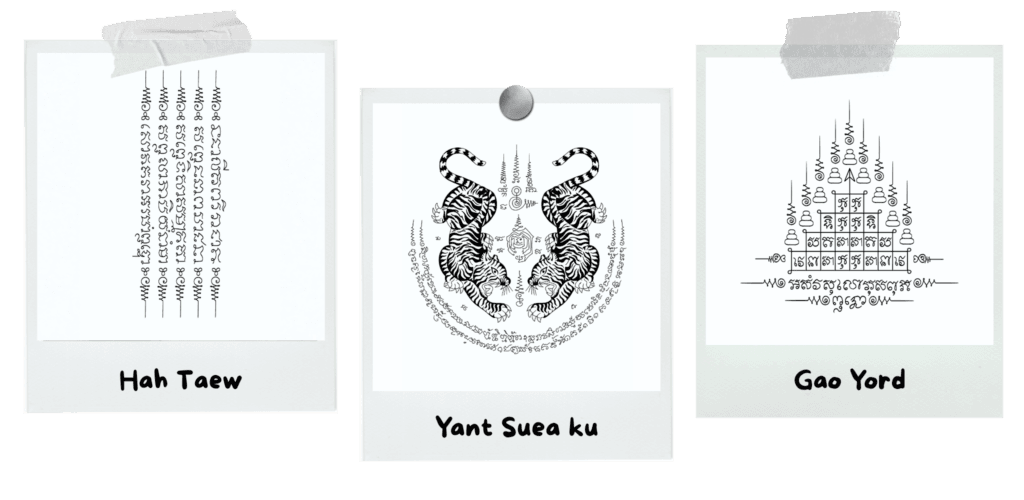
A Sak Yant isn’t decorative in the way a standard tattoo is. Each design carries specific spiritual significance, and traditionally, certain designs are appropriate only for certain people or intentions. Paak Krut is for protection and power. Hah Taew is one of the most commonly given. Gao Yord is considered the king of all yant. Research your options before you go, and go in with intention.
It’s also worth knowing that Sak Yant script doesn’t translate directly into English or Thai or any other language. A single character may derive from a long chant passed down orally and carry an intrinsic meaning.
One thing you cannot control is placement. Each yantra has its designated position on the body and traditionally, no Sak Yant is placed below the waist.
Moreover, you won’t be the one choosing the design. The Monk or Ajarn selects the yant that is right for you, not the other way around. That said, if you decide to book through a tour operator, you might choose between two or three designs.
Gao Yord.
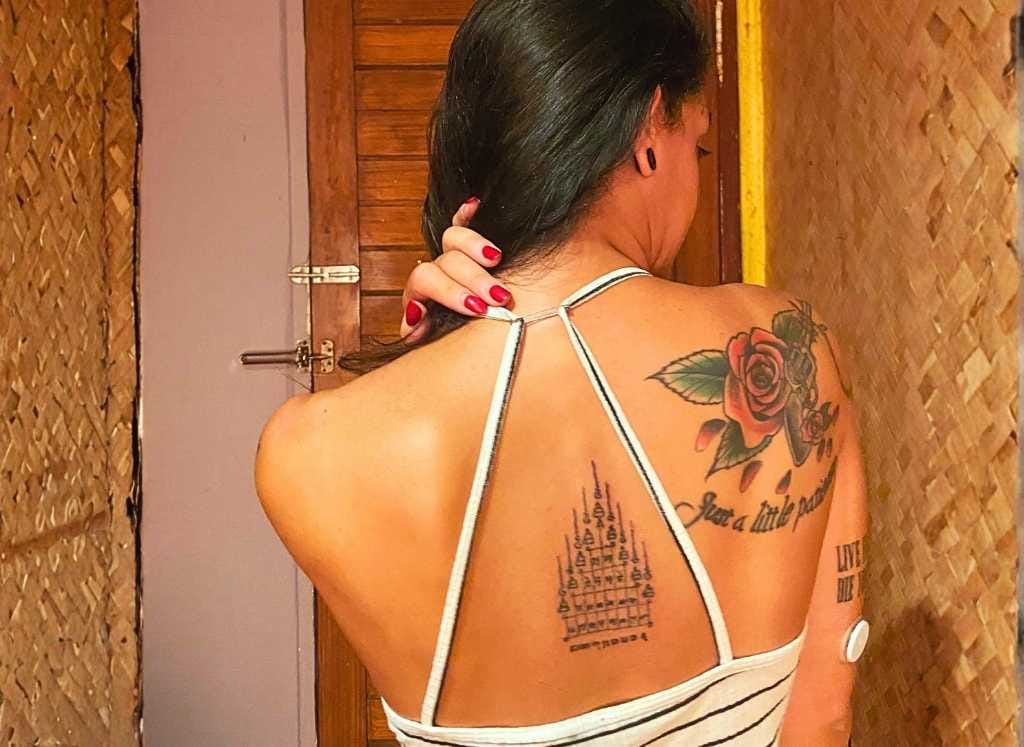
I personally joined an organised tour to get my Sak Yant (I’ll explain why in a few paragraphs). This allowed me to decide on the design upfront between Hah Taew and Gao Yord, as they were displayed on the website. I chose the Gao Yord.
Known as the “Yant Kru” (the Master Yant), the Gao Yord is widely considered the most sacred and powerful of all Sak Yant designs. Its structure represents the nine peaks of Mount Meru, the mythical mountain of the gods in Hindu and Buddhist cosmology. Nine Buddhas are embedded within the design, each bestowing a specific power or blessing on the wearer.
Look closely at a Gao Yord and you’ll see three ovals at the top, symbol of the Buddha found across many Sak Yant designs, and a grid of small squares at the centre. Each square contains an abbreviation in Khom, an ancient Khmer script, representing a different protection spell. The script running through the design comes from the Itipiso, one of the most sacred Buddhist chants.
The blessings the Gao Yord carries are wide-ranging. Protection from physical harm and accidents, good fortune, authority, charm, and the strength to fight for what is right. If you’d like to learn more, you can read more about Gao Yord on this website.
🛕 Wat Bang Phra Temple.
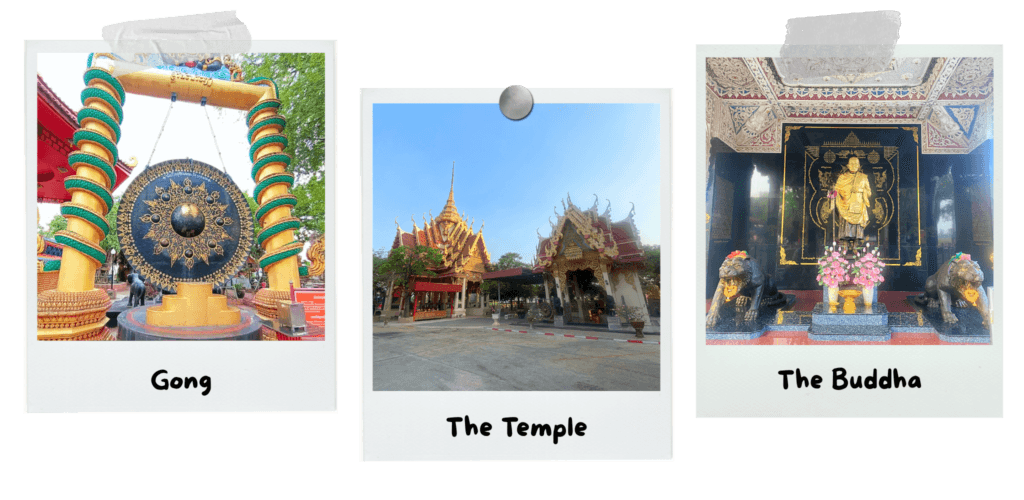
There are a few “certified” places to get the Sak Yant both in Thailand and in other countries. But of all the places in where you can receive a Sak Yant, Wat Bang Phra (formally known as Wat Bang Phra Luang Pho Pern) is considered the most authentic. It sits in Nakhon Chai Si district, Nakhon Pathom province, around 50 km from Bangkok.
The name translates as “Monastery of the Riverbank Buddha Image,” and the story behind it is worth knowing. The temple dates to the late 18th century, founded just before the second fall of Ayutthaya. When Burmese forces threatened the city, two sacred Buddha images (Luang Pho Sit Chaiyamongkon and Luang Pho Kai Sitmongkhon) were loaded onto a boat and transported downriver to safety. The boat capsized in the Nakhon Chai Si River, and the images were later recovered from the bank where the monastery now stands. The small ordination chapel is the only original structure still standing.
🎀 My Experience.
Getting ready.
As I mentioned in the introduction, I love getting a tattoo as a lasting memory of a long, intense journey. Two months backpacking across Thailand definitely counted as one.
Long before I left home, I researched extensively how to get a Sak Yant and how to prepare properly. So first things first: I got vaccinated for Hepatitis A and B, tetanus, and meningococcal disease.
Why I changed my plans.
Initially, I planned to reach Wat Bang Phra on my own from Bangkok, and I even booked accommodation in Nakhon Chai Si district. In the end, I decided against it for several reasons. Reaching the temple without a car is time-consuming and complicated. The guesthouse I’d booked had no reviews at the time, and the owner never replied to my messages through the platform. Moreover, options in the area are limited and I wasn’t sure I could find a taxi or Grab there. Finally, I was also worried about being a solo woman and running into a language barrier at the crucial moment.
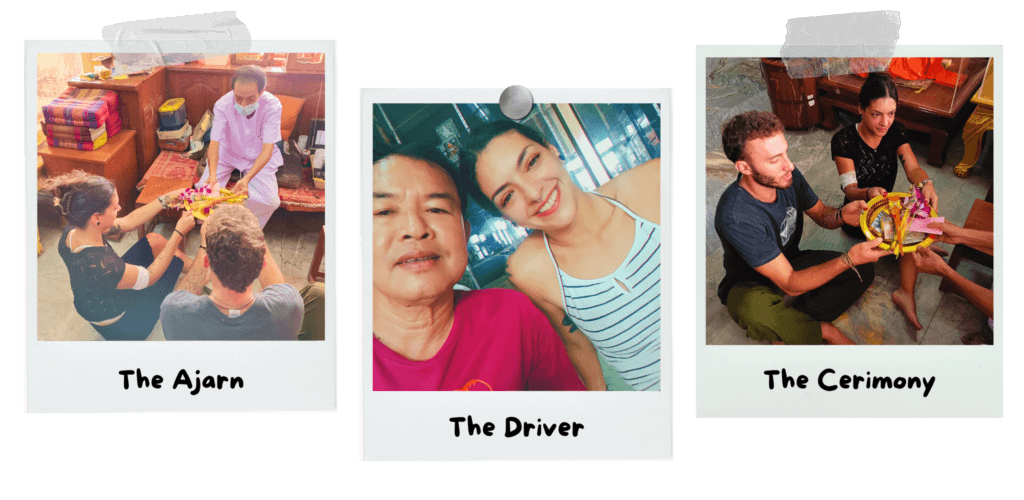
So, when I was already in Thailand, I decided to join an organised transport through GetYourGuide. It turned out to be a positive experience even though it lost a bit its sense of adventure and sacredness. The guide of the activity, who was also the driver, was indeed very nice and accommodating.
The Morning at the Temple.
The driver picked me up early in the morning from my hostel. There was one other person joining, an Italian guy, who wanted the same experience. We reached Wat Bang Phra in under 50 minutes, arriving just as the sun was rising. We had a short walk around the temple grounds before being welcomed by the Ajarn.
The guide had already prepared the offerings on our behalf, which we then presented to the master ourselves. We moved through the ceremony and the blessing together.
The Tattoo Itself.
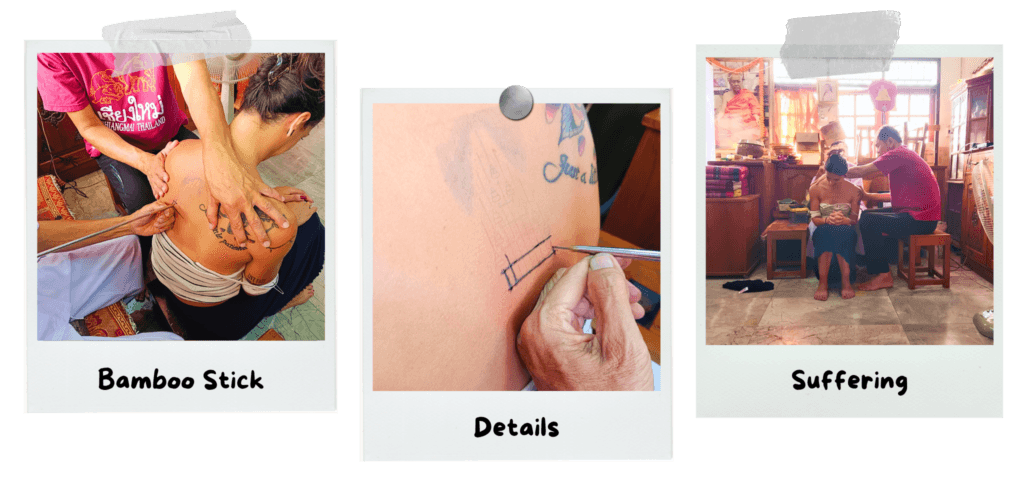
I went first. Despite already having a dozen tattoos on various parts of my body (including areas considered particularly painful, like the hips, ankles, and wrists), the Sak Yant on my back was excruciating.
The session was fast, 30 minutes at most, but the pain was unlike anything I’d felt in a tattoo chair before. There’s something about the rhythm of the rod and the depth of the ink that hits differently.
We were all barefoot inside and I was sitting in a small plastic chair. Hygiene conditions were quite questionable. The Ajarn didn’t even wear any gloves and used kitchen paper to dab away the blood and clean the excess ink off the area (which was not disinfected). In all of this, the driver was actually helping the master with the instruments, keeping my top steady and taking videos and photos.
After my Sak Yant, I stayed in the room while the other guy got tattooed. I saw with my own eyes that the Ajarn didn’t change the bamboo tip. He simply burnt it with a lighter and wiped it with a cloth with alcohol, I assumed. I still have no idea whether he followed the same sterilisation procedure before tattooing me. As of today, more than three years later, I have no health problems and no complications from the Sak Yant.
Aftercare.
The pain had gone by the very next day. For the following week, I looked after it just as I had done with my other tattoos: I washed it with a mild soap, applied a thin layer of Bepanthenol and covered it with a bit of cling film to protect it.
I soon stopped using the cling film, unless I had to carry my heavy backpack on my shoulders. What’s more, just two days after getting the tattoo, I was already swimming amongst the waterfalls in a national park! It may not have been the most orthodox post-tattoo aftercare in the world, but it healed perfectly and without any problems.
Once the session was over, the driver kindly dropped me at the train station as a favour, since I was heading to Kanchanaburi rather than back to Bangkok. Pick up and return are included in the experience.
📍 How to Get a Sak Yant on Your Own: Tips and Information.
My own experience with the arranged tour was extremely positive and I wholeheartedly recommend it. However, if you want a bit of adventure, here I’ve written a short guide on how to get the Sak Yant on your own.
How to get to Wat Bang Phra Temple.
Getting to Wat Bang Phra is not easy, and this is the main reason I ended up choosing GetYourGuide.
However, there are different ways to get there from Bangkok. First is of course by car: you can arrange a private driver, request a taxi from your accommodation, or get a Grab.
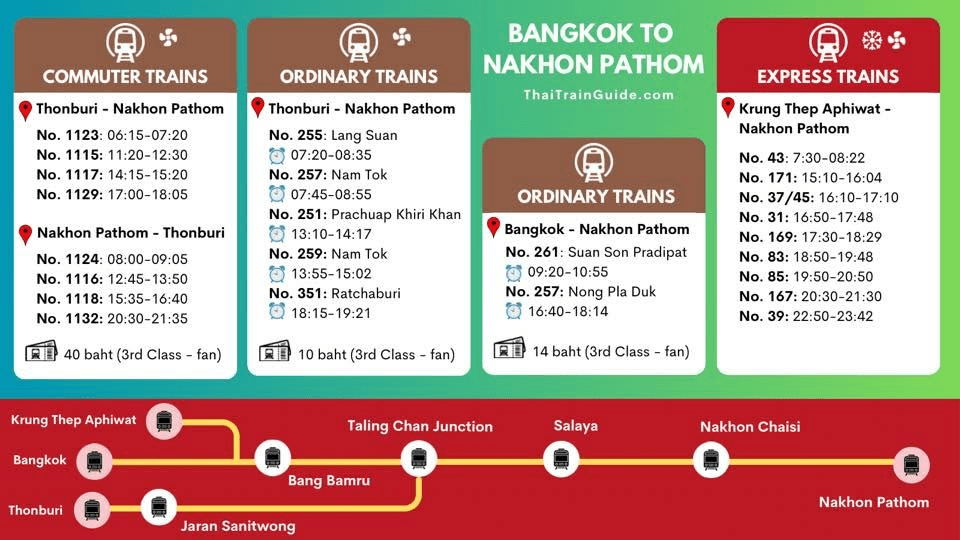
You can also consider taking a train but the journey would be more difficult. First, as of now, popular platforms don’t sell train tickets of this route, not even 12Go. You must go first to Thon Buri Station in Bangkok and purchase the ticket directly at the counter in the direction of Nakhon Pathom. The temple is located in Nakhon Chai Si District and the nearest stations are:
- Wat Ngiu Rai: Stop ID: 4012, direct trains 255 and 257.
- Nakhon Chaisi: Stop ID: 4013, direct trains 260, 254 and 252.
Below I found an image of the trains (I’m not sure if it is up to date) and I suggest you take a look at Thai Train Guide and even their Facebook page for further info and help, and to ask at the ticket office for the best routes.
You can get there even by bus. I only found Omio selling tickets and the price is very cheap (€2-3). However, just keep in mind that it is not possible to book too far in advance, maximum one month before departure. The bus departs from Bangkok’s Southern Bus Terminal (Sai Tai Mai) and arrives at Nakhon Pathom, Big C Nakornpathom, direct and non-stop.
🔽 Ready to travel? You can search for your next bus directly in the bar below! 🔽
🎁 Subscribe here to receive up to €10 off your first booking (conditions apply) 🎁
Keep in mind that whether you go by train or bus, you still need a 15-20-minute ride or a 3-hour walk to the temple.
When to Arrive and Where to Stay.
To receive the Sak Yant you need to be at Wat Bang Phra Temple very early in the morning around 6-7 AM before the sunrise, so I recommend spending the night before in Nakhon Chai Si district. However, there aren’t many accommodation options in the area on popular booking websites.
The cheapest and closest option I could find is Boat House Boutique Riverside, a nice resort with a restaurant, a pool, and even a small water park, less than 15 minutes’ walk from the temple. Prices may vary from €30 to €50 per night depending on the time of travel, breakfast included. You can find it on both Agoda and Trip.com.
🎁 Use the referral code below or register via Trip.com to unlock your €10 discount 🎁
U51IZ5
That said, Google Maps shows several hotels in the area that don’t appear on popular platforms. My suggestion is to contact them directly if they have their own websites or contact details and arrange a room that way.
The Offerings.
Coming to a traditional Sak Yant is not a transaction, and it shouldn’t feel like one. The offerings you bring, known as Parn Kru, are an act of respect toward the Ajarn or Monk, not a fee for a service.
A standard set typically includes a garland of jasmine or marigold flowers, incense, and candles. Depending on the master’s lineage and tradition, you may also want to include a pack of cigarettes, Thai rum, or betel nut. A monetary donation in an envelope is also customary. The amount is often based on auspicious numbers, typically multiples of three, such as 300, 330, or 660 Thai Baht, and goes toward the upkeep of the temple or the master’s practice.
Communication and Language Barrier.
Monks and Ajarns usually don’t speak English. I recommend preparing a printed note in Thai (you can use Google Translate) explaining clearly that you would like to receive a Sak Yant. Mention your reasons for wanting one, make clear that you have researched the tradition, and include your preference for a particular yantra if you have one. Most importantly, add that you are perfectly happy if your request cannot be accommodated, and that you accept the master’s right to choose the design for you.
💡 Travel Tips.
Vaccinations and Other Diseases.
I cannot stress this enough. Although some believe that the Buddha’s blessing protects against infection, faith and vaccinations are not mutually exclusive. Make sure you are vaccinated against Hepatitis A and B and Tetanus before you go.
If you have a chronic illness like me (Type 1 Diabetes and Hypothyroidism) you may be more vulnerable to infection, which makes Vaccinations even more important.
Come Early.
I highly advise you to come the night before, by public transport or preferably by taxi. Honestly, it is not really worth travelling by public transport to Nakhon Chai Si. Whether you go by train or bus, once you arrive you still need a 20-minute ride or a three-hour walk to the temple. If you are lucky, you might find a songthaew, the shared minibus common across Southeast Asia, near the station or bus stop that get you close to the Temple.
In any case, when I did my Sak Yant, there was nobody there besides me and the other Italian guy. Nevertheless, I’d still recommend arriving as early as possible at the temple, to be among the first, to avoid crowds, and to beat the heat that builds quickly even in the early morning hours.
What to Wear.
Modest clothing is not optional: it’s a sign of respect for the spiritual context. Cover your shoulders and knees when entering the temple. You’ll need to expose the skin where the design goes, but how you dress on arrival matters.
I wore a long skirt and a top with an open back so I didn’t need to remove or lift it up during the tattooing. I also brought a light lace bolero to cover my shoulders on arrival: simple and practical.
How to Take Care of Your Sak Yant.
I cared for my Sak Yant the same way I’ve cared for all my previous tattoos. I washed it with a unscented soap, applied Bepanthen cream, and covered it with cling film to protect it. My idea was to keep this up for a week, but after two days I dropped the cling film, except when travelling between places and needed to protect the tattoo from the friction and weight of my backpack.
If this is not your first tattoo, I suggest you to contact your usual tattoist to seek more professional advice. And if this is your first, research properly the right way to take care of it. On this website, you’ll find in-depth advice on how to look after your sacred tattoo.
Be Aware of Scams.
As with many spiritual and cultural experiences in Thailand, the Sak Yant world has its share of opportunists. Here’s what to watch out for.
The most common issue is unofficial practitioners operating near temples or tourist areas, presenting themselves as Ajarns without any legitimate training or lineage. A real Sak Yant requires years of study under a qualified master: it’s not something anyone can simply offer.
Be wary of anyone who approaches you outside the temple gates offering to arrange a Sak Yant on the spot, often at a suspiciously low price. Let alone those who instead ask you 5000-7000 BATH. Similarly, some tours advertise “authentic” Sak Yant experiences but take you to practitioners who have no connection to the traditional lineage.
If you book an organised experience, research the operator carefully. Read reviews, check that the destination is the temple of Wat Bang Phra and confirm that the practitioner is a genuine Ajarn or Monk. A legitimate experience will never feel like a sales pitch.
This is the exact tour I chose from GetYourGuide. You can check if it’s available on your dates directly via the widget below.
❓ FAQ
The most renowned destination is Wat Bang Phra (formally Wat Bang Phra Luang Pho Pern) in Nakhon Chai Si district, Nakhon Pathom province, around 50 km from Bangkok. It is widely considered the most traditional place to receive a Sak Yant.
Yes. Women can receive a Sak Yant, though some traditional restrictions apply around placement (no yantra is positioned below the waist) and only an Ajarn can perform a Sak Yant since Monks are not allowed to touch women.
Both are possible. Going independently to Wat Bang Phra is doable but logistically challenging. A guided tour simplifies the journey considerably, though it may reduce some of the experience’s sense of pilgrimage.
Yes, without question. Hepatitis B and Tetanus are the most important. Needles are not single-use and sterilisation methods and hygiene conditions are questionable. Get vaccinated well in advance, ideally months before your trip, not the week before.
Traditionally, yes. Wearers are advised to avoid alcohol, certain foods, and disrespectful behaviour to preserve the power of the blessing. As for aftercare, you need to keep it clean and protected for at least a week.
🎈 Conclusion.
Getting a Sak Yant was one of the most unique experiences of my two months in Thailand. If I could go back, I’d probably do it differently and try to approach it more independently, in the spirit of a true pilgrimage.
Nevertheless, I know that the way I experienced it was the only one possible for me at that time, and I’m happy with it all the same.
If you, too, are thinking of getting a sacred Thai tattoo at Wat Bang Phra temple, my advice is simple: go for it, but take the right precautions, respect your time and choose the approach that makes you feel most comfortable. It doesn’t matter, therefore, whether you go through a tour operator, arrive at the temple as part of a pilgrimage, or go to a certified tattoo studio; the important thing is to do it with the right spirit and with respect for the tradition.
💬 And you? Have you already received a Sak yant, or is it on your list for your next trip to Thailand? Let me know in the comments.
☕ Did you find this post helpful? If you’d like, you can support my blog by treating me to a virtual coffee!

Want to stay updated with my latest itineraries, receive practical guides and unique travel tips, and enjoy exclusive discounts on hotels, flights, and activities?
✨Click the button below and join my community of travel girls!✨
