


Last Updated on July 28, 2026 by Nadia Halfway
📜 Introduction.
When I was planning my 2-month backpacking trip in Thailand, I wished more than just travel. I wanted to do something meaningful, something that would stay with me long after I came home.
Volunteering was always part of the plan. After months of research, I found Elephant Nature Park: the first ethical elephant sanctuary of its kind established in Asia. Besides claiming to be ethical, which, frankly, many sanctuaries do, their programmes offer genuinely varied approaches: half-day visits, weekend stays, and a week-long volunteering project at a price that’s reasonable by any comparison.
The week I spent at Elephant Nature Park was one of the happiest of my entire life. This sanctuary is far more than a rehabilitation centre. It’s a community where locals and volunteers care not only for elephants, but for disabled dogs, stray cats, and other rescued animals.
In this post, I want to share with you why one week volunteering at Elephant Nature Park is a hundred times better than riding an elephant.
⚠️Disclaimer: The products listed below are Amazon affiliate links. If you decide to purchase through them, I’ll earn a small commission at no extra cost to you. Please also bear in mind that prices may vary and products may become unavailable at any time!
💚 The Story Behind the Sanctuary.
Elephant Nature Park sits in Northern Thailand, roughly an hour’s drive from Chiang Mai. It was founded by Saengduean Chailert, known worldwide as Lek, an elephant rights advocate and one of the most extraordinary people I have ever had the privilege of meeting.
Lek grew up in a small village near the forests of northern Thailand. From a young age, she witnessed elephants being exploited by the tourism and logging industries. She began providing medical aid to injured elephants in remote villages, and in 1990 she started rescuing them, one by one.
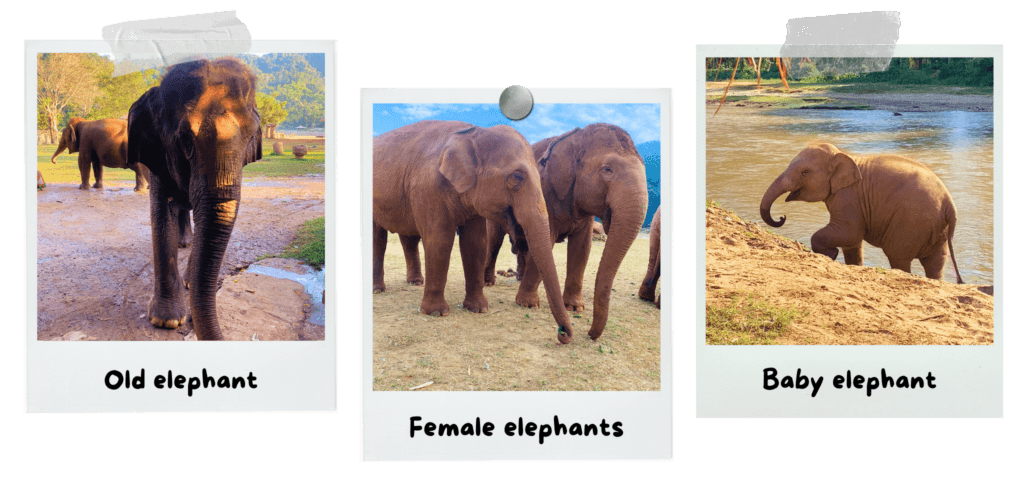
In 2003, she established Elephant Nature Park as a permanent haven for them. It was the first sanctuary of its kind in Asia and today, it’s home to more than a hundred elephants. Some of the rescued elephants are blind, crippled, orphaned, or elderly but all have been given the chance to live freely in natural surroundings, treated with love and dignity.
Lek’s work has been recognised internationally and her story is documented in the short film Love & Bananas. Meeting her in person and hearing her speak about these animals was one of those rare moments that genuinely changes how you think about travel and the kind of traveller you want to be.
🐘 The Elephants.
Elephants are widely considered one of the world’s most empathic species. They feel deeply and they remember. In fact, those who have been mistreated carry those memories for a lifetime.
Elephants rescued from abuse like street begging, logging camps, circus shows, and riding operations, arrive carrying both physical and psychological injuries. Researchers have found rescued elephants displaying signs of human PTSD: abnormal startle responses, depression, unpredictable behaviour, and hyper-aggression. These animals don’t just need medical care, but time, space, and trust.
At Elephant Nature Park, each elephant has a name and a story. Many were rescued from within Thailand, others came from Laos and Cambodia, where exploiting elephants is still widespread. Every rescue is a long-term commitment to give a traumatised, often broken being the chance to heal.
🐕 The Other Animals.
The elephants may be the heart of the sanctuary, but they are far from the only residents.
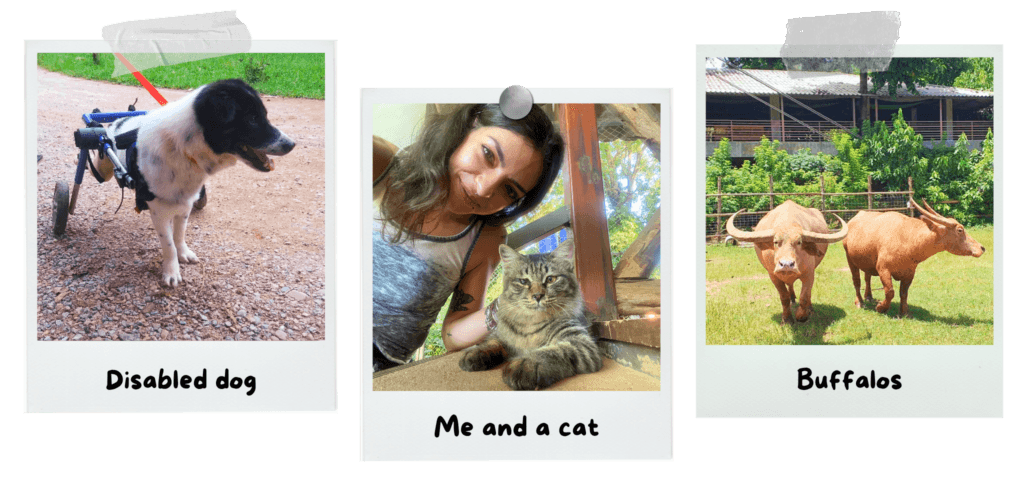
At Elephant Nature Park, you’ll also find stray cats and disabled dogs (most of them victims of road accidents) along with rabbits, horses, and buffaloes. During free time, volunteers can drift towards the dog shelter for walking them or the cat kingdom, as the on-site cat enclosure is known. It’s hard to spend more than five minutes there without a cat appearing on your lap.
All of these animals are cared for by the same community of vets, volunteers, and staff who look after the elephants. The whole place operates as a kind of village: interconnected, generous, and quietly extraordinary.
🏘️ The Location and Facilities.
The Elephant Nature Park is like a paradise jungle and I struggle to describe how beautiful it is.
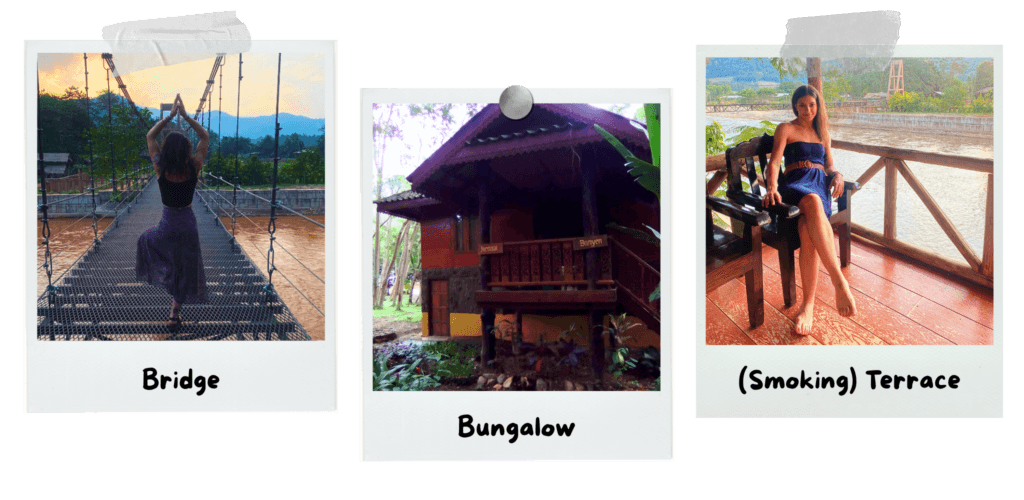
The site is a lush, green haven in the jungle. Accommodation is simple consisting of wooden bungalows and rooms to host the volunteers. I shared a double room with an Australian girl, with a private bathroom. But the surrounding space more than compensates. There’s a vast garden filled with tropical flowers and plants. A large kitchen and a buffet hall with shaded tables for meals. A river runs along the front of the property, and in the evenings you can sit on the terrace and watch elephants walking through the water as the sun sets behind the hills.
A bridge connects the sanctuary to a nearby village, shortening the daily commute for the vets, cooks, gardeners, baristas, guides, and massage therapists who work here. Within the site, there’s a shop, a coffee bar, and a small massage centre.
As I wrote above, the sanctuary take care of other animals, so you can find a dog shelter, a cat kingdom, and other sheds with horses, bunnies, and buffalos. But the greatest part is the big open space for elephants to be free.
Male elephants are kept separately. They require more specialised care and can be unpredictable, so their enclosure is far away and managed by a dedicated team.
📆 A Day in the Life of a Volunteer.
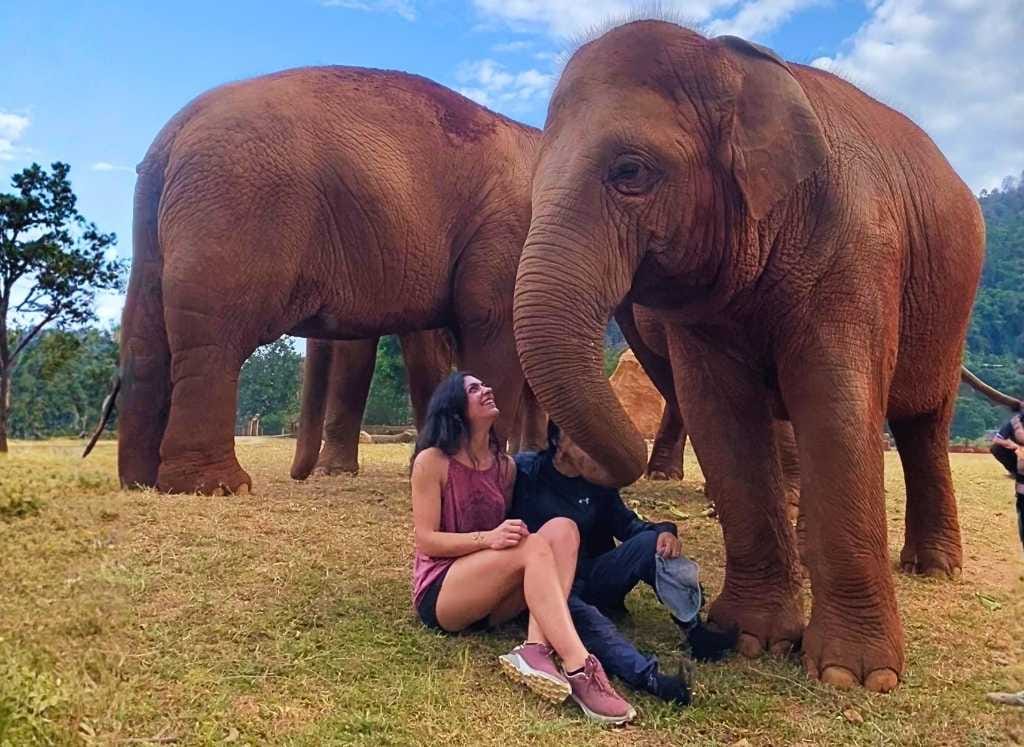
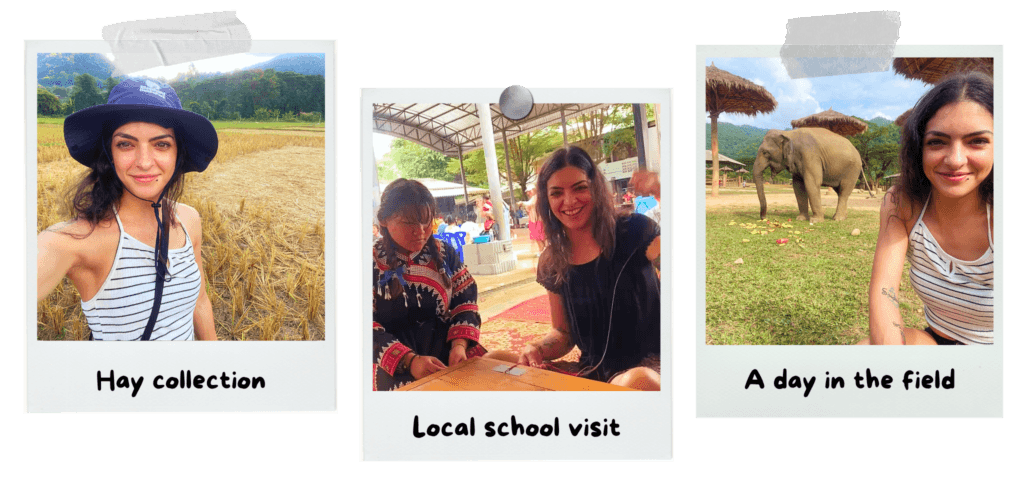
It is important to clarify that at Elephant Nature Park and other Ethical Sanctuaries, visitors and volunteers are not permitted to ride, bathe, or initiate contact with the elephants. Occasionally, an elephant would approach on its own terms and allow us to touch them with the careful presence of the guides. Moreover, when Lek joined our group, she guided us close to an elephant for a photograph (like the one you see in this post). Thus, any activity carried out here do not involve direct contact that might harm the elephants.
Regardless, a typical day at Elephant Nature Park starts early with breakfast served at 7 AM, and morning tasks at 8.
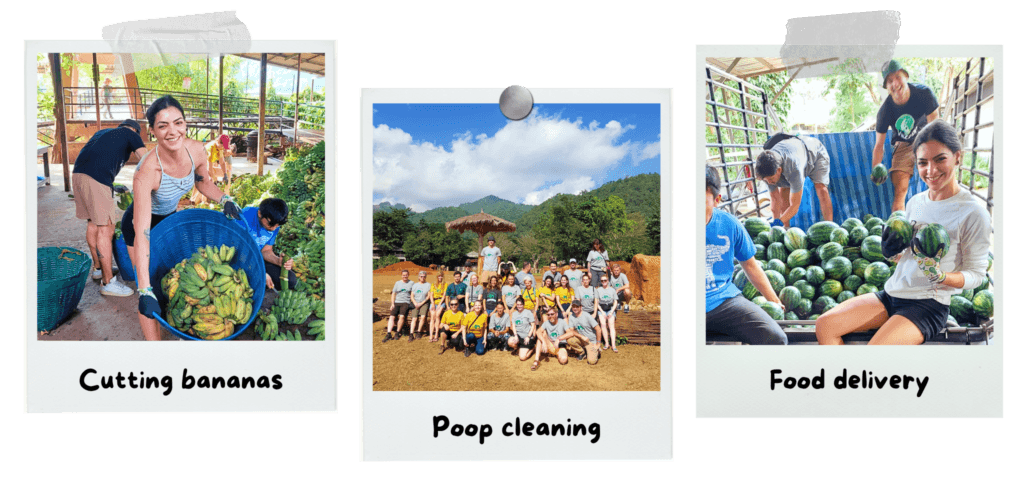
Most of the work revolves around the elephants’ food. Elephants eat up to 150 kg of vegetation daily, spending almost the entire time eating. Feeding that many animals takes real effort and great funds. We prepared elephant cakes (dense bundles of rice, fruit and vegetation), cut hands of bananas, emptied delivery trucks full of watermelons, and reorganised the kitchen stores. Once the food was ready, we placed it in the enclosures for the elephants to eat independently. No hand-feeding and no forced contact.
We also spent time cleaning, including elephant poop. It sounds more daunting than it is and if you are wondering, the smell is, genuinely, not strong.
One afternoon, we went out to a nearby field to collect hay. It was, without doubt, the hardest task of the week: extreme heat, dust rising, and mosquitoes.
On Saturday morning, we visited the local school and spent time with the children playing together, sharing a meal, and learning from them how to make traditional bracelets.
🍜 Food at Elephant Nature Park.
One of the things I loved most about the Sanctuary was the food.
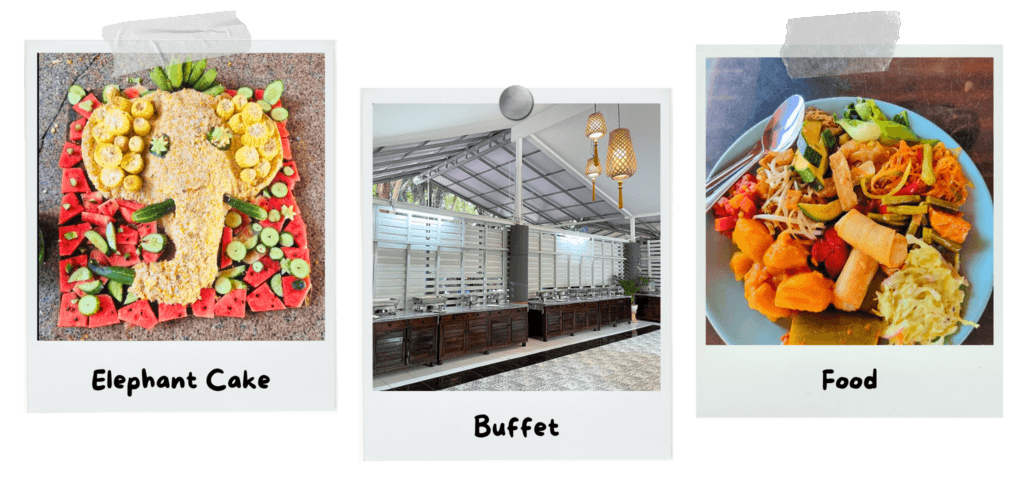
The buffet was extraordinary: rich, varied, and full of flavour from breakfast to dinner. Everything is vegetarian, but you won’t miss meat or protein. The spread includes a wide selection of Thai and Western dishes, fresh salads, fruit, and vegetables. Here every dietary requirement is catered for.
Meals are served three times a day: breakfast at 7 AM, lunch at 12, dinner at 6 PM. Moreover, the on-site coffee shop serves espressos, cappuccinos, cold drinks, and beers in the evenings.
💉 Volunteering with Type 1 Diabetes: My Experience.
In order to participate and contribute to the volunteer activities, you should be in reasonably good shape and not have any severe mobility issues or impairments. So I won’t pretend that a week of physical outdoor work in extreme heat was straightforward with Type 1 Diabetes, Hypothyroidism (Graves’ Disease), and mild asthma. Nevertheless, I believe I contributed as much as I could despite my health issues.
Most tasks were perfectly doable: walking dogs, preparing food for the elephants, light cleaning. Others like emptying watermelon trucks, cutting banana hands by the hundred, and especially collecting hay in the extreme heat of North Thailand, were genuinely demanding and exhausting. I pushed through them, but I paced myself carefully.
In fact, I was able to stop, take a break, and rest whenever I had a hypo or any time I needed to. Some volunteers, like some elderly women and a man with an injured ankle, did not take part in some of the activities.
That said, you are not forced under any circumstances to make extreme efforts. I believe that with good management of Type 1 Diabetes, consistent hydration, and not pushing yourself too much, you can absolutely participate in this project too. It just requires a little extra planning and a pocket full of glucose tablets.
Food was not a problem at all. As I wrote above, there was a great selection at the buffet, and since I have a strict time schedule for meals, I usually prepared my plate and ate it later, rather than at 6 PM.
🌿 How to Recognise a Truly Ethical Elephant Sanctuary.
Although many sanctuaries and rescue centres across Asia and also Africa claim to be ethical and to operate for the sake of the animals, only a few truly are.
This matters enormously before you book anything. Tourists often choose what seems like a harmless experience: bathing with elephants, hand-feeding them, posing for photographs up close. But these interactions frequently involve the same level of abuse as riding or circus shows. The elephant you’re bathing with has almost certainly undergone a process known as the crush.
The crush involves separating a baby elephant from its mother, keeping it in isolation, depriving it of food and water, and beating it repeatedly until it is broken enough to be controlled by fear. When tourists pay for bathing and close-contact experiences, they fund this industry.
Thus, when choosing a so-called exotic elephant experience, don’t just try to save a few quid. Make sure to choose a sanctuary that is indeed ethical. The markers of a genuinely ethical sanctuary are clear: no riding, no chains, no bathing, no forced interaction, no performances. Animals must live in open, natural spaces. Any contact happens on the animal’s terms, not the tourist’s.
Elephant Nature Park meets every one of these standards. If you visit an elephant sanctuary in Thailand, please make sure yours does too.
If you want to deepen the topic about ethical wildlife tourism, I invite you to read my Complete Guide to Travelling Without Supporting Animal Cruelty.
ℹ️ Practical Information.
Booking a place on the weekly volunteering programme is straightforward. Select your dates on the Elephant Nature Park website (all weekly programmes run Monday to Sunday) and pay the booking deposit of approximately €50. The total cost comes to around €400.
Once booked, the staff will contact you to arrange pick-up from your hotel in Chiang Mai. If your accommodation falls outside the pick-up zone, you can reach the ENP office in the city instead. Pick-up is early around 6-7 AM and the drive to the sanctuary takes approximately one hour.
At the end of the week, the staff brings you back to Chiang Mai at no extra cost. I requested to finish on Saturday rather than Sunday due to my onward travel plans, and this was arranged without any problem as they needed to bring back other visitors.
The sanctuary also offers half-day visits and weekend programmes for those who can’t commit to a full week. Check the ENP website for current dates, pricing, and availability.
💡 Travel Tips.
Wear old light clothing and confortable shoes. You’ll spend your days in the jungle, cleaning enclosures, walking in mud, and working in close contact with animals. Bring also your own towels as only bedding is included in the accommodation.
Carry fresh water in a reusable bottle at all times. The heat in Northern Thailand is intense, especially during physical tasks outdoors. A hat and sunscreen are non-negotiable. Most of all, always bring insect repellent with DEET. as you will need it more than you expect. You can find a detailed list of these sort of items on my travel essentials post.
Speak to your doctor about vaccinations before you travel. Vaccination is not compulsory for Thailand, but spending a week in close contact with wild animals and working in rural surroundings changes the risk picture. Before my trip, I vaccinated against Hepatitis A and B, meningococcal disease, and tetanus. Ask your doctor about typhoid and rabies too, depending on your itinerary.
Moreover, the Sanctuary is located in a remote village, with limited facilities nearby. Bring with you any medications you might need after consulting your doctor. My full travel medical kit is listed in this post Travel Essentials: Medicines and Supplements.
Needless to say, get travel insurance that explicitly covers volunteering work. True Traveller is one option that does. All visitors at ENP are also covered by the park’s own accident insurance up to THB 200,000 (approximately €5,200), but this is not a substitute for your own comprehensive cover. If you’re managing a chronic condition, my article 5 Insurance Policies for Travelling with Type 1 Diabetes may also be useful.
🎈 Conclusion.
The week I spent volunteering at Elephant Nature Park was one of the greatest experiences of my life.
During my staying, I had the great chance to meet Saengduean Chailert, Lek the founder of the Elephant Nature Park. Meeting her in person and hearing her story was truly inspiring and touching, giving me some food for thought about enjoying a journey with more awareness and more respect for the culture, the people, and the animals.
I had the luck to meet wonderful people, together we worked as a team and shared so many memories.
If someone asked me how paradise looks like, I would say the Elephant Nature Park.
💬 And you? Have you ever visited an elephant sanctuary, or is it on your list for your next trip to Thailand? Let me know in the comments below!
☕ Did you find this post helpful? If you’d like, you can support my blog by treating me to a virtual coffee!

Want to stay updated with my latest itineraries, receive practical guides and unique travel tips, and enjoy exclusive discounts on hotels, flights, and activities?
✨Click the button below and join my community of travel girls!✨
