


Last Updated on August 12, 2026 by Nadia Halfway
📜 Introduction.
Most people picture Sardinia as an expensive destination, all luxury resorts, yacht charters and seafront restaurants with eye-watering bills. But what if I told you that you can explore Sardinia on a budget, without giving up good food, paradise beaches and fun activities?
As a local, I know Sardinia’s limitations only too well: patchy public transport, a lack of infrastructure, and very few low-cost places to stay. At the same time, I know exactly where to go, even without a car, while keeping a tight budget.
In this article, I share some travel ideas for visiting both South and North Sardinia on a budget. You will find accommodation suggestions, restaurant recommendations, practical tips, and a list of free beaches you can reach by public transport from the main cities: Cagliari and Sassari.
While this guide is written with summer in mind, most tips on transport, accommodation and restaurants apply year-round.
⚠️Disclaimer: Some of the websites below are affiliate links or require a promo code for receiving a discount. If you book through them or use my personal promo code at the time of subscription or reservation, I’ll earn a small commission (at no extra cost to you), and you’ll get a discount or a special promotion too. It’s a win–win!
Please be aware that affiliate links may expire and promo codes may reach their usage limit. If you find that a link or code no longer works, kindly let me know. I’ll be happy to share an updated one (if available) directly with you.
✈️ How to Get to Sardinia.
First things first: how do you reach Sardinia, and when is the best time to visit it?
Sardinia has three airports (Cagliari, Alghero and Olbia) plus several ports, so you can catch a ferry from mainland Italy, Corsica, Sicily, or even Spain and France. Pick whichever option best suits your budget and the availability for your dates.
Bear in mind that, like everywhere else, prices increase a lot during summer, especially in July and August, not just for flights and ferries but for everything else too. I would advise you to keep monitoring prices, or better still, to travel in the shoulder season. If you really want that classic Sardinian summer heat, June and September tend to be a little cheaper while still being very hot.
Either way, I suggest basing yourself in Cagliari or Sassari. Cagliari is better connected to all the southern destinations, while Sassari, being a university city, is cheaper than nearby Alghero or Olbia. One week in each city, or ten days combining both, will give you a taste of the island’s beauty.
📍 If You Base in Cagliari.
Cagliari is the capital of Sardinia (the so-called capoluogo) and the best-served city on the island. Its local bus company, CTM, is very efficient within the province, with buses running every 10 to 15 minutes from early morning until 11pm. In summer, special night buses connect the centre to Poetto beach while general lines are also reinforced throughout the day.
If you want to visit rural towns, secluded beaches and remote places, it gets a little trickier, and you will need to rely on ARST, the interurban coach company.
Nevertheless, Cagliari itself deserves at least a full day of exploring. The city centre is split into four historic quarters: Castello, Stampace, Villanova and Marina. To make the most of your walking tour, start in Stampace and head up towards Castello. As these sit at the highest points of the city, you can easily walk back down towards the Marina and Villanova afterwards. For a detailed plan that leaves no landmark out, take a look at my other article, 3 Days in Cagliari: The Ultimate First-Timer Itinerary for Every Season. Otherwise, GuruWalk and Free Tour Cagliari, both offer free, tip-based walking tours of the city.
🏖️ Best Free Beaches in Cagliari and surroundings.
Cagliari and its surrounding coastline are dotted with stunning free beaches, and the water quality is consistently excellent across all of them. Most spots also have a little kiosk or beach bar nearby, where you can grab a coffee, a cold beer or a quick lunch without paying a cent to access the sand. Sunbeds and umbrellas are not free, so if you fancy lying back in comfort, you will usually need to rent them on-site or bring your own.
Beaches in Cagliari.
You can easily reach these urban beaches with CTM public transport. Buses usually depart from the city centre, in front of the station located in Piazza Matteotti.
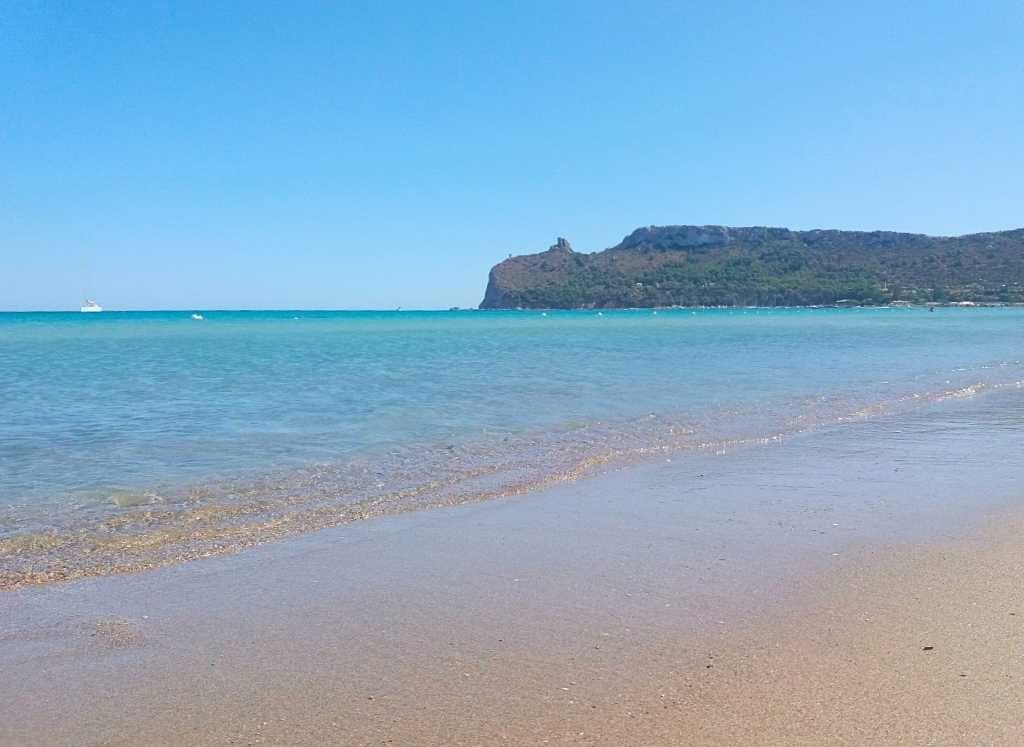
- Poetto. Cagliari has one of the most beautiful seafront promenades in Italy, yes, even better than Bari, Naples and Trieste! Lungomare Poetto was recently revamped with new kiosks, beach bars and restaurants. Despite being an urban beach, the sand is thin and clean and the water is clear. The promenade stretches almost 9km, and locals divide it into stops we simply call Prima Fermata, Seconda Fermata, Terza Fermata, and so on (1st stop, 2nd, 3rd, etc.). Pick stop 1 for more buzz, or stop 6, known for the abandoned Marino Hospital in the background. Stops 2, 3 and 4 are occupied by lidos. CTM buses such as PQ, PF, 1Q and QS pass regularly.
- Calamosca. When it gets windy at Poetto, locals head to Calamosca, on the other side of Sella del Diavolo. It is a small cove tucked into the cliffs. Buses 6, 3 and 5ZE get you there, although you will need to walk 15 to 30 minutes on foot depending on which bus you take.
- Spiaggia di Capitana. A little further from the city centre, this wilder beach is well worth a visit, even though it is not the most paradisiac spot on the island. Take a bus to Quartu Sant’Elena first, then catch the 1Q till stop Provinciale Villasimius (fronte Camping). There are other beaches along the route of 1Q bus like Margine Rosso, Spiaggia di Flumini and Is Mortorius. Of all of them, Capitana is the pick of the bunch.
Beaches on the South East Coast.
You can reach all of these beautiful beaches on ARST bus number 135. List starts from the closest to Cagliari to the further. Entrance is free in all of them.
- Cala Regina. A small, sheltered cove popular with windsurfers thanks to its exposed position.
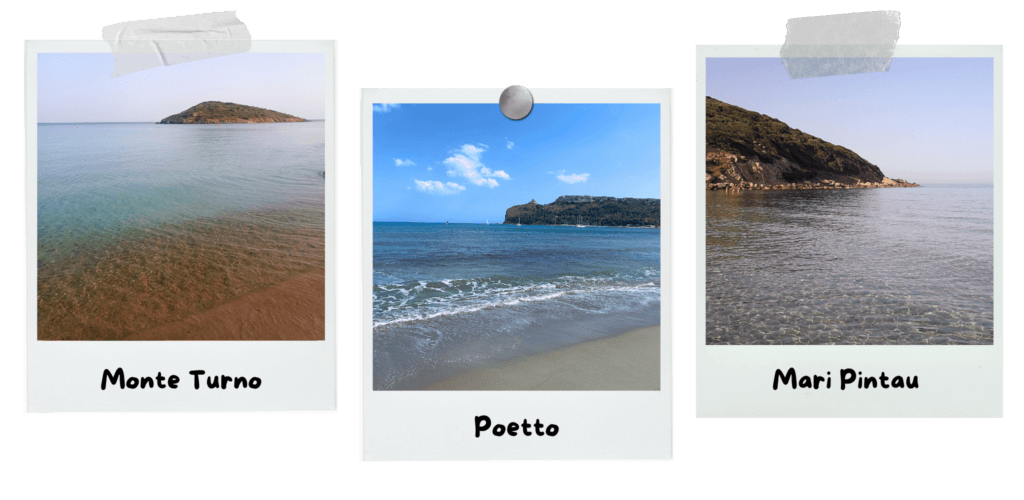
- Mari Pintau. A picturesque inlet with crystal-clear water, lovely for a spot of snorkelling.
- Kal’e Moru. A wilder, less crowded stretch of coast just along from Mari Pintau.
- Baccu Mandara. A pleasant sandy beach within easy reach of Villasimius.
- Cala Sinzias. A long sandy beach with shallow water, ideal if you are travelling with kids.
- Monte Turno. A quieter stretch of coast near Costa Rei, with fewer crowds.
- Cala Pira. A small, scenic cove framed by pinkish granite rocks.
- Costa Rei. One of the most famous beaches in Sardinia, with sweeping white sand and turquoise water.
Beaches on the South West Coast.
On the other side towards Chia, you can find world famous beaches and you can reach all of them on ARST bus number 129. Entrance is free.
- Su Guventeddu. A sandy beach close to the archaeological site of Nora.
- Santa Margherita di Pula. A long stretch of sand backed by a pine forest, popular with families.
- Riva dei Pini. A shaded beach thanks to the pine trees lining the shore, perfect for escaping the midday heat.
- Sa Colonia. White sand and turquoise water backed by dunes, near Chia.
- Su Giudeu. One of the most beautiful beaches in the Chia area, with a small islet you can wade out to.
🛏️ Where to Stay in Cagliari.
Hostel Marina is the cheapest accommodation, and as far as I am aware, the only proper hostel in Cagliari. A bed in a shared room typically costs around €40 a night with breakfast included. The location is perfect, right in the city centre, close to the bus station, the port and the main attractions of the city.
🔽 If you are looking for another type of accommodation, you can explore plenty of options in Cagliari using the map below! 🔽
🚌 Getting Around Cagliari.
As I’ve mentioned above, CTM is the public transport company serving Cagliari and its immediate surroundings. You can buy a weekly ticket for just €12, either from a kiosk (tobacco shop) or via the BusFinder app, and take as many buses as you like. If you want to explore the beaches on the south east and south west coasts, I suggest buying a return ticket each time.
You can also buy an integrated pass that lets you travel comfortably to and from the island’s main towns with a single ticket, combining buses, trains and trams, even when run by different companies. Check the ARST official website for further details. Remember to validate your ticket every time by scanning the QR code on board or at the station.
🍝 Where to Eat in Cagliari.
Sardinian cuisine is bold and rustic, and it tastes nothing like the Italian food you might be used to on the mainland. Cagliari has its own culinary identity within the island too, built on simple dishes such as pizzetta sfoglia (a round savoury pastry filled with tomato sauce that locals eat for breakfast with cappuccino) and the famous panino del Caddozzone. You do not need a big budget to try it all: most of the places below let you eat extremely well for relatively little.
- ZioTom. Specialising in pasta and dumplings, with portions priced at €10 to €15, plus typical Sardinian desserts at a reasonable price.
- La Cantina. A real institution in Cagliari. It has just reopened with a new concept. I recommend it for its sandwiches, as it is also the city’s first sandwich bar opened in 1948.
- TOAST-IT. Head here for a quick lunch. They have a great selection of toasted sandwiches and cheap salads.
- La Piccola Pizzetta. Cagliari’s iconic folded pizza, crunchy and packed with mozzarella. There are several locations around the city.
- Ammentos. You cannot visit Cagliari without trying proper Sardinian cuisine. Ammentos offers a complete menu, starter, first course, main and dessert, ranging from €20 to €35.
- Panino del Caddozzone. This is the most iconic Sardinian street food: a huge sandwich filled with whatever you fancy, sold from food trucks. Several of them park up at Poetto beach, in an area locals call Cavalluccio Marino. Baffo is the most popular, but also the most expensive. I would suggest any other truck if you want to save a couple of euros.
- Don Restaurant. Fancy something different? This pan-Asian restaurant serves a variety of Chinese and Japanese dishes at a very convenient price.
📍 If You Base in Sassari.
Sassari is the second-largest city in Sardinia, and its elegant historic centre genuinely deserves a day of exploring on foot, even though it tends to get overlooked in favour of the coast and other cities in North Sardinia.
Start in Piazza d’Italia, framed by elegant nineteenth-century buildings such as Palazzo della Provincia and watched over by a statue of Vittorio Emanuele II. From here, it is a short stroll to Piazza Castello, named after the Aragonese castle that once stood here before it was demolished in the nineteenth century.
Head into the old town to find the Cattedrale di San Nicola, Sassari’s Duomo, with a Baroque façade decorated with statues and columns. Right behind it sits Palazzo Ducale, an eighteenth-century building that now houses the town hall, and the Pinacoteca Nazionale, Sardinia’s largest art gallery, set inside a former Jesuit college. Make your way towards the edge of the old town to admire the Fontana di Rosello, Sassari’s best-loved symbol.
🏖️ Best Free Beaches in Sassari and surrounding.
The beaches around Sassari are a different story altogether. Rather than one long urban promenade, they are scattered along a wilder stretch of the northern coast, each reached by its own ARST coach route. Facilities are simpler here, so do not expect rows of kiosks and lidos at every stop, though the water is some of the clearest you will find anywhere on the island.
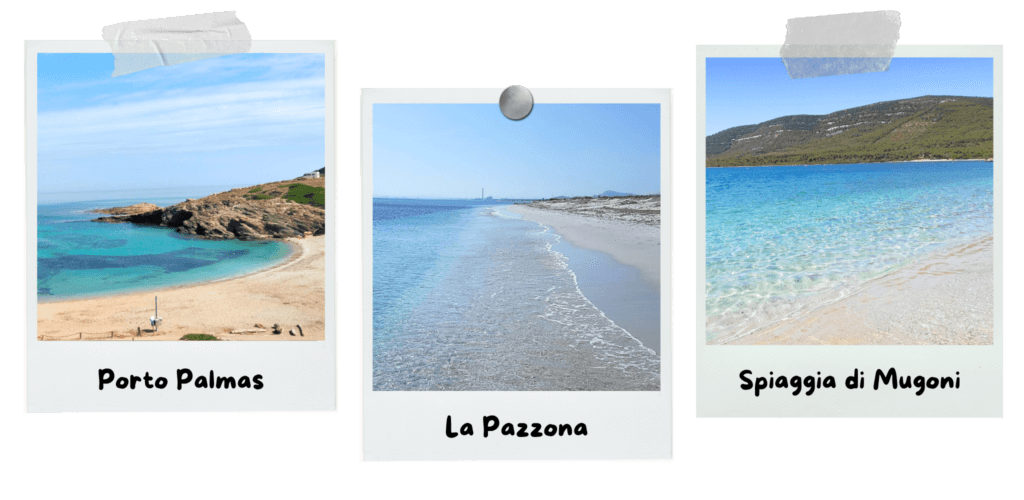
- La Pazzona. You may have already heard of La Pelosa, the stunning beach with its little tower, but this nearby beach in Stintino is just as lovely and far less crowded. From the station, take bus 727 and get off at Cuile Nuovo stop, from there you have to walk approximately 30 minutes.
- Spiaggia di Balai. It’s a small beach in the town of Porto Torres, served regularly by several ARST buses, including 719, 727 and 730.
- Porto Palmas. A small beach with crystal-clear water and white sand, just an hour away on ARST bus 732.
- Spiaggia di Mugoni. A wild, almost tropical-looking beach. It takes around 1 hour 15 minutes by public transport, with a change of bus at Fertilia (Alghero).
- Marina di Castelsardo. On the opposite side of the coast, in the famous village of Castelsardo, this urban beach sits right beneath the Doria Castle. It takes about an hour on bus 728 or other ARST services.
- Spiaggia Baia Verde. A little further past Castelsardo, this beach often takes on a greenish tint thanks to its position near the mouth of the river Coghinas. With bus 727, it is only an hour and a half. Get off at SP 90 Camping International stop: Spiaggia Baia Verde is at just 550 m.
🛏️ Where to Stay in Sassari.
Like the rest of Sardinia, Sassari does not have a big hostel culture, so do not expect endless backpacker options here. Monte Longu is a good budget option, costing around €230 for a week (six nights for one person), which works out at roughly €38 a night.
Nevertheless, if you are looking for something different, Booking.com has a brilliant variety of stays tailored to every budget and travel style.
🚌 Getting Around Sassari.
ATP runs the local public transport network, including Metrosassari, the small light-rail line connecting the city centre to the suburbs. A weekly pass costs €12 and covers the entire urban network, including the metro, for unlimited journeys. Tickets and passes are sold through the official ATP Sassari app or the regional Around Sardinia app, which also covers other transport companies across the island. Remember to validate your ticket by scanning the QR code on board the first time you use it, otherwise you risk being treated as if you had no ticket at all, even if you paid for one.
🍝 Where to Eat in Sassari.
Sassari has its own distinct culinary identity, shaped by its inland, agricultural roots rather than the sea. Look out for Fainè, a chickpea flatbread similar to Ligurian farinata, traditionally eaten on Mondays. Favata is a hearty winter soup of dried broad beans, lard and pork, not the best choice for summer, while lumache (local snails, including varieties known as giogga minuda and monzette) are a beloved delicacy, especially in spring.
- Kalipè. Pizza here is very cheap: a small margherita costs just €3, while a larger one with burrata and mortadella is only €10.50.
- Il Civico. Great local Sardinian cuisine with an excellent selection of meat, including more unusual cuts such as wagyu and kangaroo. Prices are reasonable.
- Cocco Pizza. This small bakery is perfect for a take away folded pizza and for the typical fainé. You can find different sizes and toppings at a very cheap price.
- Club Enogastronomico Mangio da Nonna. If you want something traditional, just like your grandmother used to make, this is the place.
- On the Road 2.0. For a quick sandwich of any kind (burger, focaccia and more), here you will find a great selection of panini, including one with horse meat.
💡 Travel Tips.
Travelling on a budget in Sardinia during summer might sound like wishful thinking, but with a bit of organisation, it is entirely possible.
Of course, you cannot expect to stay cheap in Costa Smeralda, visit secluded beaches like Cala Mariolu, or rent a sunbed in Punta Molentis, but plenty of beaches around the island are completely free.
Since Sardinian summers are extremely hot, I suggest buying a beach umbrella from a local bazaar or Chinese-run shop for around €15 and leaving it at your hostel. Renting a sunbed with an umbrella can be surprisingly expensive, even on free beaches.
Another tip if you want to save some money on food, is using apps such TooGoodToGo to pick up meals that would otherwise go to waste for half price, or download TheFork app to find restaurants offering discounts.
🎁 Use the referral code below or register via The Fork to receive 1000 Yums and €20 🎁
850D5DF5
⚠️ Rules to Know Before You Go.
Sardinia takes the protection of its coastline very seriously, so there are a few rules worth knowing . It is strictly forbidden, and heavily fined, to take sand, pebbles, rocks or shells away with you, even just a small bottle as a souvenir. Fines under regional law range from €500 to €3,000, and checks are regularly carried out at airports and ports.
Smoking is also banned on many beaches across the island, including in Cagliari, Sassari and several other less popular towns, with fines of up to €500 for anyone caught lighting up. Always look out for signage, and when in doubt, assume smoking is not allowed.
🎫 Where to Buy Tickets.
If you want to visit any museums in Cagliari or Sassari, you can buy your tickets through the Musei Italiani app or via their official website. Also bear in mind that, thanks to the Domenica al Museo initiative, all state museums are free on the first Sunday of every month.
If you decide to visit the more popular beaches rather than the ones listed here, you will need to book well in advance, and they are rarely cheap. Take a look at Heart of Sardinia for further information and reservations.
If you are travelling on a budget in Sardinia without a hire car, take a look at GetYourGuide, where you can often find good deals on cheap day trips and city tours. Below, I have hand-picked a few options for both cities.
❓ FAQ.
It can be, especially in Costa Smeralda or anywhere along the coast in July and August. But with a bit of planning, you can visit Sardinia on a real budget: free beaches reachable by bus, cheap local food, and guest houses or hostels from around €50 a night all make a low-cost Mediterranean summer perfectly possible.
Compare flights to all three airports, Cagliari, Alghero and Olbia, plus ferry routes from mainland Italy, Corsica, Sicily, Spain or France, and book whichever works out cheapest for your dates. Travelling in June or September usually costs a bit less.
Yes, especially if you base yourself in Cagliari or Sassari. Local buses (CTM and ATP) cover the cities efficiently, while ARST interurban coaches reach plenty of free beaches along the south east and south west coasts and around the north. You will simply need to plan around bus timetables.
Many of them are. Beaches like La Pazzona, Costa Rei and Su Giudeu have free access, though you will usually pay separately if you want a sunbed and umbrella. The most famous, photogenic spots, such as Cala Mariolu or Punta Molentis, often require advance booking and are not the cheapest option.
Two matter most. Taking sand, pebbles, rocks or shells from any beach is illegal and can lead to fines between €500 and €3,000, with checks regularly carried out at airports and ports. Smoking is also banned on many beaches around the island, including in Cagliari and Sassari, so always check for signage before lighting up.
🎈 Conclusion.
Sardinia might have a reputation as an expensive, glamorous destination, but as you can see, a summer here does not have to break the bank. Between free beaches reachable by bus, cheap local food and budget-friendly places to stay, both Cagliari and Sassari let you experience the very best of the island without the luxury price tag.
I hope this guide helps you plan an unforgettable, low-cost Sardinian summer. If you would like more inspiration or you’ve decided to rent a car here, take a look at my article on 35 Top Things to See and Do in Sardinia for more travel ideas and hidden gems in the island.
💬 And you? Have you ever travelled around Sardinia on a budget, or are you planning your first low-cost trip to the island? Let me know in the comments below!
☕ Did you find this post helpful? If you’d like, you can support my blog by treating me to a virtual coffee!

Are you dreaming of your next trip but not sure where to start?
Book a 1:1 travel consultation or request a personalised itinerary and I will design the trip of your dreams!
✨Click the button below for my Travel Services✨
