


Last Updated on September 10, 2026 by Nadia Halfway
📜 Introduction.
After my first stop in Chiang Rai, I travelled south to Chiang Mai as part of my 2-month journey across Thailand. It quickly became one of my favourite cities in the entire country and one I ended up returning to twice.
Chiang Mai has a gentler pace than Bangkok. It’s a city wrapped in centuries-old temples, and an easy access to the surrounding mountains, hot springs and national parks. It’s also home to some of Thailand’s most respected ethical elephant sanctuaries.
This itinerary brings together both of my stays in Chiang Mai into a single, complete 6-day guide. Since some days were taken up by long transfers, visa appointments, and other practicalities, I’ve included a suggested daily plan alongside my own experience to help you make the most of every day. This travel plan covers temple-hopping through the city, a full day trekking at Doi Inthanon National Park, a day with rescued elephants, and a hands-on Thai cooking class to round it all off.
⚠️Disclaimer: Some of the websites below are affiliate links or require a promo code for receiving a discount. If you book through them or use my personal promo code at the time of subscription or reservation, I’ll earn a small commission (at no extra cost to you), and you’ll get a discount or a special promotion too. It’s a win–win!
Please be aware that affiliate links may expire and promo codes may reach their usage limit. If you find that a link or code no longer works, kindly let me know. I’ll be happy to share an updated one (if available) directly with you.
Day 1: Temple-hopping and Bazaars.
I arrived in Chiang Mai by bus from Chiang Rai, pulling into the city around mid-morning. After a short taxi ride to my hostel in the Old City and a quick check-in, I set out on foot to explore the surroundings.
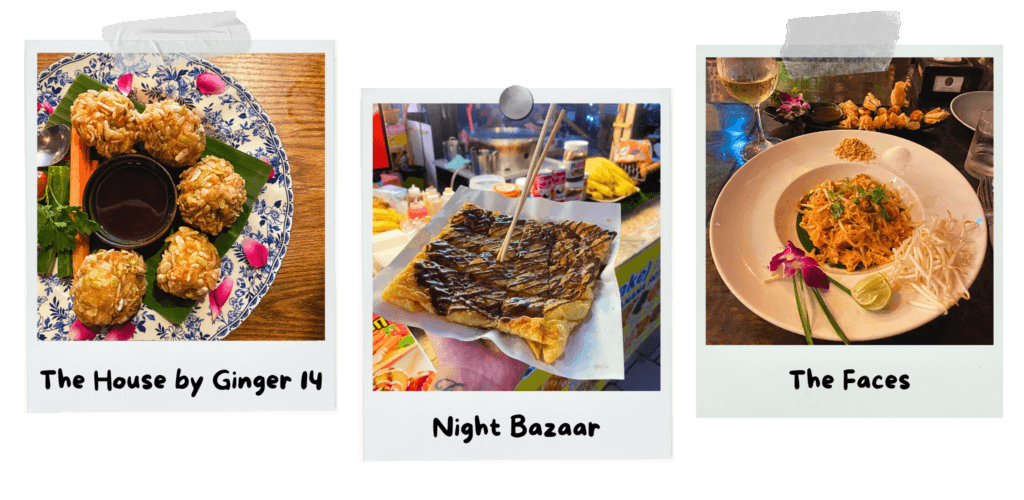
Within the old walls, the temples sit just minutes apart from one another. I spent the rest of the morning moving between them at a relaxed pace: Wat Muen Tum, Wat Jet Lin, Wat Chedi Luang, Wat Duang Dee, the Three Kings Monument, and Wat Chiang Man (Chiang Mai’s oldest temple). I stopped for lunch at THE HOUSE by Ginger 14, a wonderful restaurant, though quite pricey even by European standards. The food, however, was absolutely delicious and beautifully presented.
As I cover in more detail in my Thailand overview post, I needed to extend my visa. So after lunch, I spent the rest of the afternoon at the local immigration office sorting everything out. It all went smoothly, and I walked away with my stay in Thailand secured legally for two full months.
I closed the evening with dinner and a wander through the Chiang Mai Night Bazaar, a great spot for street food and a genuine immersion into Thai culture.
Suggested Plan.
Since I arrived in Chiang Mai late in the morning and spent the whole afternoon at the immigration office (something you hopefully won’t need to do), I’d suggest using that time to explore more of the city instead, to visit some museums and even a cruise river. Here’s how I’d plan Day 1 if I were doing it again:
- h 09:30 – Temple hopping (Wat Muen Tum, Wat Jet Lin, Wat Chedi Luang, Wat Duang Dee, Three Kings Monument, Wat Chiang Man)
- h 13:00 – Lunch at THE HOUSE by Ginger 14
- h 14:00 – explore China Town
- h 16:00 – Museum of Broken Relationships
- h 18.00 – River Ping Cruise
- h 20:00 – Night Bazaar and dinner
Day 2: Buffalo Market, Lovely Café and Wat Phra That Doi Suthep.
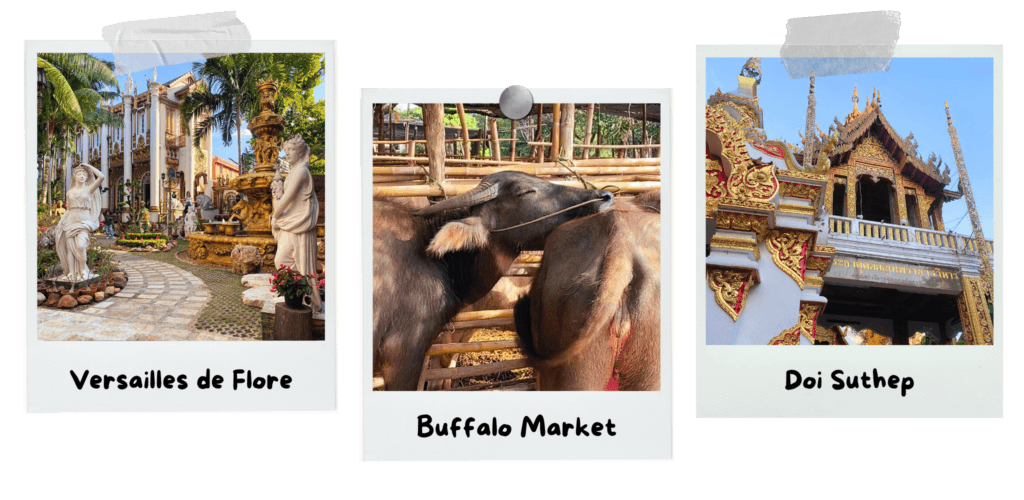
My second day fell on a Saturday, perfect timing for the Buffalo Market in San Pa Tong district, held only once a week. It’s refreshingly local: buffaloes, rabbits, chickens, fresh produce, flower seeds, and all manner of items. Most visitors to Chiang Mai don’t visit this market, but it’s an interesting place if you want to get to know the locals away from the tourist areas.
Getting to the Buffalo Market is an adventure itself. I took the famous yellow songthaew from Chiang Mai Gate Market, but I had to ask a local to confirm the direction. In fact, neither Google Maps nor Moovit is particularly reliable up north. The ride was entertaining: a packed minibus that kept stopping to squeeze in more passengers.
Back in the city, I had lunch at TULOU, a Chinese restaurant and indulged in a coffee with a slice of cake at the Versailles de Flore. This Parisian-style café, tucked beside a hotel, has genuinely beautiful architecture and décor. I’d recommend dropping by to snap a few photos.
To close the day, I booked a Grab to Wat Phra That Doi Suthep, a golden temple on a forested hillside above the city. A word of warning, though: my driver claimed there was no way back down and quoted me a fixed return fare of 1,000 THB. In reality, songthaews and tourist buses run regularly this route for around 100 THB. Don’t get caught out. The temple, for its part, was absolutely worth it.
Suggested Plan.
The Buffalo Market is only open on Saturdays, so if you want to follow this itinerary but your Day 2 falls on a different day, I’d suggest spending the whole time at Wat Phra That Doi Suthep and the surrounding landmarks instead, including Wat Pha Lat, Chaloem Phra Kiat Pavilion Viewpoint, and Bhubing Palace. Alternatively, another idea is to walk the entire length of the Monks’ Trail.
Looking at the map, my advice is to start at Bhubing Palace (entrance fee between 20-50 THB), then descend into Doi Suthep-Pui National Park by -a red songthaew. Bring your own food for lunch at the park, explore the trails, and visit Doi Suthep Temple.
Finish the day by making your way down to Chaloem Phra Kiat Pavilion Viewpoint for sunset. Avoid the main road as it’s quite exposed and not particularly safe for pedestrians. Instead, look for the Monk’s Trail towards Wat Pha Lat, which is a beautiful stop at the end of the path. The full route is around 2-3 km. As I told you, I took a Grab taxi for this stretch rather than walking it myself, so I can’t personally vouch for the difficulty or gradient. However, it’s a well-documented trail and generally considered manageable.
- h 08:00 – Breakfast at Versailles de Flore
- h 09:30 – Visit Bhubing Palace
- h 10:30 – Explore Doi Suthep-Pui National Park
- h 13:00 – Lunch
- h 16.00 – Wat Phra That Doi Suthep
- h 18:30 – Sunset at Chaloem Phra Kiat Pavilion Viewpoint
- h 20.00 – Dinner at TULOU
Day 3: Day Trip to Doi Inthanon National Park.
Chiang Mai province is home to Thailand’s highest peak so I opted for an organised tour. Booking a full-day trip with a guide allowed me to cover far more ground than I could have managed alone.
The day started with an early pickup from the hostel with a first stop at a coffee roastery in the hills.
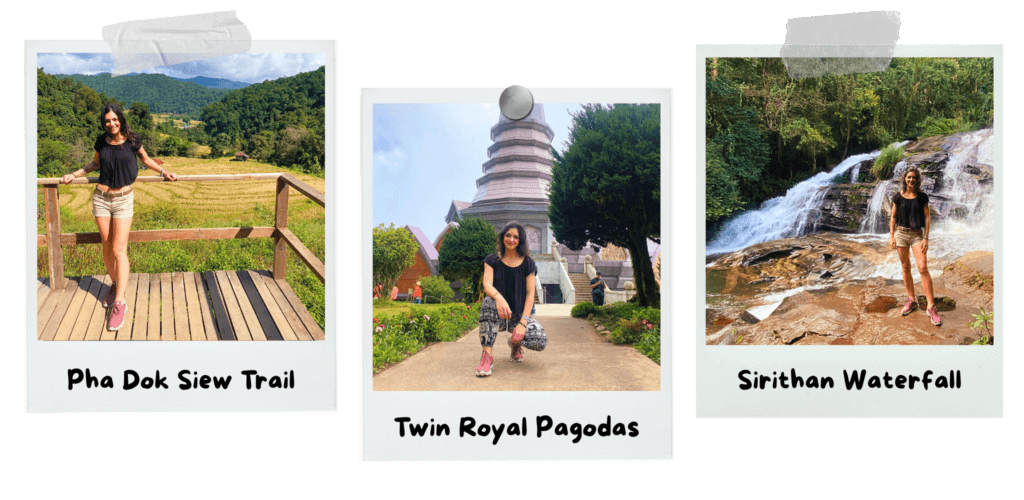
From there, the tour moved through Wachirathan Falls, one of the park’s most impressive waterfalls, before heading to Kew Mae Pan for a two-hour nature trail through cloud forest and open ridgeline. We also passed through Pha Dok Seaw Waterfall along the route.
Lunch was included in the tour price: a satisfying meal at a local restaurant along the road, perfectly timed between the trekking and the afternoon’s sights.
The final stretch took us up to the Doi Inthanon summit (2,565 metres, the highest point in Thailand), then to the stunning twin royal chedis of Phra Maha Dhatu Naphamethinidon and Naphaphonphumisiri, built in honour of the King and Queen. The complex is surrounded by immaculate gardens and feels completely unexpected at altitude. We closed the day at Ban Mae Klang Luang, a Karen hill tribe village. Back in Chiang Mai, I treated myself with a nice dinner at The FACES Gallery & Gastro Bar and went straight to bed.
Suggested Plan.
Since I’d already visited a Karen hill tribe village during my stay in Chiang Rai and hadn’t enjoyed the experience, I chose to skip that stop during the tour. The women in these villages are mainly refugees from Myanmar and Laos who are denied Thai citizenship and exploited, making them entirely dependent on tourism for survival. It’s not a stop I’d recommend supporting. If your tour includes it, skipping it is always the best ethical choice.
- h 06:30 – Pickup from hostel
- h 08:00 – Coffee roastery
- h 09:30 – Wachirathan Falls
- h 11:00 – Kew Mae Pan trail and Pha Dok Seaw Waterfall
- h 13:30 – Lunch (included)
- h 15:00 – Doi Inthanon summit and twin chedis
- h 16:30 – Ban Mae Klang Luang village
- h 18:30 – Return to Chiang Mai
- h 20:00 – Dinner at The FACES Gallery & Gastro Bar
Day 4: A Day with the Elephants.
For many visitors to Chiang Mai, seeing the elephants is the highlight of the entire trip and so it was for me. You can read about my one-week experience in my dedicated post Elephant Nature Park: Volunteer Experience in Chiang Mai, Thailand.
However, for most travellers, a single-day visit is the more accessible option and it’s a genuinely wonderful way to spend a day. A typical visit starts with an early pickup from your hotel, followed by a short drive into the jungle where the rescued elephants live in open, natural enclosures. The day usually includes preparing the food, general cleaning and walking alongside them through the jungle.
Elephant Nature Park offers a range of options to suit different schedules: half-day visits, full-day experiences, overnight stays, and the week-long volunteering programme I chose.
If you decide to visit a different sanctuary in Chiang Mai or elsewhere in Thailand, look for facilities that are explicitly no-riding, no-chain, and no-bathing. These are the markers of a sanctuary that genuinely prioritises the animals’ wellbeing over entertainment. Do your research before booking. You can learn more in my post on ethical wildlife tourism.
Suggested Plan.
The schedule for this day depends entirely on which tour you have chosen, whether it’s a half-day in the morning, or a weekend trip. If you’re not interested in visiting an elephant sanctuary, I’ve included some alternative day trip ideas in the Travel Tips section of this post.
- h 06:30 – Pickup from hostel (time varies by tour)
- h 08:00 – Arrival at the sanctuary and morning activities
- h 12:30 – Lunch (usually included)
- h 14:00 – Afternoon activities
- h 17:00 – Return to Chiang Mai
- h 20:00 – Dinner at Sai Ping Bar & Restaurant
Day 5: Back to the Old City.
I left Elephant Nature Park one day ahead of schedule. The staff at the sanctuary made an arrangement without any issue, giving me a lift back to Chiang Mai alongside other departing visitors. I arrived in the city in the early afternoon, with no plans and no pressure.
It was exactly the kind of day I needed. I drifted back into the Old City revisiting temples I’d loved on Day 1 and catching the ones I’d missed. One of the highlights was Wat Suan Dok, a spacious, serene temple less visited than the Old City cluster and well worth the short walk. No itinerary, no fixed stops: just wandering at whatever pace felt right, and ending the evening at a random street food stall.
Suggested Plan.
As I arrived in the middle of the day from Elephant Nature Park, I took the opportunity to visit the nearby Wat Suan Dok, which genuinely deserves a stop. You can easily fit this temple into any other day of this itinerary, though. If you have a full day free, I’d suggest dedicating it to exploring the east side of Chiang Mai. There are several hot springs such as Doi Saket and San Kamphaeng, with a few stops along the way there and back.
- h 09:00 – Explore Tweechol Botanical Garden
- h 13:00 – Lunch
- H 14:00 – Relax at the Hot Springs
- h 19:30 – Dinner at Meena Rice Based Cuisine
Day 6: Thai Cooking Class.
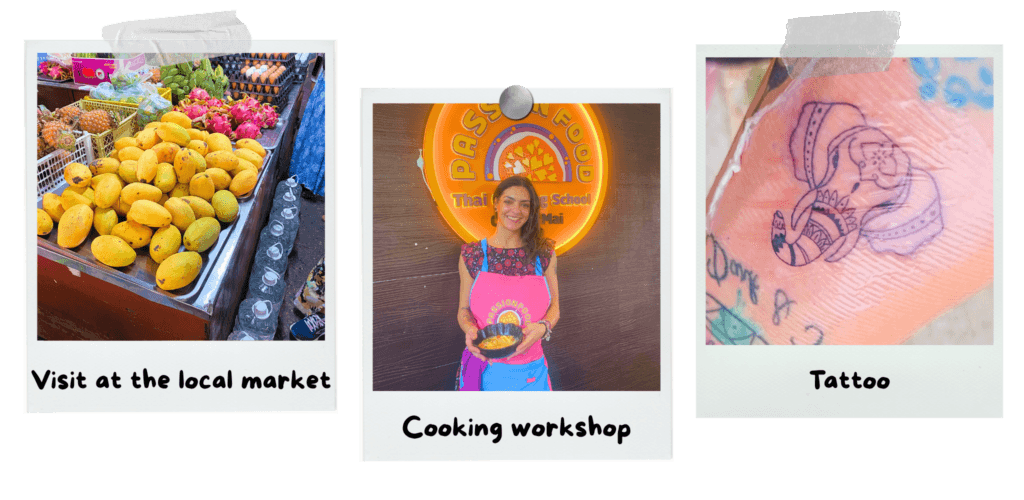
I spent my last morning doing something I’d been looking forward to since the beginning: a Thai cooking class. Before starting, we visited the Ming Muang local market to pick out fresh ingredients, to cook a full menu of classic dishes from scratch: pad thai, curry, tom yum and others. The lesson was absolutely fascinating, and after we’d finished cooking, we all sat down together to eat what we’d made.
In the afternoon, I headed to Zeero Tattoo for the first of three tattoos I’d get during my three months backpacking through Southeast Asia. I’d booked well in advance via WhatsApp, sending the artist the design, placement, and size before arriving. The studio was clean and professional, quintessentially Thai, with everyone walking barefoot, and the tattooist was gentle and precise.
The session ran longer than expected, which meant I missed my bus to Chaiyaphum. Fortunately, at the station I managed to book the next departure without any trouble.
Suggested Plan.
I genuinely recommend booking a cooking class somewhere in Thailand: it’s fun, sociable, and you’ll learn to make dishes you’ll actually want to recreate at home. Chiang Mai is one of the best places to do it, with a wide range of schools to choose from at different price points. After the class, use the afternoon for a final wander through the Old City before catching your bus onwards.
- h 08:00 – Market visit and Thai cooking class
- h 13:00 – Lunch (what you cooked)
- h 15:00 – Final stroll through the Old City
- h 17:30 – Bus to the next destination
🛏️ Where to Stay in Chiang Mai.
For my first stay, I booked into Mad Monkey (€12 per night) , a hostel right in the heart of the Old City. Location was perfect for walking to most of the temples on this itinerary. Breakfast was not included, but there’s an on-site bar and café that opens early in the morning. The vibe is that of a party hostel with a pool, but even though I didn’t socialise much, the staff were very kind and they actually provided me with the document I needed to extend my stay in Thailand.
For my second stay, after returning from the elephant sanctuary, I switched to Pinghostel (€15 per night) , with breakfast included, also centrally located within the Old City walls. The vibe was noticeably different: quieter, less chaotic, and a little easier on the nerves.
Both options worked well for a solo traveller wanting to be within walking distance of the main sights without spending too much.
🔽 If you’d prefer the comfort of a hotel, you can explore plenty of options in Chiang Mai using the map below 🔽
🍜 What to Eat in Chiang Rai.
Chiang Mai’s food scene is one of the richest in Thailand, blending northern Thai (Lanna) flavours with the city’s relaxed café culture. Here are some of the restaurants I enjoyed during my stay in Chiang Mai:
- im Lao Ngow Fishball Noodle. A local favourite for a simple, satisfying bowl of noodle soup. Exactly what you need after a long day on foot.
- THE HOUSE by Ginger. A stylish restaurant set in a beautifully restored colonial-style house. On the pricier side, but the food is excellent.
- TULOU Restaurant. A relaxed Chinese restaurant, great for lunch or dinner after a long day out.
- The FACES Gallery & Gastro Bar. A terracotta garden and gastro bar serving traditional Thai cuisine and inspiring cocktails.
- Sai Ping Bar & Restaurant. A beautiful chic restaurant just on the other side of river Ping with a great view over the city.
- Versailles de Flore. A Parisian-style café with beautiful architecture and décor tucked beside a hotel. Perfect for breakfast or for an afternoon coffee and to shoot some great photos.
- Meena Rice Based Cuisine. Known for its unique five-colored rice and peaceful green setting, it has earned a Michelin Guide Bib Gourmand rating for its quality and value. A bit far away from the city centre but totally worth it.
- Chiang Mai Night Bazaar. The place to go for cheap, varied street food and a lively evening wander through the Old City.
🎫 Where to Buy Tickets.
Temples are usually free of charge, or require a very small entrance fee paid on the spot.
However, for day trips like Doi Inthanon National Park, elephant sanctuaries, and even cooking workshops, GetYourGuide and Klook offers a wide range of options with free cancellation and English-speaking guides. It’s a good place to start if you’d rather not arrange transport yourself.
For the elephant sanctuary and the cooking class, I’d suggest booking directly with the providers. I booked my week of volunteering through the Elephant Nature Park website, and the cooking class through Passion Food Thai Cooking School directly.
For the Doi Inthanon day trip, however, I recommend booking in advance through GetYourGuide. You can check availability directly from the widget below.
💡 Travel Tips.
Day Trip Alternatives.
Since this itinerary combines my two separate stays in Chiang Mai, I suggest adjusting days 4, 5, and 6 to suit your own travel interests and schedule. Below, I’ve listed a few alternatives worth considering for a day trip.
If you skipped Chiang Rai, a day trip to the White Temple, Blue Temple, and Black House Museum is absolutely worth adding. Many tour operators include also a visit to Lalitta, a fairytale café near Chiang Rai airport.
If you’d prefer a day out in the countryside, Mae Sa Waterfall is a lovely option, though it does involve a fair bit of trekking. If you’d rather just relax, there are several hot springs just outside the city, such as Doi Saket and San Kamphaeng.
Finally, Pai is a popular destination particularly among longer-stay travellers and digital nomads. At the time of my trip, I skipped it and haven’t researched it enough to give a proper recommendation. That said, it could make a pleasant day trip from Chiang Mai or even a standalone next destination if you’re looking to meet other travellers and slow down for a while.
Whatever day trip you choose, book in advance, particularly for the elephant sanctuary, and especially in high season (November-February). The most reputable ethical sanctuaries fill up quickly.
Klook.com🎁 Subscribe via Klook.com to receive €5 off your next booking 🎁
What to Wear,
Chiang Mai is surrounded by nature, so comfortable shoes are essential, both for hiking and for temple-hopping. When enter a temple, remember to cover your knees and shoulders: it is still a sacred place.
Pack a light layer for altitude: temperatures at Doi Inthanon and around the hot springs can be noticeably cooler than in the city. And if you’re visiting the hot springs, do not forget a (modest!) swimwear, a towel and a change of clothes.
Best Time to Visit Chiang Mai.
The best time to visit Chiang Mai is during the cool and dry season, from November to February. Temperatures sit between 18-25°C, the skies are clear, and the city is at its most pleasant for walking and temple-hopping. This is also peak season, so expect higher prices and more tourists.
March to May brings the hot season, with temperatures regularly exceeding 35-40°C. More critically, February to April is the region’s burning season: agricultural fires across northern Thailand and neighbouring Myanmar cause heavy smoke and poor air quality that can last for weeks. If you’re sensitive to pollution or have respiratory issues, avoid this window.
June to October is the rainy season: lush, green, and significantly quieter. Showers tend to come in short, heavy bursts rather than lasting all day, so it’s perfectly possible to travel during this period. Prices drop and the city feels more local.
I visited in late November and early December, which I’d recommend without hesitation. The weather was ideal and the city felt alive without being overwhelmed.
Stay Safe and Connected.
Chiang Mai is one of the safest cities in Thailand, and one of the most adapt for solo female travellers in the whole of Southeast Asia. The usual common sense applies: keep an eye on your belongings in busy markets, use Grab rather than unmarked taxis, and be cautious on rented scooters in city traffic.
For staying connected, I’d strongly recommend installing an eSIM for the first couple of days before you leave home rather than buying a physical SIM at the airport. It’s cheaper, faster to set up, and you can activate it before you even board the plane. Yesim offers reliable data plans for Thailand with good coverage across the north, including in national parks and more remote areas.
🎁 Use the referral code below to register on Yesim and unlock your €5 discount 🎁
UKUO6728
Download Google Maps offline for Chiang Mai before you arrive: mobile signal can be patchy on mountain roads and inside the national park. Grab works well throughout the city for taxis and motorbike taxis.
🎈 Conclusion.
Six days in Chiang Mai gave me everything I’d hoped for from northern Thailand: golden temples scattered through a walkable old city, a long day in the mountains at Doi Inthanon, a special week with rescued elephants, and a cooking class that taught me to recreate a little piece of Thailand back home.
From Chiang Mai, my journey continued onward to Ban Khwao, a small village in Chayiaphum province where I spent two weeks volunteering and teaching English: a completely different side of Thailand, and a story for another post.
💬 And you? Have you been to Chiang Mai, or is it on your list for your next trip to Thailand? Let me know in the comments below!
☕ Did you find this post helpful? If you’d like, you can support my blog by treating me to a virtual coffee!

Are you dreaming of your next trip but not sure where to start?
Book a 1:1 travel consultation or request a personalised itinerary and I will design the trip of your dreams!
✨Click the button below for my Travel Services✨
